Wednesday, June 28, 2023

Detour

 In early June, we landed in the U.S., weary from a busy season in Juba but excited about the prospect of visiting churches and friends in the U.S. to share about how God is at work in South Sudan. But it has not worked out exactly as planned.

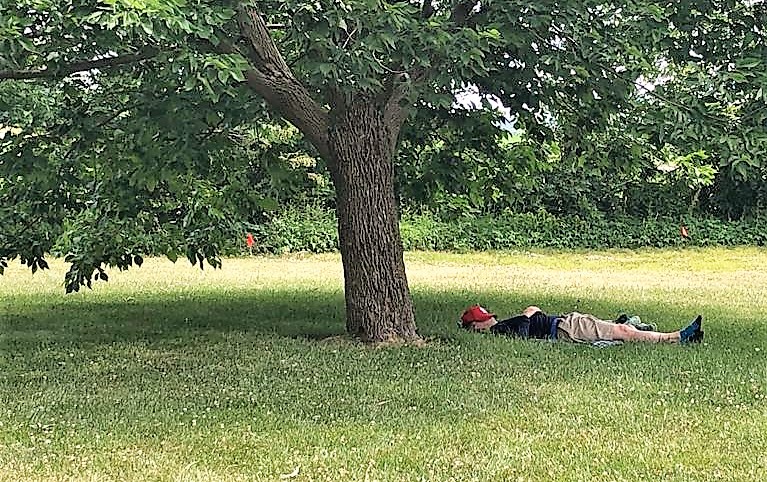
Bob has not been feeling well since before we returned to the U.S. After resting and seeing a doctor in Illinois, we decided to start traveling on our six week ‘tour’, hoping that he could rest and recover along the way. Unfortunately, after several days of travel, it became clear that Bob was not getting better and that to continue trying to travel and visit people would hinder his recovery. We made the hard decision to turn back and return to Illinois where Bob could rest and we could pursue more medical tests.

Traveling - using the rest stops to really rest,
in addition to sleeping in the car

The loss of these much-anticipated visits and the discouragement of being sick have challenged us to lean into God and wait on Him. Yesterday one verse that came up was Matthew 10:39, “Whoever finds their life will lose it, and whoever loses their life for my sake will find it.” We meditated on Jesus’ call to give up everything to follow Him, and the life that we find in Christ is not like anything the world can offer. Our motivation to be productive in raising awareness of the work and needs in South Sudan is strong, but we realize we must also open our hands to wait on God. We need God to teach us and enable us – and after all, God is the only one that can do the work that will last.

Visiting Mt. Gilead, Ohio

Bob is still recovering, so we appreciate your prayers for healing, strength, and a return to “normal.” We also ask for prayer for wisdom for the days and weeks ahead. We hope and pray that Bob will recover strength and that we will be able to resume our visits and travel. Thank you for your prayers. We are grateful for the encouragements and support that we have received, and we are grateful to know that God is in control.

Friday, May 5, 2023

War in Sudan!

In mid-April, violence erupted in Khartoum and across Sudan as two sides with powerful forces fought against each other. Hopes that the violence would end are diminishing, while more than 500 civilians have been killed and more than 100,000 have fled the country.

This map shows Sudan and South Sudan,
with the location of the capitals

We live in Juba, South Sudan, relatively far from the conflict but also the country next door. Life in Juba feels relatively ‘normal’. But Juba is already feeling the impacts of the conflict. This week I talked to one friend here in Juba, who is worried about his elderly father and sister in Khartoum and is trying to convince them to come to South Sudan. “They do not want to leave,” he said, “They say ‘we fled from the war in South Sudan in 2016. Now there is war in Khartoum. We don’t want to flee again.’” Our friend explained that civilians are not being specifically targeted, but that the bombs can fall anywhere and people are killed in the crossfire. In addition, it is nearly impossible to find water, food, and fuel for power. To stay is very risky.

A house destroyed by recent fighting in Khartoum. AP photo. 

Many of our friends and colleagues in Juba have relatives in Khartoum, some of whom are now coming to South Sudan, and specifically to Juba to escape the war. A church leader we know moved his wife and children to another part of Sudan to escape the war. There was already a financial crisis in South Sudan along with floods in rural regions that made many people in a desperate, fragile situation. Now, residents in Juba are hosting relatives fleeing war or looking for funds to help their relatives leave Khartoum. This week it was reported that more than 50,000 people have entered South Sudan from Sudan because of the conflict.

There are many churches in Khartoum, even though it is a majority-Muslim country, and they are particularly vulnerable in this conflict. This article describes some of the impact on the Christian community, and some of our partners are quoted in the article.

South Sudan gained independence from Sudan in 2011, barely 12 years ago. The people of South Sudan have a long and complicated relationship with the government of Sudan and the city of Khartoum, in particular. Most South Sudanese leaders, including church leaders, were raised or educated in Khartoum. South Sudan’s primary source of revenue is its oil, which is exported through Sudan. Political leaders from Sudan helped to negotiate the current peace agreement in South Sudan, and now leaders from South Sudan are working to negotiate a cease-fire and resolution between the conflicting parties in Sudan. Even though we are not in the midst of war here in Juba, we expect the tragic consequences and impacts of the war to be increasingly felt here in South Sudan in coming days.

Please join us in praying for the people in Sudan. We offer this prayer by deacon Noha Kassa in the Evangelical Presbyterian Church in Bahri, Khartoum, which was damaged by munitions fire last week.


For the families displaced from their homes, unable to return.

For the sick and injured who cannot find medical care.

For the poor and those trapped inside, lacking food.

For those who lost a loved one, to have God’s comfort.

“Pray for all of this to stop soon,” said Kassa. “And for all who have lost hope, that they might find it again.”

Photo source: https://www.timesfreepress.com/news/2023/apr/30/us-conducts-1st-evacuation-tfp/


Sunday, April 23, 2023

A Festival to the Lord: the 2023 Vision Convocation of the Presbyterian Mission Agency

Currently I am teaching the course “Introduction to African Traditional Religion” at Nile Theological College in Juba, South Sudan. A recent lecture and discussion focused on the role of rituals and festivals within the African Heritage. Together we discussed the role of festivals and the multiple functions which they serve. Festivals often last many days; they can even last up to one month and sometimes longer. Festivals can be a time of ritual worship, and they provide a source of entertainment through special food, music, and dancing. Festivals bring people together and they provide an outlet for thoughts and feelings to be expressed in the context of community. According to African cosmology, festivals bring together and unite the visible world with the invisible world of the spirit. Lastly, and perhaps most significantly, festivals renew the life of a community, strengthening its religious and social values.

Last month we gathered as the Presbyterian Mission Agency for our first ever Vision Convocation. We were an assembled gathering of more than two hundred staff across eight inter-related departments/ agencies:

1) Compassion, Peace, and Justice

2) Racial Equity & Women’s Intercultural Ministries

3) Presbyterian Disaster Assistance (PDA)

4) Presbyterian Hunger Program

5) 1,001 New Worshipping Communities

6) Theology, Formation, and Evangelism

7) Office of Public Witness

8) Presbyterian World Mission

This was the first time all agencies came together under one banner. It was also the first time that all Presbyterian mission-coworkers serving across the globe were gathered in one place. 


Presbyterian World Mission, all of us (almost!) gathered together
as one body perhaps for the first time

The theme of our time together was “One Band/One Sound.” We were led by Rev. Dr. Dianne Moffett, our humble and courageous leader who serves as President and Executive Director of the Presbyterian Mission Agency (PMA). In my most recent reflections on our week together, I was struck by how this gathering reflected the value of a festival according to the African Heritage. There was entertainment throughout, highlighted by music, drama, and good-natured humor. 


Rev. Dr. Diane Moffett, President and Executive Director 
of the Presbyterian Mission Agency (PMA)
Photo Credit: The Presbyterian Outlook 


We were led in a fun storytelling drama! 

Being led in song by Reverend Alonzo Johnson! 

We worshipped together each day, and we were able to spend time reflecting together on our social values or “culture code.” We were able to listen to one another, learn from one another, and simply be together “in-person” after three years of the pandemic stress of being separated physically. Over the last three years, we have known each other “in boxes” on a screen (Zoom). Now, we had a chance to all be together in one room, in the flesh. It was a fully orbed, inculturated, incarnational experience. I remember helping lead the liturgy on our first day of worship. I recall looking deeply into the eyes of a brother sitting near the front as I spoke words of confession and feeling an immediate bond of kinship with him, being united in that moment with my brother across race and generation, joined together in that consequential moment across the divides which our society constructs to separate us. I was deeply moved. Such experiences usually do not happen on Zoom.


The Reverend Gregory J. Bentley, Co-Moderator of the 224th General Assembly (2020)
of the Presbyterian Church (USA) gave a rousing, Spirit-filled devotional message 
each morning

Partaking of the Lord's Supper together 

I will be honest and share that I initially had misgivings about participating in the Vision Convocation due to various concerns. Yet, I am so glad that we were able to attend! Following the wisdom of our African ancestors and the African Heritage, I believe that such gatherings are necessary to renew the life, vision, and values of our community. Rev. Dr. Dianne Moffett and the other leaders within the Presbyterian Mission Agency were determined to bring everyone together, and for that I am eternally grateful. To God be the glory!

Other fun photos from our time together - 

Our Africa Team!


Praying together!

Learning together! (as the Africa Team)


Learning from Reverend Jermaine Ross-Allam, Director of
the Center for the Repair of Historical Harm of the Presbyterian Mission Agency,
 who came and shared his heart and vision with our Africa Team


Jeff and Christi Boyd, friends and colleagues from our
time in DR Congo


With Africa Team colleagues Rev. Cheryl Barnes and 
Rev. Paula Cooper, also Ryan White, a friend from seminary
who lives and serves in Germany with his family

With Destini Hodges, our courageous leader of the 
Young Adult Volunteer (YAV) program 


Our "White Mission Co-Workers Confronting Racism" group 
which has been meeting virtually since July, 2020
(this was our first time together in person!) 

Tested positive for Covid-19 upon return to Juba;
thankfully it was a mild case!


Friday, March 31, 2023

New Facilitators of Healing in Juba

Our new facilitators arrived at the graduation joyful but tired after an intense two days of facilitating their first Healing Hearts, Transforming Nations workshop. It had been a challenging five weeks for them during the South Sudan School of Reconciliation – giving up their weekends to be in training all day and preparing lessons during the week in a way that was new for them. We all celebrated that God got us through and the amazing way that people experienced God’s love and healing through these new facilitators in their faltering first steps.

Graduates (standing) along with trainers and church leaders

One of the graduates shared his own experience, emphatically telling the church leaders “the people who see today are not the same people that you sent to this training. I am completely changed.” He described that one woman in the workshop in which he and others had led was a widow and all of her children had died. In South Sudan this puts her in a very isolated and vulnerable position – she has no social credibility or connections. The loss, isolation, and rejection that she had experienced had led to her being full of bitterness and anger towards others. She faithfully went to church and studied the Bible but found no relief from the bitterness and anger until God touched her heart in the workshop and she was able to give it over to Jesus and let God heal her. She shared in the workshop that she was forgiving all the people who had rejected her and that she felt free to love others again.

Chol shares his testimony during the graduation

Another graduate shared that he realized the unique format of this workshop had power to open people’s hearts. He said that the dramas help people to connect with their own experience and understand principles more deeply than just through teaching. He shared how surprised he was to see a respected elder in the church come in tears (which is shameful in this culture) during the practicum workshop he facilitated. During a session about prejudice and the ways that we wound each other, the man initially said “we are Christians and we do not want to say anything bad about people of other groups.” But later during the Standing in the Gap session, a woman confessed the ways that people from her group, the Nuer, have harmed and killed those of the Shilluk people group. The man was Shilluk, and her confession freed him to express the pent up hatred that he had towards the Nuer for a series of attacks on his village and the people who had been killed and displaced. He said “this is the first time I have ever spoken of this hatred. I want to forgive the Nuer people and be free of this hatred. I want us to live together in harmony.”

A drama about how unforgiveness affects us is
performed during one of the practicum workshops

As Rev. Tut commissioned the new graduates, he exhorted them not to be limited by workshops, but to share this message at every opportunity. People in all sectors of society are traumatized and division and tensions between groups is an ongoing reality in South Sudan. We desperately need to experience God’s love and healing so that we can be freed to celebrate and embrace our differences rather than let them divide us.

The new facilitators being commissioned during the graduation

This group of new facilitators are not experts – they are humble people who come from every profession and walk of life. We had a professor of agriculture, some university students, a journalist, and a few people living in camps for displaced people, among others. And none of them have English as their first language. But they humbly submitted to learning a new way of teaching and asked God to use them. Our amazing group of trainers also labored sacrificially through the 5 weeks, even when the obstacles we faced threatened to derail and compromise the training. I think this is a great example of the ways that God works through ordinary people in unexpected ways. This was certainly not a highly publicized or big budget training, and none of us are international experts. But when we do our part to be faithful and trust God to do the work of the heart, the Holy Spirit can truly bring transformation. 

A celebration at the end of the workshops gives and
opportunityto appreciate and bless people from all groups.

Wednesday, March 8, 2023

Honoring the President, Seeking Real Peace…

Evangelist John Odhong Mayik, my friend and research collaborator, arrived at our home around 6:30am. I had been waiting all week for this day. John helped me put on a lawo, the traditional dress of the Chollo people. John also brought for me a staff, a cultural instrument assigned to older Chollo men, used for walking but also carrying the symbolic value of dignity and status. My friend Dylan arrived and John also clad Dylan in lawo. Juma, our rickshaw driver, had arrived, Kristi quickly snapped a picture of the three of us, and we were off!

John Odhong, Dylan and I 

By half past seven there was already a flurry of activity at the John Garang Mausoleum. People were finding their seats, groups practiced their marching and preparing themselves for the big day. Looking up into the elevated seating we saw two friendly and familiar faces; we were promptly escorted to sit together, up with them. His Excellency, the President, General Salva Kiir Mayardit, did not arrive until almost 11am, so we had plenty of time to soak in the atmosphere. Two things were clear as we waited. The Chollo people are a well-organized people, and they are serious about their culture. Different Chollo clans and groups from different regions wore matching lawo as they marched in preparation. The energy and excitement of the day were palpable. As we waited, we witnessed the arrival of foreign dignitaries, political leaders, the king of the Anyuwaa and a representative of the King of the Azande and his retinue. Then, the organizer and instigator of today’s event arrived, Reth Kwongo Dak Padiet, king of the Chollo kingdom. Songs were sung about Padiet, the grandfather of the current king, and how people were happy during that time as there was peace and people were able to cultivate, having “food in hand.” Songs continued, from one song-leading group to the next, songs celebrating the legacy of this royal family.


Arrival of the Representative of
the King of the Azande People


Arrival of the Ambassador of the Netherlands

Arrival of Reth Kwongo Dak Padiet
King of the Chollo People 

Today’s event was billed as an opportunity to promote unity, peace, and cooperation amongst the Chollo people of Upper Nile, South Sudan, and by extension, to promote peace and unity among all peoples of South Sudan. The event was also promoted as a day for the king of the Chollo to honor His Excellency, the President of the Republic. The king of the Chollo had been recently rescued by the President as a marauding militia from a neighboring state who had “called for the head of the king” as they invaded the heartland of Chollo land and killed innocent civilians by the thousands. The king was evacuated and brought to Juba until it is same for him to return home. Normally, the king would not abandon his people; in this case, however, circumstances became such that his temporary removal became necessary.

A day to promote unit and peace from within the Chollo people, 
A day to promote unity and peace for all South Sudanese peoples 

As the sun raised her head higher and higher, as late morning approached, it became clear to all that the most important person of the hour was on his way. We were told to put down our phones and to not take pictures. Military vehicles, heavily armed, arrived ahead of the motorcade of white SUVs carrying the President. A stillness and silence in the air carried the weight of anticipation. Entering from the other side of the large pavilion, I did not see the President until he appeared walking together, hand-in-hand, with Reth Kwongo Dak Padiet, king of the Chollo kingdom.

Reth Kwongo Dak Padiet (King of the Chollo) and 
His Excellency, President Salva Kiir 
Photo credit: Office of the Presidency 

For the next hour we watched a colorful parade of troupes from different parts of the Chollo kingdom march before the king, sit in reverence before him, and then continue marching. It was not only the Chollo who paraded before the king. They were followed by the other tribal groups of Upper Nile and then by several different tribes from different parts of South Sudan. The marching and dancing was a marvel, a demonstration of the unique strength of the peoples of South Sudan. When the marching ended, prayers for the day were offered by a Christian pastor and a leader from the Islamic community.

Some images of the Parade
(marching, kneeling in honor, dancing) 


Speeches then commenced, starting with a member of the organizing community, and then from the representative of the king of the Azande people, the king of the Anyuaak people, the Governor of Upper Nile State, and the Governor of Central Equatoria State (the host). After these short speeches, the central moment of honoring the President and his wife with songs and gifts was conducted by the king of the Chollo kingdom while the Chollo Nyikang Okwa band led a song, singing “God will bring peace, and everyone will sleep and be happy because there is peace. The God of all places will bring peace.” 


Gifts presented to the President and his wife on behalf 
of the King and the Chollo people

Traditional songs calling for peace led by Mr. Thomas Aban 
and the Chollo Nyikang Okwa band 

Finally, we heard directly from Reth Kwongo Dak Padiet of the Chollo kingdom, and then from the President of the Republic of South Sudan, General Salva Kiir Mayardit. Both speeches echoed the great themes of the day, peace, unity, reconciliation, and the development of the peoples of this great land. My friends and colleagues encouraged me to attend this event for the purpose of observing traditional dress, music, and dancing of the Chollo people, and how these cultural components have been introduced into the church, an important component for my doctoral research. As important as this reason was for me to attend, what other significance does such an event signal?  

What comes to mind is the story of Esther from the Hebrew Scriptures. When the Hebrew peoples were slated for death by King Ahasuerus who ruled a diverse kingdom of more than one hundred twenty-seven provinces spanning from India to Cush (Esther 1: 1), Queen Esther organized two banquets to honor King Ahasuerus. It was during the second banquet that Queen Esther revealed to the King the truth of the situation concerning the decree to exterminate the Hebrew people, which included Esther. The King listened to Esther and redacted the decree to kill the Hebrew people. Thus, Esther successfully intervened on behalf of her people. We remain in hope that such an honorific event for the president of South Sudan, intended, it seems, as a humble and magnanimous plea, will help move the country towards real actionable peace, a peace not intended only for the Chollo people of Upper Nile, but for all peoples in South Sudan.

“People of South Sudan, you must accept peace…the God of everywhere will bring peace. South Sudan will be a good place. Then the orphans will benefit from that peace. South Sudan needs peace, and everyone must go to his village. South Sudan must be united because of peace.” (from Thomas Aban and the Chollo Nyikang Okwa band)