Showing posts with label culture. Show all posts

Sunday, May 12, 2024

Pastor Idris & the Wedding of His Daughter

When Pastor Idris Nyalos Kida invited Kristi and I to the wedding of his daughter, along with a special invitation to a family luncheon the week before the wedding, I was thrilled! Pastor Idris is the center of my third case study of my PhD research, so any chance to spend time with him is a wonderful opportunity.

We expected the family luncheon to be a simple affair at the home of Pastor Idris and his wife Mary. When we arrived at the petrol station near his home, Idris gathered us up into his vehicle and drove us to the event. When we approached the area of his home and I saw the tents outside, I knew that the event was much bigger than what we had anticipated, but it also felt very South Sudanese. As we stepped down from Idris’ Landcruiser, we were met by Pastor Zechariah who directed us to a protocol person who directed us to another protocol person who seated us near the front. As elder family members and dignitaries arrived, the women ululated and the joy was palpable; we ourselves were greeted with this same joyful response. A young man and a young woman emceed the outdoor event, which was punctuated by traditional dancing led by the family of the groom-to-be, who are of the Acholi tribe. I joined in the dancing, and it was clear that connecting with one’s cultural roots during these occasions brings great pride and joy for the gathered families and community.


The formal occasion did not last long; we were all directed to various local homes where we would eat the special meal. Kristi and I joined a pastor couple and another pastor, all of whom serve the largest Pentecostal church in Juba and who would officiate the wedding the following week. We had a grand time connecting and enjoying the festivities together. Looking after our every need, Pastor Idris took us out from an inner room to an outdoor area where the air was cool and we could feel more comfortable.

At these types of events, one always feels extra special when the host spends time with you. Pastor Idris came and sat with the five of us; we enjoyed hearing stories from the other guests of the many and varied men and women whom Pastor Idris had led to Christ and discipled over the course of three decades and more. One story highlighted a man who had come to faith through the ministry of Pastor Idris, but who had turned away from God and had turned back to alcohol after his wife died. While driving his motorcycle from Torit to Juba, this man heard an audible voice repeatedly saying to him, “If it was not for Idris, you would not be here,” meaning, if not for Idris’ influence in your life, you would not be alive. The man, his name Martin Elijah, was shaken to the core. He immediately turned his life back to God. Today, he plants and leads churches among the Lotuko people of Eastern Equatoria State in South Sudan.


Sitting outside with Pastor Idris and other guests

Many other fascinating stories were told that evening as we sat outside of the home of Idris and enjoyed the joy of the occasion. I did not realize it during the event, but the groom-to-be and bride-to-be were not present. The following week we would see them in all of their matrimonial glory. On that day at Juba Christian Center (JCC), while others were going forward to offer well-wishes to the bride and groom, I seized the opportunity to go forward, bend down, place my left arm over my right arm (a gesture of respect), and offer my hand in congratulations to Pastor Idris Nyalos Kida on this great occasion, the wedding of his daughter, Hannah Idris Nyalos.


Bride and Groom 


Bride and Groom and their families ~ 
Pastor Idris in front row, left, tall, wearing beige suit


Tuesday, February 27, 2024

“If My Wife is Holy Enough, Can I Take Another?”

The “long semester” at Nile Theological College began earlier this month. I am teaching Contextual Theology, one of my favorite courses. Some rightfully argue that all theology is contextual, that is, our understanding of God is birthed from our experience, from our context. Stephen Bevans describes contextual theology as “dialogue” between two realities: the experience of the past as recorded in Scripture and church tradition, and the experience or present to which we who do theology now live (Bevans, 1992). David Bosch, the noted South African missiologist, describes contextual theology as “theology from below,” from the underside of history, informed by the social sciences, a theology whose primary “interlocuter” or communication partner is the poor and the socially marginalized (Bosch, 1991).

As my students and I are learning together, we recognize the need to understand the Gospel and how it relates to our cultures and peoples. On that note, at the end of class during our second week together, John, a pastor, who sits in the front near the door, asked a personal and culturally informed question when he asked, “If my wife is holy enough, can I take another [wife]?” Despite some chuckles from a few classmates, I assured John that his question was appropriate and helpful. When I asked the class if John’s question was a question shared by other members of John’s people group (the Nuer), everyone affirmed that to be the case. As we were at the end of the day, I suggested that we return to John’s question at the beginning of class the following week.

Before we met the following week, I prepared a worksheet which listed several questions and a list of scripture references concerning marriage to help us. My goal was threefold: to discuss the meaning of marriage according to the Nuer and other people groups in South Sudan, to discuss what Jesus says about marriage and God’s original intention for marriage, and to compare the two. As we began the discussion about the purpose of marriage according to local Nuer culture, these dominant themes emerged: the priority of children, protection, status, power, and overpowering others through procreation of sons. We discussed the reasons a man would have more than one wife, all of which can be identified in the above themes. When we looked at what Jesus said about marriage, we observe that he cites the creation account in Genesis,

"But at the beginning of creation God 'made them male and female.' 'For this reason a man will leave his father and mother and be united to his wife, and the two will become one flesh.' So they are no longer two, but one. (from Mark 10: 6 – 8)

One important distinction between the purpose of marriage defined by Jesus and by the Nuer lies in the idea of companionship and becoming ‘one flesh’. This idea was not cited as a purpose for marriage according to Nuer tradition and culture. 

The root question we discussed was whether it was good for a Nuer man, or even a pastor, to take a second wife, commonly practiced here in South Sudan. It seems that the motivation for John taking a second wife is that his wife is becoming old. One of the students, half-humorously and half seriously, quipped, “Well, if a wife’s husband is getting old, shouldn’t she also be able to marry a second husband, a younger man?” 

One experienced pastor felt that despite church law, which permits lay church members to have more than one wife, that the practice of marriage within the church should be for all men to have one wife only, that being the case for pastors/elders and for everyday Christians. Considering scripture, his view rings true, but the culture is still so strong. How do we make sense of the two? Although I am not sure we fully satisfied John in response to his question, I do believe that as a class we had a meaningful discussion, addressing John’s question from many important angles.

A couple of days later I was asked by an Ethiopian neighbor concerning how I had advised my student. I told him that my goal was not to give advice, but rather to help my student and the class meaningfully explore this issue for themselves, finding solutions and owning decisions. Advice from a missionary might be helpful in the short run, but long-lasting and transformative change will result from thoughtful and scripturally informed decisions made by local Christians themselves. As Christians, we invite the light of the Gospel and the Person of Jesus Christ to speak into our contexts and our cultures. Jesus must be Lord over all. In the end, as my professor at Nairobi Evangelical Graduate School of Theology (NEGST) says, “Our faith becomes our culture.” Lord, may it be so!

Sunday, August 12, 2018

South Sudanese Hospitality


While in Uganda for vacation and R&R a couple of months ago, I stumbled upon an article in a travel magazine about Levison Wood, a British adventurer who walked almost the entire length of the Nile, a 4,000 mile journey along the longest river in the world beginning at the mouth in Rwanda and ending in the Mediterranean in Egypt (YouTube short video here).  While Levison’s journey was filled with misadventures, challenges and joys, one detail stands out to me.  Levison mentions the incredible hospitality and care he received in both South Sudan and Sudan.  In South Sudan, due to war, he was advised by the government military to divert his journey for his own safety.  In Sudan, a man walked forty miles with him and helped care for his camel.  Of all the countries he passed through, he spoke most highly of the hospitality in this corner of the world where we now live.      

Photo:  Levison Wood
Courtesy:  Associated Press/Ilya Gridneff at this linked article 

Hospitality is a core value in African cultures, a key feature which has drawn us back, time and time again.  While both visiting and living in Rwanda, I was so blessed by the care given to us during our visits and the efforts taken to see us off when we left.  While living in Rwanda, I was treated like one who truly belonged, like family.  In Congo, Kristi and I ate in countless homes and were treated like royalty.  We were welcomed with open arms by our wonderful host community.  Here in South Sudan, we have been blessed in similar fashion and always enjoy being in the homes of colleagues, friends and acquaintances. 

Making the journey out to the home of a student -
the last part by foot and it was quite muddy after a huge rain!  


Today was a special day for us in the home of a student and his family.  As our friend, Rev. Paul Hensley, wraps up his time here after teaching a three week intensive at Nile Theological College (NTC), a celebration to honor him was hosted by Rev. Santino Odong, the principal, and other faculty, staff and students this last week.  During that splendid affair with speeches, songs and food, Joseph Tubo Apar, one of our students, approached me and invited Paul, Kristi and I for a special gathering on Saturday featuring the local food of their Chollo (Shilluk) tribe.  The inspiration for this idea came when a couple of the students, Joseph and John Ohdong Mayik, learned that Paul would be leaving; they said to themselves, “Ah, we must do something!  We don’t have much here, and we cannot treat them as we would in our home region of Upper Nile, but we must host them and bless them before Paul leaves.”  Thus the impetus for a grand afternoon together, eating Akelo which is a staple for their people, a greens dish called Lōm, and fish.  This sumptuous meal was topped off by sliced guava and tea with ginger.  

John Ohdong Mayik serves us the famous Akelo -
a staple of the Chollo (Shilluk) people

All three students shared kind words of appreciation with us and we were introduced to each member of the family.  Before leaving, we expressed our gratitude and Paul prayed a blessing over the family and the home; we then snapped some photos together outside.  In good African fashion, they escorted us to the bus park and said goodbye as our bus took off, having already that day paid some of our bus fares and asking us to be sure to call them to let them know we had arrived home safely. 

Students John and Daniel (left, back) with members of John's family
also a close friend to John, pictured with Paul and Kristi 

Ahhhh, what a wonderful way to spend a Saturday afternoon!  We are grateful for South Sudanese hospitality and the opportunity to enter into the homes and lives of our students here, students who are becoming so very dear to us.  May God bless Joseph, John, Daniel, and John’s family for their invitation and their gracious welcome and care for us.  “Allah kwes kalis!”  (God is so very good!).              


Saturday, June 20, 2015

Partnership

The Presbyterian Mission Agency does mission in partnership. Recently we wrestled with some of the ‘nuts and bolts’ of what this means for us in Congo. We had been struggling for more than a year with frustration about a colleague who’s actions were hindering the work of Christian Education. We wondered why he was not disciplined for his irresponsible actions, or even removed from his position. We wondered how exactly we were to respond and what role we were to play. We shared our concerns with a couple of church leaders, and one wisely told us “this is a process”; that is, there are many steps involved in disciplining someone and it often takes a long time.

As we prayed, talked, and waited, we thought about the cultural differences. This is a generalization, but Americans tend to value truth, justice, and transparency, and Congolese tend to value harmony. Americans (the “cool” culture) also value productivity, results, and effectiveness, while Congolese (the “warm” culture) tend to place more importance on loyalty, honor (hierarchy), and trust. We realized that this colleague we were frustrated with was a relative of one of the top church leaders in his region – if other church leaders pushed hard for his removal, there could be negative repercussions for them in other areas as a result.

We wondered what approach to take. In this case, he had taken some money sent for a specific project and used it for another purpose. Part of the accountability that PC(USA) provides is that they require that funds that are sent be used for the intended purpose, and that they get reported on before more funds are sent. Since a valid report was not able to be submitted, more funds for ministry in Christian Education were blocked from coming. As ‘bridge people’ working with both PC(USA) and CPC, we were tempted to say “because of the ways this colleague has disregarded the correct procedures of the use of funds, we refuse to work with Christian Education or raise more money for projects unless he is removed from his position”. However, we realized that would be rather ‘heavy handed’ and impose our values on our partner, the CPC. Yet, the other approach, of sitting back and saying “we respect the leadership of CPC and whatever decisions they take” while continuing to watch this struggle drag on also seemed irresponsible. This is the crux – where is the balance in partnership? Each side has things to give, goals to work towards, and requirements to abide by.

We decided to write a letter, expressing our concerns and outlining what we saw as the serious mistakes our colleague had done that was hindering the work. We wrote the letter in February. Then we let it be, continuing to think, pray and discuss. In April, we showed the letter to two church leaders who we work with – we said to them “We wrote this letter, but before we officially send it, we want to know your thoughts and advice about it. Is it a good idea to send this letter?” Both of them affirmed us for expressing our concerns, and the highest leader encouraged us to send it to the Department of Evangelism. So, in May we sent it, and waited rather nervously to see how it would be received.

The board meeting for Evangelism was in May. Our letter was read out loud in the meeting (with the colleague concerned present), and then everyone was invited to discuss and ask questions for clarification. It was a good, open discussion, and people expressed appreciation that we were willing to share this concern rather than just holding it in. The board made a decision to issue a written warning and give him a fixed time period to repay the funds that had been taken (so that they could then be used for the intended purpose). We felt that it was as good a result as we could have hoped. At least it was stressed to him in the context of other leaders the importance of respecting the structure that their partner, PC(USA), has put in place for the use of funds. Now, we wait to see how things pan out. Either way, we have to be willing to work with this colleague, forgive him, and continue in relationship with him. We have to respect how the CPC seeks to handle the problem. But, it doesn’t mean that we have to pretend to be blind to mistakes or that we can’t work together for resolution. There is a proverb in Tshiluba that goes “Tshikuyi, batshikulula misenga; muntu wa tshilema bamubelela mu bantu.” Literally, “They scrape the bark of the black tshikuyi tree and find white powder; a person who has erred is counseled in the midst of other people.” Figuratively, the point is that wise counselors can give needed correction to someone who has made mistakes, and help them back on the right path.

We welcome you to share with us your thoughts and experiences on the challenges of cross-cultural partnership. And we welcome your prayers too, that we would be faithful partners for the good of God’s Kingdom.

Saturday, July 26, 2014

Cultural Conundrum

As he removed the bandage, I cringed at the large open wound that covered most of Muambi’s shin. He was a tall, strong young man, but now he could barely walk with the help of a crutch. He told us the progression: In March, a railroad tie had fallen on his leg while he was at work constructing a building. It was not a large wound, and he assumed it would get better in a few weeks. But it didn’t; the wound got bigger and more painful. In late April, Muambi’s father, Malandi, came to us to ask for help. Malandi is our night guard, and part of his work contract is that we will cover medical expenses for his dependents. But because Muambi is nearly 30 years old with three children of his own, we did not want to set the precedent of taking on all of his medical expenses. So, we gave a contribution to them for the purpose of going to the doctor or getting medicine, and affirmed that we agreed he should get treatment. In late May, I asked our night guard how his son was doing. “Not good” was the reply. “He can’t walk. The wound has not healed. We have a friend who is a pharmacist who has been treating it at home, and he said he has tetanus. We don’t know what to do.” I told him that I would go see him. The next day, I happened to be with Sankara, a Congolese friend who is a nurse. I told him about Muambi’s situation, and he suggested that we go together to see him. And so here we are, sitting in the lush valley of their compound, with Sankara assessing what should be done about the wound. Sankara was able to confirm that he did NOT have tetanus, but that the wound was infected.

Muambi and his father confirmed that they wanted him to go to the hospital and get treatment. I asked which hospital they wanted to go to, and they said that they preferred to go to PAX, which is the Presbyterian clinic in town. I came home and called Bob, who was traveling at the time. We decided we would cover the costs for him to see the doctor and get tested and treated for infections. The following day, I met Muambi at PAX and accompanied him to see the doctor, get the wound cleaned, and get some antibiotics and other medicines. We paid about $13 for all of that – a modestly significant sum for medical treatment in Kasai. The doctor told him to come to the clinic each day for a week to get the wound cleaned.

In early June, a few days after going to the clinic, I saw Muambi’s wife on the road and asked how he was doing. “Not too well. His leg swelled up after going to the clinic, so he gave up going to get the wound cleaned.” That evening, I asked Malandi, Muambi’s father, about the situation when he came to our house for work. “Muambi’s leg swelled up after going to the clinic, and he was not able to climb the hill to the main road to go to the clinic for cleaning the wound. A couple of days ago, someone came to our home who told us that this wound was not an accident. Someone cursed him with nkuba. ‘You will never be able to heal this wound with Western medicine.’ he told us, ‘You need to find a traditional healer who is able to heal these types of wounds.’” I started to get frustrated. But Malandi continued “This visitor recommended someone, and he came to see us. He said that he can heal the wound, but he will charge $150 and 2 chickens. We hope that you will help us to cover this expense because we can’t afford it ourselves.”

I was getting angry now. “You didn’t even follow the doctor’s instruction for a week, and are already pursuing this other path of treatment?! You waited for 2 months without seeing a doctor. Now that you’ve seen one, you give up on the treatment immediately?” “We didn’t know the real cause,” Malandi responded, “We couldn’t discern ourselves that it was nkuba. It was only when this visitor came and told us that we realized what should be done. I know that we have different ways of seeing things, and your culture does not believe in nkuba. As Africans we know that sometimes people use mystical powers to attack someone – because of jealousy or as punishment for something they have done. the healer has already started the treatment; he mixed up a solution and put it on the wound, then put his lips on the wound and sucked until a large black bug about the size of my finger came out. He will come tomorrow morning to treat him again. You could come and see for yourself.” Malandi had been explaining patiently, like a father trying to help his child understand a foreign concept. Now he got defensive “If we had followed the western medicine instructions, they would have amputated the leg! We don’t want that to happen.”

I had heard nothing about a need to amputate, and was frustrated that he was believing that rumor. The following morning I had to leave early for a meeting, so was not able to take him up on his offer of coming to see the traditional healer. I told him that we had agreed to help him get treatment at PAX, but were disappointed that they did not follow through. They were on their own now if they wanted to continue with the traditional treatment for nkuba. We parted, both rather exasperated.
Nkuba is a Kasai term that refers to a tribe of people (the Bakuba), but also means “thunder”. The Bakuba are believed to have power to kill or wound people remotely – e.g. to put a curse on them. The death usually happens during a storm and somehow by the storm– hence the reference to thunder. There are different terms based on different regional tribes and the specific “medicine” or power that they use. In the west we know the existence of the scientifically verifiable physical world (including germs, wind, etc.) Most Christians also believe in the existence of a spiritual world, including angels and demons. But as far as I know, in English we don’t have good terms or concepts for much in between. Dozens of times we have heard reports of people being killed or debilitated by nkuba or something similar. This is not just a phenomenon that happens “deep in the bush” or among uneducated or unchurched people. Malandi, our guard, is an elder in his local Presbyterian congregation. His conclusion was that some people were jealous of his son Muambi because he had a job and a family and had good character that they could not fault. And, because he was in a Christian family, he would not retaliate with mystical powers. That is why they sent this nkuba, or “thunder medicine” to attack him.

So – what do we do? I talked to some colleagues in Kananga to understand more about nkuba. I heard that the pastor of Malandi’s congregation had experience in “freeing” people from nkuba and responding in a pastoral and Biblical way, so I encouraged Malandi to talk to his pastor. When Bob returned from his trip in mid June, we sat with Malandi and heard again his perspective, but reiterated that we were not going to help with the expenses of this traditional healer. Bob challenged him “Do you think that this nkuba is stronger than God?”

Still concerned about Muambi’s prognosis, we went to visit him around the end of June. The wound still looked big and ugly, but they said that it was scabbing over and getting better. The other leg, however, was grossly swollen. He was not able to walk at all now. What started as a significant problem had gotten worse. He was not able to work now, and his family was hungry. We prayed for him and gave them some money for food. We have asked after him periodically this month, and there does not seem to be much progress.
DSCN4706Muambi, his wife Marie and young child,
and Bob, holding “baby Bob” in 2011 at their home

This is just one incident that demonstrates the cultural dissonance that often occurs. These terms are not used in the Tshiluba Bible, exactly, but could be considered sorcery. Trained pastors here would emphatically agree that God does not approve of the use of sorcery. But most would also agree that it indeed exists.  Thus, the question – How do you respond to people who are apparently victims of nkuba in a way that honors the culture, demonstrates love, and also emphasizes the power of God and allegiance to Him alone? Here is where we live and breathe…and struggle to find answers.

Tuesday, June 10, 2014

Jingling Bracelets

“In our culture, we have a saying”, explained Mamu Luta. “‘one bracelet doesn’t jingle’. Women want to wear several metal bracelets at once so that they will make a sound. When we work together, we make a beautiful ‘sound’, But alone, we are nothing to be proud of.” She was presenting a banner to the Sheppards and Lapsley presbytery celebrating ten years of partnership with the Nganza and Tshibashi presbyteries in Congo. On the banner was a painting of a woman, showing one arm with several bracelets, and the other arm hiding because it only had one bracelet.

Last week I had the privilege of traveling for a couple of days with the Tshibashi and Nganza presbyteries as they hosted two representatives of the Sheppards and Lapsley presbytery from Alabama, helping out with translation. It was incredible to see our colleagues pull out all the stops in welcoming and caring for their visitors. On the first day of the visit, both presbyteries held a joint worship service. It was remarkably short by Congo standards (just one hour), but there was dancing and joy such as I have rarely seen in Congo. It has been several years since members of the Alabama presbytery had been able to come to Congo, so this was a much-anticipated visit.

Nganza and Tshibashi presbyteries cover a wide area near Kananga, and it was significantly meaningful to each of the parishes for the visitors to see their church. So, each day the leadership here sought to introduce their visitors to as many churches, schools, and activities as possible. I’m sure that as we lurched along over Congo’s notorious dusty roads in the bright sun, it began to feel like a blur to Billy and Lynn. But they valiantly and gracefully persevered. We heard a similar message over and over again in so many places “This school now has an office and latrines because of the partnership. We got these school benches or church benches through the presbytery partnership. Roof sheets for that church were given through the partnership. The land for this office/school/church was purchased with help from Sheppards and Lapsley.” The variety of things that have been accomplished in the last 10 years is remarkable. And what impressed me most is that nearly all the churches in the two presbyteries had received something significant, according to their need. In Congo it might be tempting to focus the attention on the churches of the leadership or on those that were largest. But a joint team of both presbyteries has tried to include everyone in this partnership, as challenging as that is. This means there are still plenty of needs and priorities of things to be done, but it does appear that they are on the right path. I don’t think that there were any complete churches or schools built with partnership funds, which leaves a significant (and perhaps good) challenge in the hands of the Congolese to not depend completely on their US partners.

Most of the church buildings we pulled up to would have palm branches posted 100 yards out as a sign of welcome. Women were dancing and singing their greeting out front as soon as they saw the vehicle. All the leaders were assembled, and as soon as we were introduced, the pastor would read a short prepared greeting and word of thanks to the visitors. Often, people would give gifts – hand-crafted wooden objects, horns or skins of animals, or gifts of food. A real outpouring of generosity and expression of thanks for the partnership. At one church they even gave a dish of live termites. Lynn leaned over and asked “And why would we want termites?” “For a snack!” I replied, and she responded “Ah yes. Of course.” I remember driving toward one school, and 200 yards away we could see the flashes of color from the children assembled in rows out front who were waving their folders as they sang a song of welcome. Incredible.

Members sing their greeting to the guests at Kapanda parish. The land for this church
was bought with support through their partnership with Sheppards and Lapsley

Each day over lunch, there was time for discussion with some of the church members and leaders. There were some good exchanges as members on both sides tried to understand the vastly different context of the other. As they shared their typically weekly schedule of worship, The Americans were amazed that one CPC parish gathers every morning at 6:30am for morning worship. The Congolese, in turn, were impressed at the outreach and generosity of this small US congregation. One Congolese elder inquired, “At the end of a Pastor’s term, there is often accusations and vying for position from others who want to be the pastor in his parish.  Does that happen in the U.S.?” Other questions included “How do you keep your youth interested and involved in church?”

From our experience here, cross-cultural church or presbytery partnerships are challenging to do well. In addition, there are about 100 presbyteries in the CPC and only 3 with partnerships, which of course means it is not going to be an effective means of bringing assistance to the church as a whole. This is one reason that we see our role as being a support and resource for the whole church. However, all that said, I do commend the leadership of Tshibashi and Nganza for their hard work to maintain this partnership and and organize a comprehensive visit this week for their guests!

The ‘traveling team”, including Pastor Tshiyoyo, Pastor Mukendi, Billy and Lynn,
along with Mamu Helene on the left (Pastor Mukendi’s wife)

Thursday, July 4, 2013

Toxic Charity

I just finished reading this thought provoking book by Robert Lupton. I must admit that sometimes I had to read it in small chunks – just one chapter at a time – because it felt like so much to think about. I have studied international development and missions, worked with several different organizations in different contexts, and experienced situations where I struggled with questions of dependency and long-term impact. Yet, I felt like in this book Lupton articulated in a fresh and poignant way the harmful long-term effects that we too often have with our charitable efforts. For example, the unintentional battering of parents’ dignity when their children receive presents from strangers rather than from them. Or a church that makes an annual mission trip which over time weakens their partner rather than empowering them. It felt a little jarring and hard-hitting at times, but definitely a message that could be the wake-up call that we need.

Lupton writes from forty years of experience in urban community development, and involvement with churches in that process. He tells poignant stories that include insightful perspectives from people who have received help in building houses, tutoring children, or cleaning up neighborhoods in poor communities. I want you to read the book, so I don’t want to give away too much. But these are common situations…we know that the world is in crisis in so many places, and people are suffering. We want to help, and doing a food drive sounds like a great way to meet one need. Or sending a team to Mexico to build houses. Most of us have participated in some effort like that, or in some way supported those who did. It is these common actions and strategies that Lupton challenges us to reconsider. “Wherever there was sustained one-way giving, unwholesome dynamics and pathologies festered under the cover of kind-heartedness.” (pg 35) The action itself is not wrong, of course, but it is good to be challenged to evaluate our strategies and priorities in the process of trying to help.

While his focus in this book is rightly on charitable efforts within America, Lupton does discuss charitable efforts outside the U.S. as well, and cites the book Dead Aid by Dambisa Moyo for statistics and examples. I have read Dead Aid, and recommend it as a book that also sheds light on efforts in international development. But in Dead Aid, Moyo bases her statistics and findings exclusively on government to government aid (e.g. the U.S. government giving a loan or grant to Congo). So – my one reservation in Toxic Charity is that sometimes he is using statistics from Dead Aid that might not be the proper fit for the context.

Lupton lays out some good principles to guide our efforts to help, including his Oath for Compassionate Service. One message stands out clearly in his book that we heartily endorse – relationship, or partnership is key. We (as westerners, or anyone trying to help someone else), need to make sure that we are not disempowering those we are trying to help, or imposing our own goals or strategies for how the problem should be resolved. This is hard. I am a person that loves to help, and likes to be efficient. Sometimes, I go overboard, in doing something “helpful” for Bob, and he has to remind me that he would have preferred to do it himself. Even more so in a cross-cultural or partnership situation do we need to exercise restraint and respect the decisions and priorities of our partner.

We encourage you to read this significant book – and you can join us to hear Robert Lupton speak and discuss more about healthy engagement in missions at the Big Tent World Missions conference in Louisville, August 1-3.

Monday, February 18, 2013

Power Encounter (in Congo)

Power encounters are common in the Bible.  One of particular note is Elijah’s confrontation with the 400 prophets of Baal on Mount Carmel.  The abbreviated version is that Elijah and the prophets erect an altar, seeing whether Baal or the God of Israel has power to torch it from the heavens.  The prophets of Baal call on the name of Baal from morning until noon.  Nothing happens.  Elijah then cries out to the LORD, praying that “these people [Israel] will know that you, O LORD, are God, and that you are turning their hearts back again.”  With immediacy, fire falls upon the altar and burns up the sacrifice.  The people are convinced, falling prostrate and crying out, “The LORD – he is God!  The LORD – he is God!” (1 Kings 18).  From Old Testament accounts of God’s power right through the life of Jesus and the early church, God’s power and demonstrations of God’s power bring forth fear and belief. 

In Christianity with Power, Charles Kraft writes that most of the world’s people are seeking greater spiritual power to deal with life’s problems.  Thus, he recommends that Christ followers use spiritual power as a means of blessing and communicating with those whom God loves.  Cultures in the developing world have a greater sense of the spiritual world than do western cultures (Kraft, 1989).  There is no doubt that this reality is true in Congo, and we perceive that people here recognize spiritual power, who has it and who doesn’t, and how spiritual power affects everyday life. 

Last month Kristi and I visited the Honorable Mbueshi in Kinshasa, a regular worshipper at one of our CPC churches in Kinshasa.  He is a humble Christian man who serves the Kinshasa government as senator.  The Honorable Mbueshi is also a traditional chief; actually he is the Grand Chief of the Bakete tribe.  During our time with Chief Mbueshi, he told us the story of how he was coronated Grand Chief.  He explained how some rival chiefs who coveted his ascendancy to being Grand Chief of the Bakete worked all kinds of charms and magic to make it rain that day, thus ruining the festivities.  However to their chagrin, there was not a cloud in the sky that day.  We were spellbound by his testimony.  He then told us that on the day of coronation the chief-to-be is not allowed to speak.  However, Mbueshi arranged for songs of praise and worship to be sung.  Violating traditional custom, he sang, giving thanks and praise to his Creator and Chief.  Also, the rival chiefs were humbled when an unexpected wind swept up and caused one of the rival chief’s tribal dress fell to the ground, while the other chief’s traditional tribal head-piece also fell to the ground.  Both chiefs were publicly humbled and humiliated by this demonstration of God’s power.  In their quest to discredit Mbueshi, a humble servant of God who was being exalted and honored by his tribe, they were themselves humbled.  This ‘power encounter’ lived out in Congo reminds one of Biblical accounts.         

P1160987 Grand Chief Mbueshi (right-center) holds us all spellbound


Indeed, our western culture and mindset has trouble accepting such stories.  However, I suggest that African cultures’ worldviews are in many ways closer to a Biblical worldview than our western mindset, which often credits the human sphere and the natural sphere above the supernatural or spiritual sphere.  Indeed, for those who believe, there is a God of power and glory who seeks to exalt Himself and lift up those who trust in Him.  What do you think?  What do you make of Honorable Mbueshi’s story?  Does God continue to work through his servants in power?  Is our western cultural mindset missing something?  Has the Enlightenment and our modern technological world blinded us to supernatural realities?  Tell us what you think.                     

Saturday, February 9, 2013

A little shopping trip


Please join me today on my weekly shopping trip to town to pick up a few groceries and miscellaneous. You can imagine that shopping in Kananga is a little different than going to the store in the U.S., and rather than just generalize, I’ll try to help you experience with me this week’s outing. It is Tuesday afternoon at about 2:30, and today the sun is hot. So, I put on some sunscreen and take my big yellow umbrella to shade from the sun.

Kristi going shopping

As I get to the end of our street, I greet Mamu Kapinga, one of the women who sells fruit on our corner. She has a few plantains today, and I remember that I need to get plantains for tomorrow’s dinner. I pay her for them (just before someone else asks for them!) and ask her to keep them for me until I come back. Mamu Marie sits next to Mamu Kapinga, and today she has some nice papaya. I greet her, purchase a papaya, and again ask her to keep it for me so that I don’t have extra weight to carry across town. It is nice to have these wonderful women so close who I can get fruit from!

Kristi with Mamu Marie
Mamu Marie (right) sells rice, peanuts, and fruit on the corner.

I walk about 1 more kilometer towards town, and pass by the fruit sellers in front of PAX, the clinic connected to CPC. There are a couple of long-necked squash. We love squash, but we still have half a squash at home and it is far to heavy for me to buy at the beginning of my outing. So, I continue on. I am in the middle of downtown now, and walk down the first block scanning the store fronts, looking for material for curtains for our office and a big plastic container to put in the fridge. I don’t see any good options, so decide to move on to the other things on my list. In the next block, I greet Mamu Kuupa Jackie, who has several large baskets of staple foods like rice, beans, onions, and potatoes set up on the sidewalk. “Did you go to Mutoto?” she asks. When I affirm that we did, she says excitedly “I saw a picture of you!”  It turns out that she worships with some of the youth in the choir that traveled with us. Small world! I get a few kilos of onions and a kilo of beans, and then step into the hardware store behind her. I am looking for paint thinner, but not sure what they would call that here. “if you are painting, what do you use to clean the brush?” I ask in Tshiluba. “Tinnare” is the response. Of course! “thinner”, with a French accent! I learn the price, and make a mental note to get some next time.

Kananga hardware storeL-D Power
Kananga’s best hardware store

I start back up the street. On this street, venders sell vegetables displayed on plastic laid out on the sidewalk. This means that you have to carefully weave through the narrow space remaining for pedestrians. “No spinach today?”, I ask a few people. “Tomorrow”, is the response. I find some okra, and get a small bag that will hopefully last us the week.

Avenue Mission, the main road in downtown Kananga –
a mix of shops and sidewalk venders

In the next block, I stop into a small kiosk that sells office supplies. They don’t have the exacto-knife I’m looking for, but I get a roll of packing tape. I then go into a large (by Kananga standards) store that sells imported grocery items and household goods. Almost all stores in Kananga have a counter at the front where the clerk sits and transactions are made. The customer comes to the counter and tells the clerk the items he/she wants to purchase and pays the money (sometimes handing the money through a small hole in the mesh wire shield above the counter). Then the clerk or another employee collects the items and gives them to the customer. Perhaps similar to small-town grocery stores in the 40’s and 50’s in the U.S.? I greet the people at the counter, and purchase a can of milk powder and some instant coffee, but they are out of light bulbs. While I am there, Seur (Sister) Claudine, one of the nuns at the Thabor Catholic center, comes in. We exchange greetings while the clerk is collecting my purchases, and she asks when we will be coming next for a retreat. I was just there last week, but mention that Bob will probably be coming this month or next.

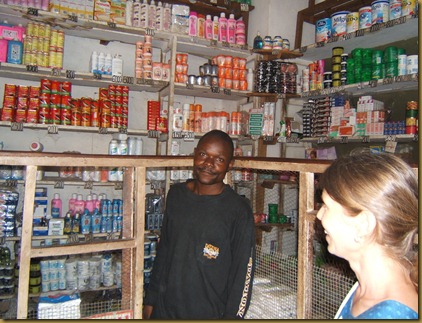
I leave the store, wondering what kind of store would sell light bulbs. I try the office supply kiosk, but they are out. I go on to Gosen, another “dry-goods” store across the street. Score! They have them! I buy a few light bulbs, and as they are handing them to me another customer or bystander admonishes the clerk that he should have put them in a plastic bag for me. “But plastic bags destroy the earth!” I argue, “I always shop with this big bag so that I avoid getting a plastic bag”. He doesn’t seem convinced, but at least the clerk, Jean de Dieu, is happy to accommodate me.
Gosen store

Jean de Dieu, the clerk in Gosen, standing in his store

I have most of the groceries on my list, and my bag is starting to get heavy. I head towards my last stop  - picking up Bob’s suit-coat from the dry-cleaners. There is one drycleaner in Kananga, and this is the first time we are trying it out. This morning I drove to town to pick up a few boxes of Bibles, and tried to pick up the suit-coat on that trip while I had the vehicle. Unfortunately, the storefront where customers drop off and pick up clothes is not the same location where they do the cleaning. Despite the fact that it is Tuesday and they said it would be ready last Saturday, his coat was still in the other location and they asked that I return later in the day. When I reach the store now in the afternoon, I am tired from the heat and my heavy bag. The clerk tells me that Bob’s coat is still at the other location! I am frustrated, and tempted to criticize her – she told me in the morning that she would get the coat, and I had told her the time I would return. This is one of those “culture stress” moments, when I long for the efficiency and relative predictability of the U.S. Fortunately, a man walks in then who appears to be the boss of the dry-cleaners. He perceives the trouble, recognizes me, and makes a phone call to the other location. “Bring that coat over here! This pastor’s wife is standing here waiting. This is not good!” He offers me a chair, and in just a few minutes a man rides up on a motorcycle taxi with Bob’s suit-coat. That was an efficient resolution! I thank them for their help, and head towards home, trying to balance my bag, the umbrella, and the suit-coat.

On the way, I stop to chat with Pastor Tulume, who is sitting under a shade tree on the sidewalk. A little further on, I look for Mambuyi, the woman who gets water for us. She normally sells peanuts and biscuits at this intersection. Our barrel is nearly empty, and I want to ask her to come tomorrow to get water. I can’t find her, so continue towards home and find her husband at the corner where he works repairing bicycles and shoes. I greet him and congratulate them on his brother’s new baby. I ask him if Mambuyi came to the market today. “She did, but she has just left to go see the new baby.” I pass on the message to ask her to come tomorrow. One more block, and we are back on our street where I pick up my papaya and plantains from the women on the corner. “Wow! Did you buy a suit-coat for Bob?” they ask. I laugh, and explain that we just got his coat cleaned. I recognize an old and frail widow who attends the same parish we do, sitting next to Mamu Kapinga. She recognizes me and starts to excitedly declare “I know you! You attend the same parish I do! We are in the same church!” “Yes, yes. I know you, mother,” I say, trying to encourage her that I do recognize her. She asks for some money to buy food, and I give her a small amount that might help with a meal. I continue up the block, greeting the women who sell in the small market in front of our home. Just before reaching home, I buy a few tomatoes from a young girl who is filling in for her mother.

Whew! It is about 4:00 as I reach home. I am grateful to get some cold water and relax a few minutes after my long walk. Thanks for joining me - I hope that you enjoyed meeting some of the friendly faces around Kananga. Now – what do you think? Would you prefer to shop in Kananga, or in the town where you live? Any particular differences of shopping here you like or would struggle with?

Monday, June 27, 2011

Cross-cultural Logistics

We are in the process of preparing for a youth conference for the CPC. Youth representatives from all of the 12 synods in Congo have been invited. It has been 4 years since a conference like this was held for youth, so we are hopeful that it will be a big encouragement and source of equipping to the faith of the youth. Both Bob and I have been involved in planning conferences and events in the past in the US and Rwanda. We expected the logistics to be more challenging in a place like Congo where infrastructure is limited. But it still takes me by surprise sometimes…

A few weeks ago, we were discussing the invitation letters that were sent to each of the 12 synods. It went something like this:

Bob: “Central Synod. check. We took their invitation with us last week to Munkamba and asked Pastor Wetunganyi to deliver it. Synod of the North. Check. I sent it via e-mail last week to Pastor Mboyo. We should call to confirm that they received it.”

Pastor Mbikayi: “I also sent their invitation via train last week. And the one to the Synod of the South East went right away, because I knew someone going there.”

Bob: “What about Tshikapa? How do we get the invitation to Tshikapa? Is there a way to send it by vehicle, or by plane? Can we call them and ask?”

(Pastor Mbikayi tries to call the synod exec, and the call does not go through. He finds the number for someone else in Tshikapa)

Pastor Mbikayi (on the phone talking to the clerk of the Tshikapa synod.): “How should we send the invitation letter to you? By plane? Is there someone at the airport that we should address it to who can get the letter to you?”

…yes, we live in the age of instantaneous communication. But we are also in a part of the world where sending a single piece of paper can be a major project.

That was just one piece! Then we have the matter of where people will sleep, how the cooking will be done, etc. The conference will be held on the site of one of CPC’s nursing schools, so the dorms will house the students. But, of course, there are not enough mattresses, or bathrooms, and only one burner to cook for 200 people. This promises to be a good learning experience for us. :) Thankfully, our colleagues have plenty of experience and connections to hopefully find solutions to all the ‘logistical challenges.”

We welcome your prayers for this youth conference. It will be July 26-28 in Tshikaji, near Kananga. In Congo, unpredictability and flexibility are a way of life. We trust God to guide all the preparations and accomplish HIS purposes in the conference!

Wednesday, April 20, 2011

Congolese Creativity

I must admit that in our moments of frustration, it feels like there is little evidence of ‘resourcefulness’ or creativity. Sometimes we sense an attitude 'of ‘helplessness’ when someone complains about their limited resources. However, we DO see lots of evidence of creativity, so in an effort to remind myself, I will share some with you. :)


1. The ever-versatile flip-flop.

I have watched very young children come into church and find a space to sit on the cement floor. Though only 2 years old, a little boy knows to take off his flip-flops and use them as a seat cushion! One woman told me that she uses her worn-out flip-flops to start her charcoal fire every day. And last week a mechanic was looking under the vehicle we drive to determine a problem. He was laying on some plastic sacks on top of the sandy gravel, but after just a few minutes he took off his flip-flop and slipped it under his head. Smart!


2. The writing in the sand…

Unlike the US, most roads, side-walks, yards, paths are sand or fine dirt. When we were in Munkamba last year learning Tshiluba, we walked with Tatu Kankonde to a nearby village. I was amused that when he wanted to make sure that we caught a new word, he would stoop down, find a small twig, and write the word in the sand. I thought perhaps it was a habit unique to him, until I started seeing it again and again, in all situations. Chalk functions the same way – Churches will paint a black space on their wall that functions as a chalk-board for announcements. Or names being nominated for election in a church are written with chalk on a wood surface, like a table.

P1080952

A coffee-table is up-ended to stand in
as a chalk-board at a church meeting.

3. Exotic eats

We have heard some people say “Congolese will eat almost anything!”. We would agree – I am thoroughly impressed with their creativity in this area. Caterpillars, termites, dried and salted fish, tree grubs, dried eels —all are a valued part of the diet here. Since there is not electricity or refrigeration in most places, and because livestock is not plentiful, people need foods that are locally available or can be preserved well. In our limited experience with these new foods, the Congolese do not eat everything indiscriminately though. We have learned that some varieties of ants can be eaten, some not. Some bugs can be eaten live (if you make sure to bite the head first), but tree grubs certainly can not be eaten alive.

These “creative” (from our perspective) food options are also not eaten out of desperation or starvation. The Congolese we know thoroughly enjoy their caterpillars and termites. One of our colleagues actually mailed a package of caterpillars to his Congolese friend living in the US, so he could have a ‘taste of home’. Last year when we were first introduced to the flying variety of termites and watching the children eagerly chase them and pop them in their mouths, I asked our tutor, “…but can someone get full eating lunana??” “No,” he replied, “It just makes the cheeks happy.” My cheeks are not quite there yet, but we keep trying.

If all works well, below you should be able to view a video of my first try at eating “Lunana”, one of the varieties of flying termites.


P1090112

Caterpillars – yum!

4. If I just had the right tool…

We continue to be amazed at the ‘creative’ use of tools here. In America, we often extol the value of having “the right tool for the job”. Here, it feels more like “what is available and could possibly do this job?” For example, one family we stayed with had about 10 children staying in the house, and only 1 knife for cooking. It functioned as paring knife, butcher knife, vegetable peeler, and can opener. I have never seen a can opener for sale in Kananga…I guess people figure it is an unnecessary thing since a knife can be used (although I admit that our Congolese friends make it look easy to open a can with a knife. It is not!).

Plants and natural products are used here in more ways than we thought possible. Long pieces of grass or thin strips from palm fronds are often used instead of string or rope to tie bundles or bunches of vegetables. Hardy grasses are used to weave baskets, sleeping mats, even containers that hot food can be kept in. Fish, insects, and cooked cassava is often wrapped in large leaves to be sold, which helps with short-term preservation.

DSCN3391 fish for sale!

On our recent visit to Mueka, we heard an impressive choir that had chime-like instruments. After the service, I inquired about them, and was told they were bicycle axels! Another choir in that church used locally-made wooden guitars. Men’s choirs often add rhythm using two sticks that are knocked together. Women tend to use shakers to add rhythm, which are made from tin cans that have holes punched in them and beans inside. Make a joyful noise! :)

P1090325 The bicycle-part chimes

I hope that you’ve been as encouraged as I have by these examples of the creativity that we see in Congo. I don’t recommend that you start using  your knives for a can opener or munching on caterpillars, but we can appreciate each other’s gifts! How are you exercising your creativity?

Tuesday, April 12, 2011

Fair trade in an unfair place…

What exactly does ‘fair trade’ mean? I understand the principal that a worker who produces a product should get a fair wage rather than being exploited by his employer or by the distributer. But when you are living in a foreign place, trying to figure out what things are supposed to cost and attempting not to get taken advantage of, the lines get a little grey sometimes….

We have noticed that items which are hand-made with local materials are often dramatically cheap. One day a young boy came to our door selling some hand-made mats and baskets made of palm fibers. We did not really need anything, but decided to inquire about the price of the basket. “500 francs”, he said (about 50 cents). “500 francs??”, we questioned, surprised but wanting to verify that we had heard correctly. “Ok, 400.” he said quickly. “No, 500 is a good price. We’ll buy it.” This basket perhaps took one day, perhaps 2 to make? Is that a fair price? The price is determined partly by what people are willing to pay, and apparently the local demand has set the price at 500 francs.

 P1090365

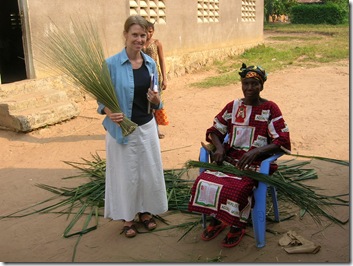
In another case, the woman in the picture below is a widow who lives with the family of her adult son. She does not want to be a financial burden to them, so she makes brooms out of palm branch fibers and sells them. In the picture below I am holding one of her brooms while she works on stripping the palm branches. Brooms like this are ubiquitous in Kananga, and the standard price is 100 francs (10 cents). This woman is able to make 2 brooms per day if she works all day. The profit she makes is not enough to buy food for one person, let alone support a family. It gives her a small amount that can supplement the income of her son, and perhaps is a good job for an older widow. But how is it that the people making these brooms are willing to accept 100 francs as the purchase price??

DSCN3736

On the other hand, sometimes we feel ‘taken in’ by what seem like exorbitantly high prices. We might be told that a small statue is $30, or a woven piece of material $25. We realize that there is a culture of bargaining here…people rarely buy anything without negotiating the price with the seller. So, sellers tend to start a bit high, and with foreigners they might even notch their price up again just to see what they can get. We have artists or distributers of art come to our door frequently. We do want to enjoy locally made crafts and support these artisans, but we also want to do it at a reasonable cost. We bargain with them, and hope that they will not agree to a price that is not reasonable. Our goal is to find that ‘sweet spot’, where they make some profit and feel validated, and we feel we have paid a fair price for the product.

The concept of a ‘fair price’ is tricky, though. A few weeks ago, an elder in the church came to show us his hand-carved figurines made of coconut shell. We were impressed, and decided to buy a village scene. He said his starting price was $20 for the set, but he would negotiate. We decided to answer with $10, figuring that we would settle somewhere in the middle. But he just looked a little disappointed, shrugged his shoulders, and said “Sure. If you think that is a good price, $10.” We hurriedly decided to give him $12 for the set, and tried to assess in our conversation if that price was really OK. Sometimes I just want to throw up my hands and say “I just want to know the truth! What is the price?? What is a fair price?” As Americans, we place a high value on truth and fairness. I hate the feeling that I am being treated unfairly, or that I am treating someone else unfairly. We are not trying to get such a good price that the producers do not make a profit—we just want to know what the right price is!

The economic environment does play a part. Average wages in Congo, in real terms, are only a fraction of what they were before independence. A qualified medical doctor in Kananga earns about $150 per month. An unskilled day-laborer earns only $1 or $2 per day. Even salaried workers have little money to spend, which keeps the profit margins very low for farmers and producers of local goods. So, if the woman making brooms charges enough to make a ‘living wage’, would it make sense if she earned as much as a doctor? That is how a market environment works, for better or for worse. Only those people who have no other options of earning an income are willing to make brooms, and they thus have little bargaining power to push up the price. It’s true—life is not fair.

How do we determine reasonable prices to pay for things? How can we positively influence the livelihoods of these crafts-people and producers, while honoring the culture environment here? We are open to suggestions and comments!

Monday, April 4, 2011

Charting a course…

While visiting the village of Bulape, we got to spend some time with a dynamic young pastor named Jackie. She is the chaplain at the Bulape hospital, and has a thriving ministry among the patients. Her ‘congregation’ at the chapel is mostly children, drawn to her because she makes her sermons understandable to them. Her heart of compassion and desire to make God’s truth known really inspired us, and we thought you might enjoy hearing a bit of her story.

P1090028

Jackie, at her desk at the hospital

Jackie was invited to come to seminary in Kananga on a scholarship for women students in 2004. She and her husband sensed God’s call, so she packed up 2 of her 3 children and moved to Kananga, while her husband remained in Bulape. During her first year she gave birth to her 4th child, and 5 days after the birth was back in class. During her first year, 10 female students began studying theology. After their first year, the scholarship ended, and only 3 of the students remained. She pushed on, and her husband and family struggled to support her study. In her second year, her 2nd child and only son got a bad case of malaria and died. In her distress she decided to quit school, but her husband exhorted her to persevere and continue. She graduated in 2009 with a master’s degree in Theology, and returned to her home in Bulape. As we heard her story, we were struck by the sense that she has a true, “tangible'” commitment to her Lord, and has endured plenty of pain and shame in her journey! On a redemptive note, after Jackie returned from university, she had 2 more children – both sons.


In rural Congo, boys are still favored to receive education over girls. Families prefer to save their resources to educate sons, and often the dowry money paid for a bride is used by the family to support the education of their sons. (I should mention that one thing the CPC has always advocated for in its 100+ year history is the education of girls, and Jackie is one evidence of that effort). Culturally, men are also favored for jobs and leadership roles in the community. Women very rarely get a ‘voice’ in decisions, and their lack of education further squelches their opportunities. When Jackie returned to her village with her degree, many were not sure how to respond to her. As a pastoral candidate, she was given the position of assistant pastor in a local parish. After 1 month, the male head pastor left on extended leave, entrusting the ministry of the parish to her. In her first week of solo ministry, attendance at the church plunged from 400 to 90. She cried out to God, asking why God had called her to ministry and brought her this far only to let her be humiliated and the church scattered. She prepared her sermon for the following week, but on Saturday night she had a dream. She heard a voice tell her a specific text and subject to preach on, and describe for her the thoughts and questions that were plaguing many of the congregation. After the service the next day, people went home shaking their heads - “She taught exactly what I was wondering about!” Attendance grew, and after a month attendance was back at 400. She served as pastor in that parish for 6 months, until she was called to be the chaplain at the hospital. She was then ordained in early 2010, and the whole village came to support her at her ordination.

P1090016 The pastors of Bulape with Bob, Pastor Mboyamba
and Pastor Mbikayi from Kananga

Over the past year, she has preached on the radio a few times from a neighboring town. She said that she is the only woman and only protestant who has preached on this government station. Most people who want to preach on the radio pay a fee, but the station director is so enthralled to host a woman pastor that he does not charge her. She said that after each time she preaches, she gets phone calls and letters from rural parishes with invitations to come preach. People say that although they have heard her voice, they want to see her in person – they have never seen a woman pastor before. She continues to teach religion and literature in the local high school, and said that she is encouraged by several families in the community who have supported sending their daughters for higher education. She has also motivated 2 women to study theology at the university level – the first step to becoming a pastor.


In her role as chaplain, Jackie seeks ways to minister holistically to the patients. Chapel is held twice per week at the hospital, and she makes rounds to pray with patients personally. She bought a few chickens, and gave them to a couple of widows to care for. Periodically, she collects the eggs and uses them to feed malnourished children at the hospital. Sometimes she picks a day and makes beans and rice to serve to all the patients at the hospital. Occasionally she buys candy to pass out to the scores of children in her congregation. When patients do not have food to eat or clothes to wear, she is often their primary source of comfort and help.


We thoroughly enjoyed our conversations with Jackie – she is a refreshing and hopeful voice in Kasai. Her husband, Emmanuel, is one of the few men in Congo who would be willing to sacrifice for his wife to be more educated than himself. Her life holds hope for many of the girls in her rural area, that they too can be used of God and help instruct others. We look forward to seeing the fruit in years to come!

Thursday, November 18, 2010

“Where, O death, is your victory? Where, O death, is your sting?”

bringing body to lukitaThe Women bring Mamu Jaqueline Nyemba to be buried

The sun was intense. Umbrellas bloomed everywhere. They just brought the coffin from the church service. A long stream of cars drove at a walker’s pace. We walked with the multitude. After greeting some friends, we walked closer to the actual grave site. People were everywhere. We were standing about 200 feet from where she would be buried. The coffin, shouldered by about 10 women, passed us by. The bereaved and I greeted one another. From above, we could look down and see the sprawl. I could hear a few people speak below, but with the frivolous chatter above, I couldn’t hear much. Something propelled me forward. I went down, and entered another world.

DSCN4485 The crowd below (another world)

The intensity of the crowd was jarring, and overwhelming for many. The atmosphere was altogether separate from watching above. Death was right in front of us, visible in the form of a coffin and a fresh hole in the ground. I looked at individual faces, observing reactions to this fate-filled reality. Some stood with curious stares. Many sobbed and wailed. A host of women resisted, opposing the coffin’s entry into the ground. Screams, shouts and cries filled the air. We seemed on the precipice of chaos.

Magically and rhythmically, one of the pastors began singing a familiar hymn. “The blood of Jesus is our salvation,” we sang. The tide slowly turned. Peace gained the upper hand. Another pastor spoke up, reminding us of the “spiritual war of our faith.” Death is a threat to our faith in a loving God. Another pastor spoke words of comfort. He prayed a faith-filled prayer that touched my heart, renewing and strengthening my faith in a loving and caring God. His prayer reminded us that there is life beyond death. Death does not have the final word.

Jesus said to Martha in the book of John, “I am the resurrection and the life. He who believes in me will live, even though he dies; and whoever lives and believes this will never die. Do you believe this?” (John 11: 25-26)

Prayer: Lord, we entrust your servant Mamu Jaqueline Nyemba into your loving embrace. We entrust others we love into your loving arms as well. We trust and believe that You are a God of love and forgiveness. For those of us who hope in You and choose to walk in Your ways, there is hope for eternal life…life beyond a coffin and a fresh hole in the ground.

“Where, O death, is your victory?
Where, O death, is your sting"?” (1 Corinthians 15: 55, Hosea 13: 14)