Friday, May 26, 2017

Connecting through Language


The other morning Kristi and I found ourselves in a lively conversation in the doorway of our apartment with Isaac, one of the guards, and Susan, who cleans all the apartments on our floor.  What was striking about this conversation is that most of it was in Juba Arabic**.  It began with the basic greetings that we have been learning, but quickly shifted to new vocabulary as Isaac and Susan saw pictures of our families on the wall mounting and began pointing fingers and asking questions.   We quickly learned the word for father, “abuu,” mother, “uma,” and sister, “okut.”  Susan pointed to Kristi in one picture from 8 years ago, and I responded, practicing in Arabic, “My wife.” “You have two wives??”, Susan exclaimed, and we laughed and assured her that no, it was really Kristi in the picture. We then learned that Susan was one of three wives, and has 10 children.

Later that morning a colleague asked Isaac, “So are you now speaking Arabic with Bob and Kristi?”  While our Arabic is still quite limited, we are making a little bit of progress each day.  Yesterday I was literally overjoyed when I figured out, after she had just left, what Susan had asked me – “Ita rija kalaas?”  (meaning, “You have returned?”).  I just about jumped off the couch and shouted when I realized she had introduced the verb “return” and the perfect tense which ends with the word “kalaas.” 

While learning vocabulary and grammar can certainly be an arduous affair, it can also be fun as it connects us to the people we have come to live amongst and serve.  In so many ways language is about connecting with people.  Even as we go down to the small shops along the way to buy this and that, if we can greet folks and say a few things in their language, it builds instant rapport.  While many people here speak some English and we can technically “get by” with English in our respective work roles, the Arab influence in South Sudan is still quite strong, so learning Arabic will help us build relationships with those we rub shoulders with everyday and strengthen relationships with colleagues.  It also helps us as we travel around the city and shop. 

While we served in Congo, we had no choice but to learn the language of the people.  Learning and speaking Tshiluba and then French built a permanent bond.  We hope that a similar phenomenon can happen here.  Having learned Tshiluba and French gives us confidence in learning a new language, Juba Arabic.  Of course many African tribal languages are spoken here also – Anywaa, Madi, Bari, Shilluk, Dinka and Nuer to name just a few.  Sadly, it will be impossible to learn all the mother tongues of folks we will grow to love, but hopefully we can learn a few greetings and phrases from these languages as well, showing an interest in them as valued persons with deep roots in this place. 

So, with all that sharing about language, we close with the familiar Arabic blessing, “Salaam alekum.”  May God grant you peace.   

**The localized form of Arabic in South Sudan is colloquially called “Juba Arabic” – a pidgin form of Classical Arabic.

Wednesday, May 17, 2017

Stuff

In the midst of our multiple recent moves and transitions I’ve been thinking a lot about possessions. After more than a year in the U.S., we packed up to return to Africa. I struggle every time we go “across the pond” with the tension of wanting to ‘pack light’ and not have too much stuff, versus wanting to have some of those things that will make life easier or which we can not get in Africa—like a bar of chocolate, a fun movie, or enough vitamin C. Most of our possessions had been left in our apartment in Kananga, because we anticipated returning there to continue working. In the process of moving to South Sudan, we anticipated returning to Kananga to say good-bye and collect some of our things. But because of current insecurity around Kananga, we had to plan for the contingency that we might have to cancel those plans at the last minute. Packing felt particularly challenging to me, wanting to bring enough to ‘survive’ if we could not go to Kananga, but also not bringing much since we anticipated getting most of our clothes, books, and other things from Kananga to take to South Sudan.

In the midst of our preparations, we heard from a few colleagues who had been evacuated from South Sudan during times of insecurity wihtin the last 5 years or so…at least two of those colleagues lost everything in the upheaval. They left their homes with a backpack and never returned. One warned us not to take anything to South Sudan that we did not want to lose. But, at the same time, we want to feel ‘at home’ in Juba and settle in there. So how to pack??

Just before we left the U.S. in April, I started reading the book Missions and Money, which explores the issue of ‘affluence’ in the Western missionary movement. Our Western culture is significantly more affluent than the countries we are sent to, especially those that Bob and I have found ourselves in. I am challenged and convicted by reflections from both westerners and Africans about the gulf that can exist between us because of our western sense of self-sufficiency, the value we place on privacy and private ownership, and our abundance of ‘stuff’ that we are so attached to. How can we preach Jesus’ gospel - ‘good news for the poor’—if we are clinging to our Western comforts? And truly, in our personal experience, one of the hardest aspects of living in a country like Congo is being confronted with the struggles of poverty in the people we relate to on a daily basis.

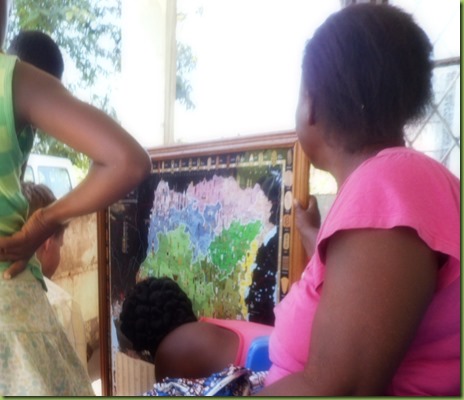
We gave our map of the tribes of Congo (a treasured
posession!) to Pastor Mboyamba’s family

When we arrived in Kananga, I was grateful to see everything in our apartment still there, safe and sound. We collected books – some that have been so useful or insightful to us that they feel like old friends. But at the same time we realized that most of what we found in our house, we could live without, or we could buy another in Juba. We started making piles of clothes, books, kitchen supplies, linens, and other things to give away. We had joked before that our apartment was almost like a museum of local paintings and carved figures—so we picked just a few pieces as momentos and piled up the rest to let our friends choose from. As Bob described in his post about Kananga, whenever friends came to see us and say good-bye, we invited them to take something. Some would ask for something specific – a basin, a radio, a skirt, or a picture of us. It was a little scary for me at first, inviting people to take whatever they wanted, but also very liberating. One friend in Kananga joked that you never realize how much stuff you have until you have to move! We gave away nearly half of our clothes and books, and even with the remaining, it felt like we had too much. Finally, we squeezed our stuff into five suitcases – two of them just for books—and took off from Kananga.

Donating some books to UPRECO, the seminary in Kananga

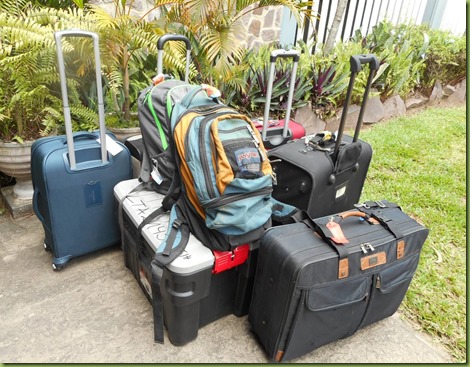
Our baggage as we leave Kinshasa for Juba

We landed in Juba last week with 6 suitcases, and found two there which had been brought previously by our very kind colleagues. A lot of stuff can fit into 8 suitcases! We unpacked, and are settling in to our very nice and modern furnished apartment here in Juba. And now I find myself constantly adding to a mental list of things we need – a frying pan, bowls, tupperware…and of course shelves and baskets to put all the stuff into! I’m trying hard to take it slow and try to get by with less, even if it means washing dishes after every meal or not having exactly the right utinsel. But mostly, I am grateful for this upheaval and long period of transition that has helped me realize how little is really essential, and the value of focusing on relationships and memories that last forever.

“Where your treasure is, there will your heart be also.” (Luke 12:34)

“Keep your lives free from the love of money and be content with what you have, because God has said, ‘Never will I leave you; never will I forsake you.” (Hebrews 13:5)

Thursday, May 4, 2017

Returning Home and Saying Farewell


For the last seven years Kristi and I have made our home in the city of Kananga in the Democratic Republic of Congo.  For the last seven days we have been in Kananga, spending almost every waking hour either sitting with people we have grown to love or stripping down everything in our apartment that has made it our home.  Today our bodies and our emotions are weary.

On our first full day back we went to visit the grave site of Rev. Dr. Mulumba Musumba Mukundi, who served as the General Secretary of the Congolese Presbyterian Church (CPC) for the past twenty plus years.  Standing over his grave and praying felt like the end of an era.  Mixed with the morose feeling of loss and death were feelings of excitement and new life as we saw one of the graduates of the Ditekemena program for street children who came to greet us at Dr. Mulumba’s grave.  He and his sister are living with their grandmother in a new house built by the program and are worshipping regularly at a local church.  Because Dr. Mulumba has been buried at Ndesha Mission where he served as rector of the University of Sheppards and Lapsley (UPRECO), we were able to give away some books to the school and in doing so were able to spend some time with first year theology students, representatives of the future of the church in Congo.  It was a gift to sit with them, to see their bright faces and to hear briefly about their lives.   


At Dr. Mulumba’s grave with Pastor Tshipamba

When we arrived in Kananga we promptly informed friends and former colleagues of our presence.  While we only had time to visit a few friends in their homes, most of our time was spend hosting people in our home as we made coffee/tea and made regular runs to buy bottled water, peanuts and bananas to host our guests.  People came in and out of our home during the morning hours or in the afternoon.  We made spending time with people a priority, using hours in the evening and when we had a break during the day to pack up.  Kristi and I guessed the other day that probably an average of 30 people came to see us on most days.  While having so many guests could have been simply overwhelming, somehow God gave us the energy and ability to sit and visit with so many folks who have built rooms in our hearts over the last seven years.  In Kasaian culture, people often ask for something to remember you by when you part ways, so we invited everyone who came to see us to choose something from our house to take as a momento. After watching several people walk out with sacks full of stuff, I commented that perhaps this is how the Egyptians felt, being plundered before the exodus of the Hebrews.  We allowed ourselves to be pillaged in the Name of Jesus!    

DSCN0868
Visiting the family of Pastor Mboyamba

DSCN0831
We enjoyed hosting waves of visitors almost every day

The general response from most was excitement and surprise to see us, but then shock and dismay to learn that we would be leaving them.  While we have had time to process this change over the last few months, for most of our Congolese friends it was something new.  One pastor in Kananga had heard through their sister church in the US the news that we would not be returning to live and serve in Congo.  When I called him and told him that we were in Kananga, he was ecstatic.  I remember seeing his face light up across the room when I saw him in our home.  When we then explained to him and others the news that we would be leaving, his enthusiasm faded.  However, being a wise and discerning man, he and I then had a fruitful and affirming conversation about our life of discipleship and how God often takes us down paths unexpected but necessary. 


Tatu Willy and Mamu Monica and their three young children

DSCN0875
Kristi with Luse Kristi, her “shakena” or namesake, daughter of
Pastor Manyayi and Mamu Biabanya

A couple of conversations and meetings were particularly rough.  One such conversation was with Tatu Sammy, a retired driver for CPC with whom Kristi and I have developed a close bond over the years, travelling all over the Kasai region together.  Sammy sat alone with me in our living room thunderstruck, as if his whole world had been turned upside down.  His tears and lament were palpable; all I could do was sit silently with him in his pain and consternation.  Later that day he came by again and he couldn’t even bear to come inside. Sammy joined a few others who made the final trip to the airport with us yesterday, a ride drenched with immediacy and poignancy.

As we shared our news, we also listened to the news of our friends.  The major theme of what we heard was the insecurity and destruction of human life in Kananga and in the Kasai region.  One whole section of the city has become a ghost town, save the presence of soldiers.  This commune, called Nganza, is wedged between Kananga and the village of Tshikaji.  Government soldiers have sought out militia members in this area, but according to everyone we spoke with, they have killed indiscriminately, taking the lives of innocent men, women and children.  The grisly descriptions we heard were traumatizing.  Other sections of Kananga have been hard hit as well.  Our friend Pastor Manyayi and his family have taken in three extra children in their small home.  The parents of these children are missing.  The story is that the parents fled into the forest, but I wonder if the sad reality is that they will never be returning.  Pastor Mukendi and Mamu Helen, two close friends, have welcomed many into their home which has become like a refugee camp.  Young people are being targeted as members of the growing militia.  People fear for the lives of their children.  The government is showing no quarter.  During most nights during our visit we heard gunshots.  We also heard stories the following morning.  The day we left we saw four huge trucks filled with government soldiers driving into town, a foreboding image of what may lie ahead for those we love in Kananga.  I felt so grieved and angry watching the soldiers in these trucks arrogantly parading power and veiled terror, wanting to do something but feeling paralyzed and helpless.          

We knew that our time in Kananga would be good for us and those we saw, but also difficult.  It has given us and our friends and former colleagues the chance to saw “farewell for now.”  It has allowed us to share the depth of feeling we have for each other.  It has allowed us to pray together, break bread together, laugh, cry and fellowship together.  It has reminded us that life can feel capricious and uncertain, yet our faith buoys us as we have the hope of Christ in us, a hope which sustains us and gives us assurance that our our partings are truly only a ‘farewell for now’, that we will see each other again someday, either in this world or in the world to come.  Thanks be to God. 

Lord, bless and protect our dear friends in Kananga.     

Friday, April 28, 2017

Refreshed

We just completed a truly amazing week in Rwanda, and feel refreshed, encouraged, and excited for our next steps. Nearly 50 other mission-coworkers serving in Africa gathered in Rwanda for this conference, along with several of our mission leadership staff based in the US. As you can imagine, the fellowship of people with similar experiences and passions is particularly sweet – and throw in the Holy Spirit and our connection as God’s children, and that made for a uniquely powerful time together.

Kibuye breakfast
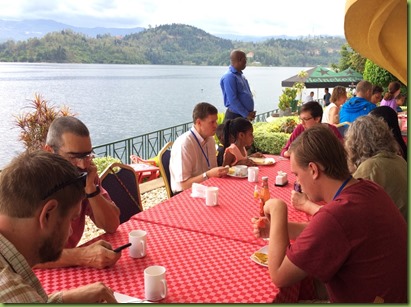
Breakfast with colleague, overlooking Lake Kvu

The conference happened to be in Kibuye, a town in Rwanda that is right on Lake Kivu. Lake Kivu is dramatically beautiful, with hills along the shore, islands dotting the horizon, and a lush green landscape where bright flowers and birds are plentiful. Fishermen in large dugout canoes sing together as they head out onto the lake at night. In 2003, Bob and I first met at another gathering on Lake Kivu, so it was particularly meaningful to return after so many years.

Loving the view of Lake Kivu!

The week started by visiting the genocide memorial in Kigali, which walked us through the tragic and horrible cataclysm that was the genocide in Rwanda. Each day after that, we heard from a Rwandan church leader about their process of healing and recovering from the genocide, starting with the Presbyterian Church in Rwanda’s confession in 1996 of their failure to be a prophetic voice speaking out against injustice and genocide ideology. One of the most tragic aspects of the geneocide was that massacres happened in the very places where people expected to find sanctuary – in churches, schools, and stadiums. You can imagine how hard it would be for someone whose family members were killed in a church to return to the church to worship, with all of the memories and trauma that experience includes. This is why one of the msot poignant moments in the week was hearing from a few members of a reconciliation group called Umucyo (light). Pastor Jerome was sent to Zambia to be trained in reconcilliation and conflict resolution. He returned to Rwanda, and realized the deep trauma and fear that many members of his congregation were experiencing. Many had lost spouses, children, parents, or close friends, and their homes and livelihoods had been destroyed. At the same time, around 2008, people who were in prison for participating in the genocide were going through a community judicial process – those who confessed their crimes were allowed to return home to their communities. Pastor Jerome gathered both survivors and perpetrators together, and helped them to gradually find healing, forgive, and be willing to pursue reconciliation. We heard from one woman, whose husband and 5 children were killed in the genocide. She shared how traumatized and immobilized she was for years after the genocide. Yet becaue of her participation in the light group, she has been able to forgive individuals who killed people during the genocide, to the point that she can socialize and appreciate other members of the group who were perpetrators. Seeing the evidence of that before our very eyes was powerful – a true miracle.

Testimonies in rwanda - AnastasieAnastasie shares her testimony

We also spent time getting to know our new colleagues who are based in South Sudan. We have a lot of respect for these fellow-mission co-workers who have walked with the South Sudanese in spite of long years of instability and conflict there. Most of them have been evacuated at some point from their homes in South Sudan because of conflict in recent years. Yet, they return and continue to be present and continue in partnership with the church in South Sudan. Over meals, we talked and laughed and continued to anticipate jumping into life in Juba in a few weeks and building relationships with our new South Sudanese collleagues.

After this week of refreshment and inspiration in Rwanda, we continue our journey of transition by going to Kananga. We look forward to reconnecting with friends and colleagues – important links in the chain of our life and experience on this amazing continent of Africa.

Tuesday, April 11, 2017

The Wilderness Within


I entered this essay on wilderness into a contest for the Christian Century two months ago.  Some of the images and metaphors are inspired by the late poet and philosopher John O’Donahue in his seminal work, Anam Cara.  

We hadn’t planned to do such a long hike. We were just excited to be in the wilderness of Yosemite for a couple of days in November. Yet when I overheard the Park Ranger describe to a couple of chaps the fourteen mile hike up Vernal Falls, and then up Nevada Falls, then hiking above and crossing over on the Panorama Trail, marching up to Glacier Point, and then blazing down to the valley floor on the Four Mile Trail, my curiosity was piqued. We approached the elder statesman of our national parks, and, with a twinkle in his eye, he gave us the same recommendation. He sized us up, “Yah, you’ll make it, but you sure as hell will be tired and sore afterwards. This is the type of hike you want to go and discuss doing over pizza n’ beer. If you do it, it’ll remain in the family annals forever.” My wife Kristi and I went outside and sat under the glare of the mid-day sun. “So, what do ya think?” we asked each other. It certainly wasn’t the relaxed jaunt we anticipated, but there was something captivating about the ranger’s recommendation. We felt we could do it, but we also knew it would be a stretch. The decision was made.

The following morning we arose before sunrise. It was thirty five degrees out, so we outfitted ourselves with long underwear, jackets and stocking caps. Along with our lunch, we packed lighter clothes, knowing that the temperatures would climb into the seventies. Crossing a river, we headed up towards the falls. Like a giant monolith, Glacier Point towered above us. I crooked my neck to see the top of the precipice. The trail going up and up and up was heavy underfoot with large stones. The morning was gray and bleak and cold. The silence and grandeur were palpable. Our bodies were miniature in scale compared to the vastness of the wilderness surrounding us. It felt like we were the protagonists in a Lord of the Rings movie, moving towards some enchanted land. The undulating, sometimes unsure path maneuvered us hither and to, across rivers and up waterfalls. Finally we reached a high haven where the glory of Half Dome spoke majesty to us. The trail delivered us over and down, across, and, was it true? Up another mountain? Yes, it was true! We soldiered on, walking like persons half dead, drinking in the beauty, begging our bodies forward to the pinnacle of the day’s adventure. Finally, atop Glacier Point, our beat-up bodies radiated sheer glory. We found rest in this holy habitation, looking down on all that we had covered, enjoying a moment of sublime ecstasy. After a fine rest, we sallied gaily down the mountain. After an eternity of switch backs, we returned to the valley floor, where, returning to our digs, we did enjoy a pizza and a beer. We did it, and yes we were tired and sore.

Often, wilderness takes us “out there.” We take a hike. We sit on a rock. We backpack through wild and uninhabited regions. We breathe in the thin, untainted air. We sit under a two hundred year old tree. We feel small, yet alive, broadened. These are the hallmarks of the external journey. But another wilderness journey beckons us. It is far more grueling, demanding so much more. Feeling unforgiving and inhospitable at times, this journey delivers us home. It is the journey to the wilderness within, filled with rocky crags of hurt and disappointment, with giant monoliths of pain, but also covered with cool streams and green pastures of hope and healing. This journey is not one of bagging or conquering. It is subtle, disarming, beckoning us to come and look, as the flaming bush brought exiled Moses to I AM. Actually, this journey requires patience with self, a touch of gentle, loving care. Strength is found through solitude, in the wilderness within, in this journey home. It is the journey of the soul, and it is the journey we do well to take. In our nurtured souls we find shelter, as we take the time to be, as we become acquainted with our true selves. Inside of us resides a world unknown. Looking into the eyes of a stranger, a friend, or a loved one, we look into a world we cannot fathom. Often, we are a stranger even to ourselves. Our fragmented lives bury shards of pain unuttered, memories unspoken, incidents of shame, relationships distressed, and a weightiness of heart which overwhelms. There appears no path home. There is no peace. Joy is ever elusive.

Our Yosemite adventure last year was sandwiched by two heart-wrenching blows. Before, was a failed and final fertility attempt. “Why, O God, do you stand so far off? Why are we left out, while others are brought in?” The sharp daggers of disappointment dug deep. After, and most recent, we found ourselves on an island of uncertainty, standing before a closed door. Stripped of agency, we could only pray and wait.  I found myself puzzled and panged, which is why I packed my bag and took the hike into the wilderness within, the wilderness of the soul. On this solitary journey I found mountains and crooky crags, longings unfilled and hopes dashed, but I also found the sweetness of silver streams of grace mingled with golden, glorious rest. Reflection, solitude, diving deep within, here is where I make a friend with myself again. Here is where the Holy One sets out the linen, prepares the table. I just stop, sit, and listen. At the end of the day, it is the wilderness within, the journey I take in, back, to my Faithful Friend. Thank you, Lord Jesus.