Showing posts with label Suffering. Show all posts

Wednesday, November 27, 2024

Simon's Support Team

The four of us sat together in a circle at a small outdoor seating area which serves tea, just behind and adjacent to the military hospital. We were together for one reason: Simon Akol. A few months previous, one of us had found Simon living on the street near where we live, having seen the terrible wound on his leg caused by a bacterial infection called “Necrotizing fasciitis.” This infection is aptly known as “flesh eating disease” in that it kills parts of the body’s soft tissue and it spreads rapidly. Simon’s wound began just under his knee and extended down to his foot, just above Simon’s toes. Skin and soft tissue had been eaten away across major sections of his leg; it was a terrible sight to see.

One day when Simon’s wound was being treated by the Street Children Ministry (SCM), a young man came up to us. Looking at Simon’s wound, he audibly and publicly exclaimed, “He is finished!” (meaning, he will die!) I understood the young man’s sentiment. That is exactly what I thought when I first saw Simons’ wound. However, in that tender and significant moment, I responded gently but firmly to the young man, “We do not know.” Simon was sitting there under my arms, wincing in pain, having his wound cleaned for the second time; though his English is limited, Simon heard this exchange. I can only wonder what he was thinking.

Simon Akol is from Gogrial in Bahr Al Ghazal State. His father died and his mother left Simon and his younger sister when Simon was only seven years old. His mother had joined the Sudanese army and left for Darfur. Simon and his sister went to live with their mother’s sister, but Simon was forced to leave after a disagreement. Girls, apparently, have it a bit easier as bride wealth remains a hope and promise for their family. For boys and young men, their lot is different. Placed in vulnerable family situations, they are often left to fend for themselves and find their own way. Having to abandon any hopes for education, they ply the streets selling sundry items or perform menial work in the kitchens of small make-shift restaurants, doing work which others are unwilling to do. Simon decided to join a group of youth to come to Juba to see if they could improve their lot. Simon worked for a foreign merchant for a while, but then he was afflicted by this wound.

The four of us have become “a team” of support for Simon. Achuil currently leads SCM. He and his colleagues and the children of the children’s home visit Simon every day at the military hospital, giving Simon money for breakfast and bringing him food for dinner from their home each day. Daniel Aleek is a student at Nile Theological College (NTC). Daniel has become a friend to me; he is from the same area as Simon. Daniel has served as a valuable source of encouragement and spiritual support to Simon. If Simon decides to return to his home region, Daniel will connect him with one of the churches which Daniel helped to start in that area. Juma is our trusted rickshaw driver. Juma has been involved in the care process from the beginning, helping with transportation needs, but also directly asking Simon questions about his situation so that we can better understand how to help. Lastly, I have been involved (with Kristi’s support) with initial wound care visits, visiting Simon at the hospital, and helping with medical needs. Interestingly, government hospitals in South Sudan do not have medical supplies. Thus, it behooves the family of the patient to buy all of the wound care dressings, antibiotics, and other medical supplies for treating the patient. As long as these items are provided, the hospital can accept to continue caring for the patient with a minimal charge for the hospital bed.

Simon has been in good spirits during our last two visits. Juba took him to the market to find some green sandals which he likes very much, and we found some crutches to help with mobility. Kristi also connected with a local Christian organization which donated an audio Bible in the Dinka language for Simon. We are now working with Simon to understand his hopes for the future. Simon is twenty years old; it seems that he would like to return to his home region. He hopes that we can help him with income generation. Two ideas he has expressed are buying a motorcycle so that he can be a “boda driver” (motorcycle taxi). His other idea is to start a charging station for cell phones. His schooling was interrupted at the level of primary six; thus far, it seems that he would prefer to work than return to school.

Please pray with us for Simon. He has become a younger brother to us. Regarding the ‘team’ mentioned above, Simon is the center of our team, demonstrating a courageous spirit, a commitment to healing, and exhibiting hope for his future. May our good Lord bless Simon. May the return and blessing which Simon brings to his family far extend the payment of cows his family would receive as “bride price” for a girl. May it be so!

Simon Support Team: Achuil (front), Bob,
Simon Akol, Daniel Aleek, Juma


Friday, May 5, 2023

War in Sudan!

In mid-April, violence erupted in Khartoum and across Sudan as two sides with powerful forces fought against each other. Hopes that the violence would end are diminishing, while more than 500 civilians have been killed and more than 100,000 have fled the country.

This map shows Sudan and South Sudan,
with the location of the capitals

We live in Juba, South Sudan, relatively far from the conflict but also the country next door. Life in Juba feels relatively ‘normal’. But Juba is already feeling the impacts of the conflict. This week I talked to one friend here in Juba, who is worried about his elderly father and sister in Khartoum and is trying to convince them to come to South Sudan. “They do not want to leave,” he said, “They say ‘we fled from the war in South Sudan in 2016. Now there is war in Khartoum. We don’t want to flee again.’” Our friend explained that civilians are not being specifically targeted, but that the bombs can fall anywhere and people are killed in the crossfire. In addition, it is nearly impossible to find water, food, and fuel for power. To stay is very risky.

A house destroyed by recent fighting in Khartoum. AP photo. 

Many of our friends and colleagues in Juba have relatives in Khartoum, some of whom are now coming to South Sudan, and specifically to Juba to escape the war. A church leader we know moved his wife and children to another part of Sudan to escape the war. There was already a financial crisis in South Sudan along with floods in rural regions that made many people in a desperate, fragile situation. Now, residents in Juba are hosting relatives fleeing war or looking for funds to help their relatives leave Khartoum. This week it was reported that more than 50,000 people have entered South Sudan from Sudan because of the conflict.

There are many churches in Khartoum, even though it is a majority-Muslim country, and they are particularly vulnerable in this conflict. This article describes some of the impact on the Christian community, and some of our partners are quoted in the article.

South Sudan gained independence from Sudan in 2011, barely 12 years ago. The people of South Sudan have a long and complicated relationship with the government of Sudan and the city of Khartoum, in particular. Most South Sudanese leaders, including church leaders, were raised or educated in Khartoum. South Sudan’s primary source of revenue is its oil, which is exported through Sudan. Political leaders from Sudan helped to negotiate the current peace agreement in South Sudan, and now leaders from South Sudan are working to negotiate a cease-fire and resolution between the conflicting parties in Sudan. Even though we are not in the midst of war here in Juba, we expect the tragic consequences and impacts of the war to be increasingly felt here in South Sudan in coming days.

Please join us in praying for the people in Sudan. We offer this prayer by deacon Noha Kassa in the Evangelical Presbyterian Church in Bahri, Khartoum, which was damaged by munitions fire last week.


For the families displaced from their homes, unable to return.

For the sick and injured who cannot find medical care.

For the poor and those trapped inside, lacking food.

For those who lost a loved one, to have God’s comfort.

“Pray for all of this to stop soon,” said Kassa. “And for all who have lost hope, that they might find it again.”

Photo source: https://www.timesfreepress.com/news/2023/apr/30/us-conducts-1st-evacuation-tfp/


Tuesday, December 20, 2022

Call to prayer for Upper Nile

Indeed, most of us like to be “home” with family for Christmas. Interestingly, that was not the case for two humble Jewish villagers, Mary and Joseph, living under the shadow of the Roman Empire, finding themselves far from their home on the birth of their firstborn son, 2,000 years ago. In Fashoda County, South Sudan, the situation is worse than it was for Joseph and Mary. People’s homes and communities are being burned to the ground, they are running for their lives, they are hiding in swamps, surrounded by floodwaters. The innocents have been targeted for death, the elderly, women, and children. Please pray for those in harm’s way, those who seek refuge, and those who need God’s supernatural intervention. Bob visited this area in August of this year, so it feels close to home. Two evangelists and several members of the South Sudan Presbyterian Evangelical Church have been killed in Fashoda this month.


Bob in Kodok with pastors and evangelists of SSPEC this year

We want to share a ‘call to prayer’ (below) from the Stated Clerk of the Presbyterian Church (USA) this month, and invite you to join thousands of hands and hearts in prayer for the people of Upper Nile in South Sudan this Christmas Season. Shukran! Thank you.


Dear friends in Christ,

I urge you to join me in prayer for justice and peace for the people of the young nation of South Sudan.

Within the last few months, relatively localized fighting between two groups in the Upper Nile region of South Sudan has gradually become a more widespread conflict between the Shilluk and the Nuer peoples, two ethnic groups who used to live peacefully together. The latest reports indicate that more than 3,000 people — mostly women, children, and elderly people — have been killed in Fashoda county.

This situation is made even more dire due to heavy flooding in the region, so survivors have had to flee their homes and are living on small “islands” of land or seeking shelter in camps for displaced persons. Many people have no way of contacting their loved ones, so they do not know if they have been killed or if they are alive and displaced or in hiding.

Let us be in prayer for the people of South Sudan, especially those who carry the burden of this ongoing conflict — the women, children, and the elderly. Pray also for our Global partners, the South Sudan Presbyterian Evangelical Church, the Presbyterian Church of South Sudan, RECONCILE, ACROSS and the South Sudan Council of Churches. Pray that God will give wisdom to these partners as they minister to their fellow South Sudanese and that they can be a voice to the leaders of the country. Let us pray for the leaders of South Sudan that they will put peace, genuine security and the dignity of all the people of South Sudan as the priority of their leadership.

Pray also for the anticipated joint ecumenical visit to South Sudan by Presbyterians, Anglicans and Catholics in early 2023. May this visit bring hope to the people of South Sudan and prompt meaningful action to address the suffering of the people.

I would also invite those who feel able to do so to contribute to the PC(USA)’s efforts to accompany and support our partners’ ministries by making gifts to:
  • DR000097-South Sudan, Presbyterian Disaster Assistance’s crisis response and recovery initiatives in South Sudan
  • E051172, Presbyterian World Mission’s South Sudan Education and Peacebuilding Project
  • E052152, the Presbyterian Ministry at the United Nations and the Office of Public Witness in Washington, D.C., help to amplify our partners’ voices in the public square.

Let us look to God, our help, our hope and our salvation.

Stated Clerk Signature
Rev. Dr. J. Herbert Nelson, II
Stated Clerk of the General Assembly
Presbyterian Church (U.S.A.)

Call to prayer published by PC(USA) News Service here.

Saturday, July 9, 2022

An African Lament

Recently I taught an intensive course on Spiritual Formation at the Tyrannus School of Ministry in Juba, South Sudan. I spent a week with twenty-eight wonderful young men from different parts of Sudan and South Sudan. It was an incredible time together. In this course, I highlight and teach on the spiritual practice of lament. Lament is a practice found in many of the psalms and even whole books of the Bible, such as the book of Lamentations.

Tyrannus School of Ministry, class of 2022
led by our friend Hany from Egypt

Praying with and being prayed for by students

Theologian Emmanuel Katongole suggests that hope lies within this practice, the practice of lament, a practice whereby individuals and communities argue and wrestle with God. Lament grounds a person and his/her community in hope despite multitudinous dislocations and challenges. Lament is a means of mourning and protest; it is a way to engage God. “Lament,” writes Katongole, is “a way of acting in the midst of ruins.” Lament sustains and promotes Christian agency and grounds the Christian life in hope (Katongole 2011; Katongole 2017).

On that note, I gave my students the opportunity to write a lament, coming out of the depths of their souls, representing the heart cries of their peoples. Several students shared their lament with the class. It was a powerful and poignant time, hearing the heartaches and hopes of God’s children. Below is one of the laments from a student whose initials are YSA. He gave permission for me to share his lament with a wider audience.

From student YSA of South Sudan -

God, you are so powerful. There is no one like you. You have created us in your likeness oh God. Lord, we have seen and acknowledge your goodness in the land of Africa, your greatness, your majesty, and beauty are seen in the land of Africa – green land, full of resources, gold, silver, mountains, rivers, animals and with all kinds of trees. By your goodness you make the land of Africa green and different than any other land worldwide. And by your grace you create us in it. Thank you, God.


But, my God, let me ask some questions. All other people compare Africa with none other than paradise. But we Africans, we do not see the benefit of this land and the benefit of the resources in it. Why, why God? We plant and we plant, but we reap no thing in our land. Your people are dying because of hunger and from thirst. Where is the benefit of this land for us God? Africans lose hope from their lands; they are hoping outside their land. Believers draw back and worship other gods like you are not here. We service idols and are reigning under evil spirits which cause hatred, jealousy, and war among our nations within Africa. People become like cannibals. We are hunting ourselves like nothing.

We Africans totally lose any confidence in this land. We are secreted all over the world. We are secreted like simsim* mixed with soil. Who can separate simsim from soil? Only you God can do that. Not only people are secreted, even the animals and the birds of our land are fleeing away to places where we do not even know. We who remain in Africa, we are struggling with a bad situation and there is no change.

We really, really lose hope oh God. I think if we get wings today no one will remain in this land, oh God.

Why are we suffering like this God, especially in Sudan and South Sudan. Those who are living in the desert are better off than us who are living in green land of Africa.

God, why are we suffering like this, oh God?

In night our dreams come to pass but when we wake up in the morning, we feel bitter and more bitter. Why do we rejoice and enjoy beauty at night and mourn in the morning? We lose tears from our eyes. Why? Why…oh God? We do we see the sun rising with a new condition every day, and at midday we hear sounds of many people crying everywhere.

The number of dead people increases every day. People are dying everywhere. I think the blood of African people is raining like water in the river under the ground of land. I think their souls are crying before you. When will their voice and the voice of their children be heard, oh God? When will you respond?

African orphans hope that things will change, but today things become worse and worse than yesterday. Every year becomes more bitter than last year. The hours of yesterday are better than the hours of today. Africa is like a fatherless child who sees his friend walking with their father, feeling happy and enjoying life. White people help us every year from generation to generation. God when will you help us so that we can reward our brethren white people?

God, hear my prayer. Forgive my people and heal our land. Forgive all Africans their sins.

God, one day one time you gather us like a hen gathers her brood in her wings. Your name is most higher. God thank you for hearing this prayer of mine. I believe my dream will pass. In Jesus’ name I pray.

*simsim is a colloquial term or translation in South Sudan for sesame seeds

Thursday, January 17, 2019

Malu?

A Tribute to the Courageous Peoples of South Sudan

Malu?**
Ai, saiid muktelum**, it is true...
Our peoples straddle the Nile
Our land is lush and green
Our cattle outnumber the stars
Blessed, are we, beyond measure.

Malu?
Ai, saiid muktelum, it is true...
The biblical account counts us tall and strong
Our wives are hearty and wise
Our children make full many quivers
Blessed, are we, beyond measure.

Malu?
Ai, saiid muktelum, it is true, but have you not heard...?
Our children and our wives, stolen as slaves
Forced, are we, to learn tongues not touching our own
Strange and new beliefs, substitute our well worn ways
Our lands, besieged, decade upon decade upon decade
Our peoples displaced, and often, not embraced.

Malu?
Ai, saiid muktelum, I pray thee to continue...
The Egypto-British Condominium
The Arab Islamic Regimes from the North
Little do they know, little have they cared
About us Southerners, catching us...awares.

Malu?
Ai, saiid muktelum, humbly I beseech thee to know...
We are proud peoples possessing a rich history
Reduced to ashes by proxies and divisions
Emanating from without, germinating from within
Humbled to the ground, a mortally wounded lion -
Are we, much to our chagrin.

Malu?
Ai, saiid muktelum, I pray thee, stand with us in prayer
To be a people united, humbled, but not in despair
A healed people, a people made whole, under the banner of Him
Our Savior, Redeemer, our Comforter and Friend
From Malakal to Mundri, from Pochalla to Torit to Wau
From Yambio to Yei to Abiyei, every people
Covered with peace and joy
Every tongue rejoicing
Singing the eternal
Hymn.

~ Bob Rice, New Year’s Eve, 2018

** “Malu?” Is a question in Arabic and/or the local version of Arabic in Juba, meaning “What is it?” or “What is wrong?” 

** “Aii, said muktelum” is a classical Arabic expression meaning, “Yes, honorable sir”


https://photos.app.goo.gl/qJxXVbiEr2riPe5t5 - this link will take you to a video of me presenting this poem to a group of missionaries on New Year’s Eve at the “Do-It-Yourself” talent show at the Renew Conference at Brackenhurst in Limuru, Kenya

Friday, August 3, 2018

Visit to the camp

It was only seven-thirty in the morning as our motorcycle taxis navigated the puddles on the muddy road that led to the big camp at the edge of town. As we came over the hill, the expanse of white tents came into view, which stretched as far as we could see. Later, one of the pastors would ask, half-joking, “Do you see our white city? This is our Jerusalem!” This was POC3 (Protection of Civilians Camp 3), for South Sudanese people displaced from their homes. We had come on this Sunday morning to join them for church.

The strong voices of the youth belted out their song in such an arresting way, and made me wish I could understand the Nuer language that they were singing. The pastor whispered to us that they were singing about their suffering, and asking whether it was because of their sin, or the sin of Adam or their ancestors that the suffering had come. Another youth choir followed, singing a song of lament about the suffering in South Sudan. “We are all scattered;” they sang, “we listen for sounds of peace, but there are none.” A third choir of youth sang later, about Jesus being our light in the midst of the darkness. It was evident that all of the congregation enjoyed the choirs and resonated with their songs. One woman, in particular, danced up and down the aisles during the songs, while holding high a small wooden cross.


A short clip of the first youth choir - an impressive group!

Bob preached from Lamentations 5, which describes the suffering of Israel as they are in exile. This chapter describes several specific aspects of Israel’s suffering that are true for the South Sudanese, thousands of years later. Homes being taken by foreigners, women raped, even going to gather firewood for cooking at the risk of their lives, This, of course, is why the Bible speaks to us today – because just as the suffering is the same, God’s power and promises are also the same today. Bob reminded us of reasons for hope that we find in the midst of the suffering described in Lamentations: That God invites us to express our laments, and He hears us; that God grieves with us in our suffering; and that God has the final word (and not any of the governments or leaders that appear to hold people’s fate in their hands). As Bob finished his sermon, one woman sitting near the pupit solemnly came to shake Bob’s hand. Several others followed, wanting to express appreciation, even as the service continued.

Bob preaching
Bob preaching while Pastor Peter translates into Nuer

After the service, we followed Pastor Peter and several elders, winding our way through the narrow paths between tents to reach the pastor’s tent. Pastor Peter built the home himself, using sticks for a frame that is covered with the UN-issued white tarp. They brought in several bowls of food, meat broth, fish, kisra (a thin dough/bread like Ethiopian injira), and kop (a small grain a little like rice). It felt like an extravagant gift of food, especially as we discussed the challenges that many of these people have endured. We learned that the pastor’s wife left him in the midst of her trauma of losing a child in childbirth. An older woman, who is an elder in the church, has no family because all of her children and close family have died in the conflict.
Pastor Peter in his home
Pastor Peter, sitting on the bed in his home in the camp;
a woman elder of the church is to his left.

Yet, in the midst of the long period of dispalcement and suffering, these faithful people persevere. The church hosts Good Shepherd Primary School in its building – 2000 students study in clusters around the large sanctuary, without any barriers to block the noise or teaching of the class next to them. Several of the members serve as voluntary teachers, wanting their children to get some education. Pastor Peter has lobbied to try to get a separate building for the school, but has not yet found the funds and permissions.

women sitting in church
The women’s section of the church – you can see a blackboard
on the wall that is used for the primary school.

As we prepared to leave, Pastor Peter expressed his appreciation to us for coming to worship with them. He said that our presence is a tangible reminder that they are not forgotten. We know that many of you far away are interceding for South Sudan, advocating for peace, and even contributing to efforts like education in the midst of the displacement. It is our privilege, in being present in South Sudan, to represent and communicate the concern and prayers of many of you. So, of course, we felt that Pastor Peter deserved our appreciation even more, for inspiring us with the faith and perseverance of these Christians, who gather to worship and seek God together in the midst of suffering.

Saturday, March 10, 2018

Gratefully Sharing

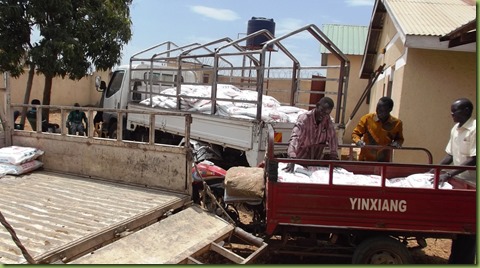
Last week our church partner, the South Sudan Presbyterian Evangelical Church (SSPEC), was busy distributing food through all of their congregations. When Pastor Philip opened the the shipping container and I saw the long rows of 10 kg sacks, I was truly amazed. How would they distribute all of these? Three different congregations came that morning, two with a rented truck, another with a small utility vehicle. I could see joy on their faces in the midst of the sweat as they loaded the heavy sacks. Sacks of corn flour and lentils were carefully counted, with more than a hundred sacks going to each congregation.

SSPEC food dist Pastors Philip and Lado at containerThe shipping container at the church headquarters
that was filled with sacks of flour and lentils.

In Juba, SSPEC bought more than a thousand sacks of corn flour and several hundred sacks of lentils. Funds were also sent to around twelve different locations around South Sudan where there are groups of congregations that will also purchase and distribute food.

SSPEC food dist Trucks loading at office

Loading trucks to take to the congregations

On Sunday, I worshipped at the Lologo congregation, and got to witness their distribution to the congregation. After the service, people waited patiently until their name was called and they were given their distribution. Bags of lentils were divided between families by joyful mothers. Neighbors around the church and those in the community known to be particularly poor were also called to receive a portion. Even young people who attend the church without their parents were given a full portion for their families.

SSPEC food dist Lologo giving out foodThe Lologo congregation distributing sacks of corn flour to members


SSPEC food dist Lologo dividing lentils

Dividing lentils into portions for each family

I talked to two women as the collected their food. Christina Odiel, 40, is a widow with five children. She used to have a job, but said that now she is not working. I asked how she survives, and she said that she depends on help from others to eat. Later, on the way home I asked Pastor Philip how someone could survive like that. “Allah kariim” (God is generous) – he said. “You will find that a lot of people survive like that in South Sudan – they survive by “Allah kariim”. Somehow God provides. The other woman, Rosalyn, has seven children, the youngest of whom is 8 years old. Her husband is alive, but he married a second wife and left her on her own. She said that many times she and her children go the whole day without eating anything. She makes crafts with beads and sells them, but often she does not sell enough to buy food. She said that this flour and lentils will last her family a few weeks because they will make it stretch by not eating it every day. Both women expressed their appreciation for those who sent the support for this food. They pray that God would increase the help and resources to those generous people, so that they would continue to help others.

SSPEC food dist Lologo two women with food

Christina and Rosalyn with their food allotment

We grieve over the man-made famine in this fertile country and the suffering that results from the insecurity in the country. So many people are displaced from their homes because of fighting, and have had to leave their fields or work. Others are in their homes but rebels or raiders have plundered their fields. Millions are living in UN camps within South Sudan or near its borders. They are given food, but usually it is not enough to feed their families for the whole month and people still go hungry. A recent UN report says that more than half the population are currently “extremely food insecure”. The general population is really suffering from the ongoing conflict and insecurity in South Sudan.

But in the midst of the suffering, I have heard so many expressions of thanks from South Sudanese for the people that generously help them and care about them in their suffering. Shenango Presbytery in Pennsylvania is one of SSPEC’s partners who seeks to connect in meaningful ways and share together in the work of God’s Kingdom. The congregations of Shenango gave generously and collectively to the effort of providing food relief in South Sudan, as a way of showing their sympathy with the suffering of their brothers and sisters in a distant land.

SSPEC food dist Lologo boy sitting on sacks

A young boy waits for his mom to return for their food allocatio

Wednesday, February 28, 2018

The Face of Suffering


Here we are, into the third week of the semester and it is going well.  What a gift and a pleasure it is to get to know my students and fellow faculty members.  Most of the students, and even faculty, have been displaced multiple times over the last three to four decades.  The fact that our students are still persevering in their studies and now preparing to more fully serve their congregations, denominations and communities is a marvel.  Sometimes I feel like I need to take off my shoes before them, for their lives are truly holy ground. 

The first week of my Church History I (Pre-Reformation) class we discussed how Christianity provided a salve to so many living under the tyranny and impersonal realities of empire during the first few centuries, so many uprooted from their home regions, losing touch with their families, their roots, and their worshiping communities.  The displaced masses were spiritually hungry for a faith that would give them “self-respect,” which Christianity provided.  One of my goals in teaching this course and other courses is connecting the “Big Story” of the subject with the individual and collective stories of my students.  As we discussed the issue of displacement and slavery in the first century during that first week, one of my students, Paulino, shared with us how his grandmother was stolen from her village and taken into slavery.  This testimony served as a stark reality check for me, hearing from one of my students how his family had suffered so egregiously.    

The eminent St Josephine Bakhita is the patron saint of victims of slavery
Image: CNS (Catholic News Service)

The following Monday, as we were about to begin our Contextual Theology class, Rev. John*, one my students, pulled me aside to share some terrible news.  Rev. John pastors a congregation across town where I have visited a few times and preached.  He shared with me how within the last week or two people from his home region had greatly suffered due to the ongoing civil war.  The village and church center of his birth were attacked and twenty two people were killed and sixty three were injured. Among those slaughtered was his mentor in the Christian faith.  Moreover, he told the story of a young mother who went to the river to hide from the soldiers.  In the process of hiding she lost her twin babies to the swift current.  Beside herself, she went and hung herself.  Pastor John then told me how on Sunday, during worship, people could not pray for peace because their hearts were so burdened and filled with pain.  This morbid report is the news I received minutes before teaching…can you imagine? 

The Face of Suffering
photo from World Vision

Last Sunday I went to visit another church where I was invited to preach, a congregation filled with members of the tribal group on the other side of the current breach from that of Rev. John.  In my message I tried to help the congregation acknowledge their pain and to publicly acknowledge that they have really suffered; their deplorable situation was described to me before visiting.  To a person, almost everyone in this congregation has been displaced from their home region, their land occupied by a warring faction and all their cows taken.  My friend, Rev. Abe, with whom I teach at NTC, told me that he himself had lost one hundred cows.  For two of the tribes in South Sudan, the Dinka and the Nuer, cows are central to life.  Cows serve as dowry and are like a bank account.  To lose one’s cows and to be removed from one’s land is to lose everything. 

The face of suffering we see and hear about on an almost everyday basis is almost too terrible to bear.  Sometimes it just feels like too much.  Lord, have mercy on Your people here in South Sudan.     

*Rev. John is a pseudonym to protect the identity of the person whom I cite. 


Monday, January 29, 2018

Lament for South Sudan

God most High, who designed this earth in fine detail,
You blessed this fertile land and formed the peoples who call it home.
We see them laugh, embracing life, teeth gleaming white against night-dark skin.
Ornate beadwork and bright flowing robes distinctly mark their tribe.
They are always eager to welcome a stranger with a meal.
Tall, strong people, their courage proved by the deep cuts of the knife in their youth that leave the scars across their forehead.
Some tilled fertile land to abundant harvest or plied the web of rivers rich with fish.
Others raised their boys to follow the cows – perhaps hundreds, kept without fences because they were affectionately known and cared for.
Lord, we celebrate these beautiful and diverse peoples in the land of South Sudan,
Surely you blessed them by giving them this land.

The tribes together endured the long years of war with their northern neighbor,
oppressed and forgotten as power changed hands.
They cried out to you, God, earnest prayers of united hope,
While working and fighting for years on end.
You answered their prayers, rescued them.
Independence at last, and freedom from oppressor.
“We praise and glorify you for your grace on South Sudan”,
declare the opening words of the national anthem.
You answered prayers – surely peace had finally come.

Lord, we cry to you – we trust in you;
You alone are our salvation, you alone are our hope.

Lord, did you turn away just as South Sudan rejoiced?
‘Uphold us united in peace and harmony’, people sang at national events;
But inner turmoil quickly soured the barely tasted peace.
Cattle raiding, revenge killing, child abductions, ethnic cleansing;
People are fleeing, weeping, hiding, dying.
Forced from home, waiting in camps for elusive peace;
New enemies now– hunger, cholera, poverty, despair.
A fresh agreement signed by factions, but hopes dashed when hostility resumes.
Lord, where are you now?

Lord, we cry to you – we trust in you;
You alone are our salvation, you alone are our hope.

Lord, do you see your children here?
Susan, a widow, scrubs floors and washes clothes,
But does not earn enough for her son to go to school.
We watch boys wearily pick up their cardboard mats in the early morning,
building a fire out of trash to warm themselves. They left their families – because of hunger? Or war?
Or pushed out when poverty weighed down and parents needed someone to blame.
Eager young children want to go to school –the future of South Sudan, people say.
But long months without pay make teachers desperate –
they refuse to teach, or withhold the reports that allow students to start a new year.
Prices climb higher, but salaries don’t, as the currency slides.
Now the sack of flour that feeds ten days takes the whole month’s lot.
Even the soil heaves a sigh and shudders from the struggle,
Farmers too afraid to plant because of raiders lurking near.
Lord, we know that you see the suffering, you care for the poor.
Why do you let this continue? Will there never be relief??

Lord, we cry to you – we trust in you;
You alone are our salvation, you alone are our hope.

God, you created this mosaic of peoples, you called them good.
You gave them faith that perseveres, that continues to call out to you.
In spite of the greed or power or disregard from their leaders,
The people low in the world continue to hold up this land;
As they gather to worship and pray for peace
They are the hope for South Sudan.

Lord, we cry to you – we trust in you;
You alone are our salvation, you alone are our hope.

Saturday, December 2, 2017

“College Day” at Nile Theological College

 A festive quality filled the air.  The large tents were erected by students and faculty for this special, annual occasion.  We were gathering to celebrate the 26th anniversary of the founding of Nile Theological College (NTC).  Our small contingent of mission co-workers showed up close to eleven in the morning amidst a flurry of activity.  In attendance were alumni, faculty, former faculty, esteemed guests and the student body.  A local choir led us in song, filling the tent with vibrant sounds and distinctive Arabic praises.  The theme verse for the day, emblazoned on the banner upfront, was from Paul’s letter to the Philippians.  Amidst all of the adversity the Apostle Paul faced, he boldly proclaims, “I can do all things through him who strengthens me” (4: 13). 

"College Day" at NTC, Rev. Santino, (Principal) speaks

Gathered together under the big tent


Perhaps this theme reflects well the journey of Nile Theological College, particularly over the last six years.  From their origin in Khartoum, a second campus was planted and developed in Malakal in the Upper Nile State in 2011 .  This initiative was a labor of love, establishing this institution in the newly created country of South Sudan for the purpose of training future leaders who will serve their congregations and communities.  Yet, the new school would be destroyed as fighting erupted in late 2013, lasting well into 2014, and continuing even to this day.  The new campus would relocate to Juba where scattered students and faculty would find each other once again.  The faculty asked the handful of few students, “What should we do?  Should we reopen?”  The students replied “Yes, it would be good to reopen.”  Thus, with only five students, the school reopened in early 2015.  In these two years, with two new intakes, the student body has quickly grown to more than seventy.  It feels as though God’s Spirit is at work.  Most of these students have been displaced from their home regions and ten of them currently live in Internally Displaced Person (IDP) camps in and around Juba.  Most of them face challenges communicating with family who are either in refugee camps in Ethiopia or in rebel controlled regions of South Sudan.

Bill, a doctor who teaches about HIV/Aids at NTC,
raises his hands in praise

During the anniversary celebration last Saturday, we heard from many different voices.  A representative of the Student Union spoke along with a distinguished alumnus who is now serving the Africa Inland Church (AIC).  A faculty member then preached a message from Philippians, making the point that the Arabic Bible uses the word ‘Abd’ for Jesus in the well-known Philippians two passage.  While many English translations use the word servant, ‘Abd’ in Arabic means “slave.”  He compared our service to that of Jesus, who emptied himself and took the form of a slave, impressing on us that the Spirit presses one to serve, even as a slave is compelled to serve his/her master.

Rev. Samuel Jok, who teaches Sudanese Church History at NTC,
preaches from Philippians 4: 11 - 13

The celebration continued with worship through song and remarks from the academic dean, the former principal, the current principal, the chairman of board and a representative from the government of South Sudan, the Honorable Rebecca Joshua Okwaci.  Rebecca and others gave tribute to her father, a leader in the community and church and one who greatly encouraged many.  Rebecca spoke at length, citing the depth of the riches and wisdom and knowledge of God – how unsearchable are his judgments! (Romans 11: 33).  She herself volunteered to meet some of the needs expressed by the student representative, and encouraged us all to do whatever we can to strengthen and help this institution.  She spoke passionately, fluent both in Arabic and English. 

 Rev. James Partap, Chairman of NTC, pictured with
Honorable Minister Rebecca Joshua Okwaci and
Honorable Minister Yien Oral Lam

Rev. Peter Gai Lual gives the closing words and benediction
he shared that though he felt pain in his body, he stayed for the
duration, sensing God's healing presence in the gathered assembly

Our time together came to close with a nice meal and time of laughter and fellowship.  It was wonderful to be part of this celebration, giving thanks to God for twenty six years of equipping and preparing leaders for the manifold works of God.  May God’s hand of grace and mercy continue to rest upon Nile Theological College.         

Students enjoy the meal under the tarp


Saturday, September 16, 2017

Sitting with Suffering

We Americans have many natural gifts and talents derived from the strengths of our culture.  We are good “fix it” people.  If there is a problem, we are right on it.  A natural disaster happens, a flood, a hurricane, and we have already mobilized first responders even before the catastrophe happens.  Months and even years later we give money and our time to help those in need.  We are creative problem solvers who cannot live with intolerable suffering in our midst.  On the other side of the pendulum, on the negative side, lies our propensity to shield ourselves from the pain of others, because often we cannot identify with their suffering.  When someone we know is in pain, we may try to placate the situation with statements such as – “Just give it time, things will get better soon enough.”

We, Americans, are good at "fixing things," but not always
good at sitting with suffering


Having lived in places like Rwanda, Congo, and now South Sudan, I have come to realize that our American propensity to fix things and to avoid pain with polite half-truisms will only take one so far.  What happens when the problem can’t be fixed, or be fixed expeditiously and efficiently?  What if time isn’t enough to heal generational wounds?  Here in Juba, South Sudan, it feels like every day we are bombarded from all sides with needs.  Every time we step out of our building we are accosted multiple times by men, women, and young children who have the look of hunger and hopelessness in their eyes.  They ask for a handout but obviously they need so much more.  How can one “fix” this problem?  What words will ever be enough?  Last week Susan, one of the cleaners of our building, came up to Kristi and grasped her hair, saying, “God must love you White People.  He gives you nice, soft hair and a good life.  God must love you more than the rest of us!”  Kristi, understandably, was at a loss for words.  How does one respond to such an honest lament?  How does one respond to the inherent injustices of our world, a warped world which favors some to the exclusion of others?

Two years ago I was asked to provide time for theological reflection for a divinity student named John who had come to Congo on a summer internship.*  Every few weeks John and I would sit down and reflect together on what he was seeing and learning.  In one particularly poignant session, we reflected on the nature of suffering.  John told me that the suffering he was confronted with in Congo made him want to turn and run.  The suffering John was witnessing was simply intolerable to his American, white, middle class sensibilities.  Yet, as we sat together with the Scriptures and in a posture of prayer, we came to see that Jesus was unique in that he was able and willing to sit with people in their suffering.  He did not turn and run from them.  This theological reflection became an object lesson for both John and I, that sitting with people in their suffering is a form of ministry, even when we are unable to fix their pain and don’t have the words to make things better.      

This lesson has become even more poignant to me on a deeply personal level over the last three months as I have been diagnosed with the Epstein-Barr Virus, an illness which has rendered me weak and tired, an illness which lingers and can last months and even longer.  It has been difficult for me and others to understand that this sickness has no medicine and no defined time frame for improvement.  It feels like there is no real "fix" to this ailment - just time and rest and a good diet.  I am thankful for many of you who have expressed both lament and support through this period.    

Beyond my own ailment, so often I feel rather helpless here in South Sudan.  I cannot fix the multitudinous problems and my words will never be enough.  What I can do, as I am learning even from my own situation of pain, is to simply sit with people in their suffering.  I can bless and serve them by looking them in the eyes and seeing them as human beings worthy of dignity and honor.  Of course I can also pray for healing and change and seek to find long term solutions, but perhaps what is most needful in the moment by moment realities of everyday life is to just accompany people, sitting with them in their pain, and being present to them with their questions.  Sitting with suffering, I believe, is what God is calling us to do, above and beyond what our cultural instincts might tell us.  Lord Jesus, may we heed this call. 

*John is a pseudonym for the divinity student mentioned.