Showing posts with label Language learning. Show all posts

Saturday, January 13, 2018

Afternoon tea

Come along with us back to our neighborhood tea stall. It is late Tuesday afternoon, when the heat is just starting to lessen but still 95 degrees in the shade. We pick our way over the ruts and trash in the dirt alleyway of the market to where there are some chairs set up in the shade along a wall. This spot is the afternoon location for Mary’s ‘mahel shayi’, or tea stall. In the midst of greeting Mary, I hear someone yell “Kristi!” and see a shape come flying towards me. Mary’s daughter Fonfon, about age 9, runs around the corner and wraps her arms around me in an exuberant hug. She is with her sister and cousin, and we exchange greetings and congratulate her on the recent award she won for being the top student in her class.

Then we go and greet each of the three men sitting in the chairs, sitting down ourselves at the end of the row. We exchange greetings with Mary, asking about her other children and family. We order our tea – Bob, hibiscus with ginger, and me, green tea. Mary teases, asking if I drink green tea because I am on a diet as she turns and goes to make our tea. Perhaps it is the Arabic culture and Sudan to the North who have passed to the South Sudanese the habit of drinking hot tea even on a hot day. People in Juba can drink tea all day long, and it is one of the most common small businesses for women.

We notice Bushara, another regular at the tea stall, standing a few paces away at his table, set up in the alley where he is repairing electronic devices like cameras and printers. Bushara is a basketball coach, and we have seen him a few times at the basketball stadium with his team as we pass by on our walks in the neighborhood. Bushara likes to talk to Bob about NBA basketball; he is a fan of the Chicago Bulls, but concedes that they aren’t very good. Somehow we start talking about his time in Khartoum many years ago. He tells us how while in the army, when they issued him an ID card, they marked his religion as ‘Muslim’ because of his name. When he told them he was a Christian, they mocked him and started making life difficult. One of the reasons many Southerners left Khartoum was because they were persecuted there for being Christians. But then Bushara also tells us about a girls basketball team in the North who prayed and worshipped together and had great faith. “They won,” he said, “because of their great faith.” As Bushara animatedly tells his story, we struggle a bit to follow his Khartoum sounding Arabic, able however to get at least the sense of the story. “People used to have faith here, Bushara continues “but then with the war and the economic crisis, it is no longer like that. People just want money.” Like so many others, he laments the current struggle in South Sudan.

As we talk with Bushara, Santino, a stately older gentelmen who is another regular, walks up with another man. They greet everyone and find chairs in the middle of our row along the wall. His friend asked our names and how long we have been in Juba. “About seven months”, Bob replies in Arabic. “No, seven years!” he adamantly replies. “No, seven months,” Bob says again. “Not possible.” the man insists. “You can not speak Arabic like that in seven months.” We laugh, and ask Santino to vouch for us that we indeed came to Juba just last year. Before leaving, we learn that the man is actually Santino’s younger brother, which means that he is of the same tribe as Santino. Bob has intentionally learned some greetings and phrases in some of the local tribal languages and greets him in Bari. “Oh, you speak Bari?” the man replies in Bari. This, of course, is beyond what we know in that language, and we are befuddled. But Bob, always eager to learn, has him repeat the phrase until he can write it down and repeat it.

Finally, after an hour of talking and drinking tea, we get up to leave. We are grateful for these familiar and friendly people who help us feel connected in the community and who help us as we practice and learn Arabic. We wish that we could show you a picture of this wonderful place of hospitality, but we do not take pictures in public in Juba because it often makes people angry. So, you wil lhave to imagine from our word picture, and give thanks to God with us for these inspiring and helpful people that we drink tea with in the shade. 

Friday, September 22, 2017

Home visit

We have really enjoyed getting to know our Arabic teacher, Elder Charles Peter during our lessons. We hear about his family, his neighborhood, and his work as a missionary, showing the Jesus film and preaching in various parts of town. In Africa you don’t need to wait for an invitation, so one day we told him that we wanted to visit his home. “Wonderful!” He replied in Arabic, “My wife will make kudra for you. It is delicious!”

Last week the big day came. We took two different buses out to Gudele, a district near the edge of town. We met him on a busy street corner, and then took a rickshaw (a three-wheeled covered contraption that holds 4 people) down a dirt road until we reached his neighborhood. Then, a short walk, where we were thrilled to see grass and flowers along the sides of the road and streams that bisect the road (and swell to make them impassable when it rains). In the middle of town where we live in a 4-story building, we are a little starved for nature, so it felt very refreshing to be reminded of what a more typical neighborhood looks like.

Bob and Charles on the road in Gudele - Enjoying the green!
When we reached the house, we met his wife, son, nephew, and a few neighbors. We were ushered into the
house, and we enjoyed the chance to finally talk with his wife who we had heard so much about. We looked through pictures from their wedding and early years together. We heard more of their experience in Malakal in 2013, when war erupted and they were forced to flee, leaving all of their household possessions to be looted by the invading soldiers. They lived in a UN camp for a few weeks, sleeping under only a tarp, until a friend helped to evacuate them to Uganda. They returned to South Sudan because of a commitment to God’s work here, and their persevering hope and sacrifice to make the gospel known is humbling. Most of our conversation was in Arabic, which meant that sentences had to be repeated sometimes or new words clarified, but still a victory to be able to connect meaningfully in our new language!
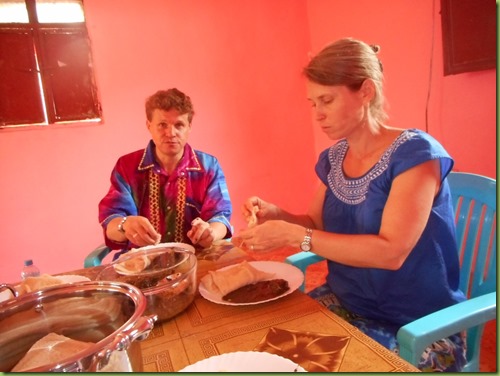
Then, lunch was served and the awaited kudra was brought in. Kudra are leaves that are ground and cooked to make a thick green soupy mixture, often with chunks of meat included in it. In Juba kudra is eaten with a starch like kisra (similar to Ethiopian injira) or asiida (like ugali in East Africa). Charles Peter was right—it really was delicious, and Mama Wigdan was vigilant to make sure that our plates were never empty until we were stuffed and protesting that we couldn’t possibly eat any more.

Eating kudra for the first time – a favorite dish in South Sudan
After that great meal, we realized clouds were gathering and we should start the journey home. Charles accompaied us back to the main road, rode the first bus with us and even paid our fare on the second bus back to our part of town. With Bob’s energy still low because of the virus, big outings like this feel very special and appreciated. We felt so grateful for wonderful people like Charles Peter and Wigdan who exemplify to us the warm hospitality of the South Sudanese people.


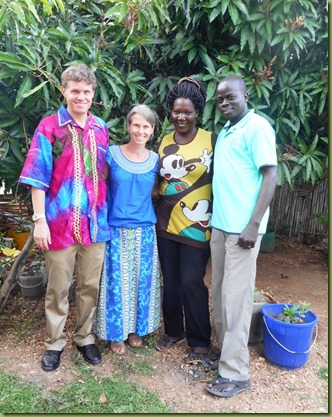
With Charles Peter and Wigdan, at their home

Wednesday, September 6, 2017

Learning, like little children

I am repeatedly reminded of the similarities between us as language learners and very young children as they are learning to talk. When we walk the streets of Juba and greet someone we know, other heads turn in amusement. “You speak Arabic?” they ask. When we say yes, we are learning Arabic, people are excited, and often want to quiz us on what we know. One fruit vendor pointed to different fruit “what is this? And this one?”, celebrating the ones I knew and correcting the ones that I had forgotten. And then they might rattle off some question that we don’t understand at all. When we ask them to repeat and slow down, they happily comply, simplifying the language so that we are more likely to catch the meaning.


We enjoyed a long talk in Arabic with Santos about life, family, and farming –
using lots of gestures and props to help when words were lacking.

One of our favorite places to practice has been Mary’s friendly tea stall across the street. The tea stall only has room for about 8 people, all facing each other. It is a great atmosphere for conversation, and often everyone gets engaged in the conversation. It is rather humbling and embarrassing when other conversations stop as people ask about why we are in Juba, where we are from, etc. We have met some wonderful people and patient teachers on our random visits there. Many people patiently repeat what they are trying to communicate or help to correct our pronunciation—just like you might for a two-year old. When we manage to use a word or phrase that is an idiom, or is perceived as beyond our beginner level, people laugh and exclaim and praise us—just like you would for a precocious young child. And then, of course, there are the times when people talk ‘over’ us, conversing about us while we are left guessing what they are saying. Or going back to their ‘real’ conversations while we listen and observe and just guess at what they are discussing—just like children overhearing bits of the ‘adult’ conversation!
Mary, making tea for us at her tea stall

Most people we encounter are amused and affirming of our desire to learn Juba Arabic…even when we make mistakes. When we are trying to say something but have the words bumbled up or the wrong pronunciation, they are patient with us as we search for words or try to explain until they finally understand and laugh at our mis-pronunciation or wrong words. We are grateful that we can provide some amusement, and also grateful that people are willing to be patient with us and help us learn…just like adults do for young children!

And we DO make plenty of mistakes. Here are a couple of our recent faux-pas.:
During a language lesson, Bob got  call from a man who wanted us to come visit. “Let me talk to Kristi”, Bob said in Arabic, and then meant to say “then I will call you back”. Except that the word “call” in Juba is the same words as to ‘beat’ or ‘hit’ something. So without the right conjunction, what Bob said was “then I will beat you”. Our language teacher, listening to the conversation, corrected him and then burst out laughing at the difference. Lesson learned!
I was sitting outside with two women, Umi and Mary, one evening. I mentioned an area of town where we had visited a church, called in Arabic “the Arab neighborhood” because historically there was a concentration of Arabs there. Except that I did not remember the name correcty, and instead said, essentially, “The neighborhood of the long white robes”. Similar word and similar concept, but they found it a rather amusing slip. Umi roasts and sells pumpkin seeds on the street, so she offered some to Mary and I as we chatted. I was happily chewing mine, when Mary asked me “Kristi, where are your shells of the seeds?” I realized then that she was spitting them out, and I was swallowing them. Oops! They laughed again at my naivete, but I am so grateful for they were willing to point out my mistakes and help me learn.
It feels like this is a sweet ‘period of grace’ in our language learning. After three years, we will no longer be the novel new people, and will not be shown the same grace and patience with language that we are today. We hope that with the help and correction of many ‘elders’ around us, we will improve and mature in our ability to communicate in Arabic.

Saturday, August 26, 2017

Meeting the Neighbors!


Last Sunday we decided to take our daily evening walk in a different direction.  On the way towards one of the shops we frequent we saw the smiling face of Adil, the shop owner.  We stopped to chat and before we knew it, he invited us to his home!  Then we saw the butcher of the shop, Anwar, trailing close behind.  The four of us walked the short distance to their home, learning that Adil and Anwar are brothers and live together.  Entering the compound of their home was surreal.  It felt more like an open air boarding house for young migrant workers.  We saw several other workers from the shop/butchery and were surprised that they all live together.  Being in the relaxed environment of their home was a pleasant experience.  Most of them donned their “Jalabia,” the long flowing white robes which conjure images of Middle Eastern life.  They gave us sodas to drink and peanuts and other snacks to eat.  They took out their phones and began taking pictures with us all together as we laughed and enjoyed this serendipitous moment.  All of these men are from Sudan (the neighboring country to the north) and their families and children all live in Khartoum, the capital city.  One of them whom I spoke with returns once a year for a couple of months, which is probably more or less true for all of them.  

Picture taken with Abdulafat (left) and his brother who
sent us this photo from his phone via WhatsApp

Before leaving, Anwar gave us a tour of the place, leading us back to Adil’s room, the only fully enclosed room on the compound that we observed.  Adil is the elder statesman of the group, a wise and affable looking fellow who will soon be travelling back to Khartoum for the big feast of Eid al-Adha.  Adil has a nice room with a couple of beds and a television; when we entered his room he was watching an impressive prayer service from Saudi Arabia.  He took out a small bottle of cologne and began spraying us with it – commenting on how nice it smells! 

Walking in the other direction on most evenings we have met Ismael, Adam and Naem.  All three are young men and live near each other and possibly work together repairing cars.  Ismael’s father died and his mother and siblings live in Khartoum.  He is of the Dinka tribe and is originally from a place called Bor.  Adam, his friend, is from Darfur.  Naem, whom we have met twice now in the last week, lives with his son and mother and other children related to their family.  His mother, Helen Frederick, is a dignified looking woman who calls us “her children.”  She has invited us to come and visit her in her home sometime.  Ismael and Naem have invited us to join them for the upcoming feast commemorating the sacrifice God provided in place of Abraham’s son.

A significant component of our language learning methodology and philosophy is learning language in community, not in a classroom.  We don’t have a language teacher but rather a “language helper,” and our goal is to learn with him on a regular basis, but then to be “out and about” listening, learning and speaking with native speakers of Juba Arabic and Sudanese Arabic.* 

Each person whom we have named in this blog post is Muslim. It has been interesting how we have connected with several Muslims in our neighborhood in the process of language learning.  While the Arab/Islamic influence from the North is indeed strong, South Sudan is a predominantly “Christian” country, in that most of its citizens would ascribe to being either Catholic or Protestant.  South Sudan is the only Arabic speaking country in the world which is majority Christian.    

We are enjoying building these relationships in the community and thankful for these new Muslim neighbors and friends.  Here in South Sudan there is a great deal of acceptance and grace given to one another across the religious spectrum; there are even inter-religious marriages between Muslims and Christians.  In a world that is becoming increasingly polarized along national, ethnic and religious lines, we are grateful for the opportunity to build bridges with our Muslim sisters and brothers.  Pray that we can continue to find ways to bless one another!

*Sudanese Arabic and Juba Arabic are two distinct languages, similar but different.  Sudanese or Khartoum Arabic is closer to the Classical Arabic of places like Egypt and Saudi Arabia.  If one knows Khartoum Arabic, one is able to speak more widely in the Arab world.  Juba Arabic is a creole or pidgin.  It is a language unto itself yet does not have an official status, not even in South Sudan.  It is widely spoken and understood here in Juba and throughout much of South Sudan, particularly the Equatorial regions. We are primarily learning Juba Arabic, but also picking up some of the more classical words and expressions as well.    


Saturday, August 5, 2017

Taking the plunge

This week we worked with our Arabic helper to create a ‘text’ for a conversation about family. We learned to briefly introduce each other, say that we have no children, and describe our families in the US. We then would ask about the other person’s family – are they married? Do they have children? Are their parents living, and where? Do they have brothers and sisters? We recorded our language teacher saying all of this, so that we could listen to his pronunciation when we practiced and mimic it. We rehearsed with each other, pretending to be various people. All of this working up to going out in the neighborhood to practice.

But going out in the neighborhood to practice a text feels intimidating sometimes. Will we draw a crowd? Will I understand what people are saying to me? Can I make this a real conversation, not just repeating memorized lines to get through it? So this morning we prayed that God would lead us to the right people, and make this an encouraging experience. And we reminded ourselves that our goal in learning Juba Arabic is to connect with people – to be able to communicate and understand them.

As we headed out this morning, we saw Mary, one of the ladies who cleans our apartment, as we were going down the stairs. We asked if we could talk to her about family, and Bob launched into the text. People passed by on the stairs and some of the security guards came to join the conversation. These are people we know and see regularly, and all of them are excited that we are learning Arabic, so it was an encouraging place to start.

Kristi with two women who work in our apartment building – our favorite conversation partners!

Then, we took the plunge, heading across the street to an outdoor market area. We were able to engage a few of the venders, learning their names and now learning a little about their families. We found Mary, a woman we had met before who has a tea stall, sitting with some of her customers. Once we started greeting them in Arabic, we were kind of a novelty and they were eager to talk. We introduced ourselves, and began our discussion about family. Some responded with long explanations about what their children were doing or the challenges of life, and we were quickly lost. We’ve only been studying Arabic for a whopping three weeks now!

We decided to stop for tea at Mary’s stall. This provided an opportunity to get to know her a bit more. As we sipped our tea and coffee, other customers came into the stall, and joined the conversation. Bob was able to talk to a policeman who sat next to him, who is based at the police station right next to our apartment. Mary does not speak English, but we were pleasantly surprised at how much we were able to understand with our limited Arabic. As we ask people about their families, we are often confronted with the hard reality that many of their family members have died in South Sudan’s long conflict, or that their children or siblings are far away, living in a refugee camp. But hearing those sad things from an individual puts a personal face on this tragic environment and helps us to come to understand the daily struggles people face here. We came back home after an hour encouraged and grateful that God had answered our prayers. Please continue to pray for good conversations and relationships as we go out to practice Arabic, and also for Bob’s energy to continue to improve so that we can go out more often to practice.

Friday, July 21, 2017

Seizing opportunities

We laughed as we greeted the staff of the small grocery store down the street, and they quizzed us on their names. They were excited to see Bob, especially, since he doesn’t get out to the store as often since being sick. Anwar, the butcher, came over from the adjoining shop when he heard our voices. They would rattle off a question in Arabic, then repeat it or simplify it for us until we could understand. They were excited that our Arabic is improving, and seem eager to help us practice and also impatient for us to be able to converse fluently.

Anwar grabbed Bob’s hand and led him over to his side of the store. Anwar is a large man with a commanding presence, who likes to laugh and joke. We had actualy intended to buy some meat and had just learned how to say a few types of meat used here (goat, sheep, chicken, beef). Anwar pointed to the different cuts of meat, explaining the names of everything. He also introduced Bob to the other staff, wanting to make sure that we knew everyone’s name. We were the only people in the store, fortunately, and all of us laughed as they asked us questions and tested our limited Arabic.

We finally settled on beef, and Bob successfully said the phrase we had learned “I want half a kilo of beef meat.” Anwar looked pleased that Bob was able to repeat the precise phrase he had taught him for ‘boneless meat of the cow’. Most shop keepers know enough English to use English with their prices, but we had just learned our numbers in Arabic, and were able to practice with the prices. Anwar offered to cut up the meat for us and put it in a bag. We took it over to the cashier (right next to the meat counter), and the cashier asked us “What do you have?” We realized he was asking just to test our Arabic, but we took the opportunity to say again “this is half a kilo of beef.”, and confirm the price “tul tul miya wa hamseen” (350 pounds).

We left the store, feeling grateful for the warm reception and the opportunity for some good Arabic practice. While Bob is still recovering and his activity is limited, we are trying to seize every oportunity to interact and practice what we learn in our lessons. This gives you a picture of one of those opportunities – please pray for good daily interactions, especially as we seek to build relationships using our new language.

Thursday, June 1, 2017

Detour

We felt like we were starting to know our way around Juba --finding things in the market, taking rickshaws, and practicing new phrases in Juba Arabic. We were reviewing our language learning books and preparing to start lessons this week with a tutor. And then a few physical/medical issues stopped us in our tracks and forced us to change our plans.

On our last evening in Congo three weeks ago, we celebrated with a nice dinner of fish. Bob ate his with bidia, which camoflauged a fish bone in his mouth until he felt it poking his throat on the way down. We hoped that the bone had not gotten stuck in his throat, but when he still felt like something was caught there two days later, it was hard to be sure. We saw a doctor as we passed through Ethiopia en-route to Juba, who said that there was no bone in Bob’s throat, but that there was some inflammation where perhaps the bone had poked him. He gave Bob some antibiotics and sent us on our way. Good news! Except that, two weeks later, Bob’s throat still periodically felt sore or clogged, and it was disconerting that it did not seem to be healing.

Just as we were wrestling with these thoughts of Bob’s throat, he started feeling very weak, achy, and tired. We went to the doctor in Juba, thinking perhaps he had malaria. The malaria test was negative, but the doctor prescribed the treatment for malaria anyway, given that it could be in the early stages.   He also examined Bob’s throat with a flashlight, but did not have any equipment beyond that to asses what was irritating his throat. After a couple more days of resting, praying for healing, and seeking guidance but not feeling any better, we decided to come to Nairobi to see a doctor and get more tests.
We arrived in Nairobi on Monday of this week, and saw a doctor and had a battery of tests on Tuesday. We are very grateful for the encouragement to come and get treated, for the reassurance of ruling things out or knowing what is going on physically, and also for the time and space to rest and recover. It is humbling to be forced to change plans and accept physical limitations. We had only been in Juba two weeks before suddenly leaving again for Nairobi. But sometimes being humbled and forced to change our timetable is exactly what we need to ensure that we depend on God and the people around us rather than just on ourselves. So we are waiting and trusting God to restore health and energy so that we return to Juba and to language learning. And in the mean-time we enjoy some ice cream, cool weather, and bird watching while we pass the time in the big city of Nairobi.
Amani Gardens Bob reading
Relaxing in the shade at the guest house in Nairobi
IMG_3891
We appreciate the lush trees and flowers at the Amani Gardens Guest House

Friday, May 26, 2017

Connecting through Language


The other morning Kristi and I found ourselves in a lively conversation in the doorway of our apartment with Isaac, one of the guards, and Susan, who cleans all the apartments on our floor.  What was striking about this conversation is that most of it was in Juba Arabic**.  It began with the basic greetings that we have been learning, but quickly shifted to new vocabulary as Isaac and Susan saw pictures of our families on the wall mounting and began pointing fingers and asking questions.   We quickly learned the word for father, “abuu,” mother, “uma,” and sister, “okut.”  Susan pointed to Kristi in one picture from 8 years ago, and I responded, practicing in Arabic, “My wife.” “You have two wives??”, Susan exclaimed, and we laughed and assured her that no, it was really Kristi in the picture. We then learned that Susan was one of three wives, and has 10 children.

Later that morning a colleague asked Isaac, “So are you now speaking Arabic with Bob and Kristi?”  While our Arabic is still quite limited, we are making a little bit of progress each day.  Yesterday I was literally overjoyed when I figured out, after she had just left, what Susan had asked me – “Ita rija kalaas?”  (meaning, “You have returned?”).  I just about jumped off the couch and shouted when I realized she had introduced the verb “return” and the perfect tense which ends with the word “kalaas.” 

While learning vocabulary and grammar can certainly be an arduous affair, it can also be fun as it connects us to the people we have come to live amongst and serve.  In so many ways language is about connecting with people.  Even as we go down to the small shops along the way to buy this and that, if we can greet folks and say a few things in their language, it builds instant rapport.  While many people here speak some English and we can technically “get by” with English in our respective work roles, the Arab influence in South Sudan is still quite strong, so learning Arabic will help us build relationships with those we rub shoulders with everyday and strengthen relationships with colleagues.  It also helps us as we travel around the city and shop. 

While we served in Congo, we had no choice but to learn the language of the people.  Learning and speaking Tshiluba and then French built a permanent bond.  We hope that a similar phenomenon can happen here.  Having learned Tshiluba and French gives us confidence in learning a new language, Juba Arabic.  Of course many African tribal languages are spoken here also – Anywaa, Madi, Bari, Shilluk, Dinka and Nuer to name just a few.  Sadly, it will be impossible to learn all the mother tongues of folks we will grow to love, but hopefully we can learn a few greetings and phrases from these languages as well, showing an interest in them as valued persons with deep roots in this place. 

So, with all that sharing about language, we close with the familiar Arabic blessing, “Salaam alekum.”  May God grant you peace.   

**The localized form of Arabic in South Sudan is colloquially called “Juba Arabic” – a pidgin form of Classical Arabic.