Wednesday, March 2, 2022

New house in Juba

One morning this week we watched the sunlight stream through the windows and listened to the birds sing and said "this is amazing! We are so glad that we are here!" Another evening, we sat outside in the moonlight with a cup of tea, enjoying the cool breeze and the gift of being outside. We have been in our new house in Juba for one month now, and are slowly more settled and organized.

Enjoying the morning light in our new house

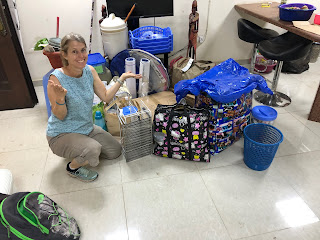
After 4 1/2 years in our previous apartment, packing up felt like a big project. Several friends and even one of our neighbors pitched in to help us transport our stuff 1 mile down the road to the new house. We were a little embarrassed at all the things we have accumulated in four years! 


suitcases and boxes ready to be moved. The piles kept growing!

We now are in a small pre-fab house - about the same size as our previous apartment, but divided into more rooms. This means that Bob and I each have an 'office', and we even have a spare bed. Anyone want to visit? We are still working on curtains and decorations, but we see progress! We have enjoyed getting to know some of our new neighbors, as well as people who are working in remote parts of South Sudan who pass through for a few days.


picnic tables and green space by our new house

One of the perks of our new location is that Bob can walk to work in about 10 minutes. We have also started taking more frequent early morning walks, trying to take advantage of the cool and quiet mornings for getting outside. Now we are hoping to find a neighborhood tea shop to visit, although we really miss the people that we met at Mary's stall in our old neighborhood!

We put up a sign over our door that says
beyt'a amin, "house of faith"

Sunday, February 13, 2022

Unexpected Blessings

Last month David Dach and John Odhong, my two research assistants, came to our home and we enjoyed warm fellowship over “franzowi,” coffee with heaping spoonfuls of milk power and sugar. We took time to catch up, each of us sharing the ‘one thing’ that most energized us and blessed us over the Christmas and New Year holiday. For David, it was the birth of his daughter. For John, it was the reconciliation that happened at church on Christmas Day. For me, it was the unexpected blessings I experienced through the persons I met and friendships I made during our time in Kenya.

Kyama Mugambi is a church leader, a scholar of world Christianity, a PhD holder, a teacher, and a graduate of Africa International University (AIU) in Nairobi, Kenya. We met for lunch at Java House, a popular eatery with multiple locations in Nairobi. We shared on a wide swath of issues, ranging from friends and family, to racism and systemic issues related to poverty and injustice, and finally to our respective research concerns. Kyama is earnest, thoughtful, articulate, and wise. He demonstrated an interest in me, sharing important contacts who could assist me in my doctoral research. Kyama also invited me as his “personal guest” to a PhD Seminar in early January whereby I could meet his mentor and friend, Professor Mark Shaw. Our two hours together went by quickly, and I was sad to break company.


Dr. Kyama Mugambi
Photo from ANVIL, a CMS online periodical
 
Being at AIU I was able to meet many wonderful people, from Káren who worked security at the library, checking my bag in each day, to Elvis who prepared tasty meals with creative flair, to Yolandè who is a visiting scholar from Central Africa Republic. When Abyot and I met in the PhD Carrels in the library, I felt an instant connection. Abyot is from Ethiopia and he is doing his PhD at AIU. Abyot and I sat together under the teaching of Professor Shaw for the PhD Seminar; we would encourage each other early each morning as we went running together. The day after our course finished, Abyot cooked a traditional Ethiopian meal for us as we celebrated Christmas together (January 6th for Ethiopians) and discussed his upcoming wedding in June; Abyot asked me for any advice concerning marriage. I was able to share some thoughts on the blessings and the challenges of marriage.

Abyot and I 

True to his word, Kyama put me in touch with Professor Mark Shaw and I was able to attend the PhD Seminar he taught. While the content of the course was wonderful, and some of it will undoubtedly find its way into my dissertation, the greatest blessing was meeting with Professor Shaw at Art Cáffe, a fun restaurant down from AIU which has the best “Dawa” (lemon/ginger tea) in Kenya. Prof Shaw took an interest in me, inquiring about our service in various countries in Africa to our current ministry and life in South Sudan. He responded to one of my vexing research questions with a thoughtful, sensitive, pastoral attitude. Being with him made me feel like I was in the presence of a caring father with whom I could pour out my heart and share my mind. From his gentle wave as he stood up, watching for me upon arrival, to his final goodbye, I felt the presence of a man dedicated to servants of the Gospel like myself.

AIU PhD Seminar with Professor Mark Shaw
(though I am a student at Stellenbosch University in South Africa,
I was graciously welcomed into this learning community)
  
Life is interesting. You never know who you will meet and where those interactions/conversations will take you. I am grateful for the “unexpected blessings” of new acquaintances and friends from our time in Kenya. Thank you, Lord.

Tuesday, December 14, 2021

Residents

One of the more arduous and frustrating tasks of life in South Sudan is keeping track of and renewing our visas, work permits, police registration, and alien registration. We are reminded often that we need the approval of various departments of the government in order to live and work here. Last week was another cultural lesson and test as we navigated renewing our visas.

Bob went to immigration on Friday to request one-year visas, expecting it to take one or two hours. We have renewed visas many times, so we thought we knew what was required. But when he arrived they gave him a long list of required documents that would be needed. As they discussed what was needed, Bob became frustrated by the sense that they were trying to convolute the process in order to get a bribe. But he decided he would bring the documents if that is what was required. A young man who had jumped in to help Bob through the process pulled him aside and agreed that the staff were not going to be satisfied with the added documents. The young man communicated with someone in leadership in immigration, and took Bob to him. David* assessed the situation, and then told Bob that instead of one-year visas, he could help us get two-year resident permits for the same price. Bob accepted this new path forward. They just needed a letter from our church partner requesting the permits and some copies of other documents.

Saturday morning, our colleague Rev. Philip wrote the letter from the church and we took it to immigration along with the other documents. We asked David at the office how long it might take – one hour? “More than an hour,” he said, “I’ll call you.” There was no phone call on Saturday, so Monday morning we call to check in. “Come around noon,” he says. Both of us put our plans on hold for Monday and head over to the immigration office at noon. When we arrive, we learn that he is at another office, and should be back in an hour. We go to a restaurant nearby and have lunch to pass the time. We call David and he tells us it will be another hour. We pass the time, starting to have doubts about this process. At 2:00 we call again and David does not answer his phone. We return to the immigration office and sit at a tea stall in the street, seriously doubting whether David is actually working on these permits and realizing that we have no documentation for the money that has been paid. Finally, around 3pm, an immigration officer comes out and recognizes Bob from his visit on Friday. Thomas* reassures Bob that David is at the head office and is working on our permits. Thomas is sympathetic concerning our doubts, and it feels like he is an angel sent to reassure us. Thomas shows us pictures of his family and his farm in the village as we pass the time. Thomas helps us finally get in touch by phone with David around 4pm, and we meet with David just as the offices are closing and arrange to meet at 10am on Tuesday.

Tuesday, 10am sharp, we show up and meet David on the street outside the immigration office. He explains that a director in immigration had a family funeral on Monday which all the staff attended, which caused his delay. He explains the various approvals and signatures that remain outstanding for our residence permits. We learn that David is also a pastor and he encourages us as a brother in Christ. He tells us that they will call us in the afternoon for fingerprints. We leave for some mid-day meetings and return in the afternoon. It is close to 100 degrees in Juba during the day, so we are sweating as we walk the dusty roads and taking the bus across town to and from immigration. Finally, after waiting a few more hours in the afternoon, we are called in for fingerprints at around 3:30. The office staff, helpful now that everything has been facilitated by David and they have seen us around for four days, inform us that all the signatures have been done and all documents are ready except for the ‘smart card’. We are told to come back in the morning to pick up everything.

Wednesday morning, Bob gets a call from Thomas to confirm that the smart cards are being printed and that everything should be completed soon. We go by Rickshaw to the immigration office, hoping and praying for a good conclusion to this process. Bob goes into the small room where our passports and documents are held and receives our passports with the new residence permits, smart cards, and receipts. He shares his appreciation and a parting word with the staff, using a Dinka phrase that he learned. Finally, the process is complete, and just a few hours before we are to board a plane for Nairobi!

Us with our new 'smart cards' that show residence status
(pic taken in Nairobi - notice our sweatshirts!)

We are grateful for many answered prayers and the people God sent to help in that unexpected process. Now we are officially residents…but still aliens. We were reminded of the value of seeking out our colleagues for help with these government requirements, something we failed to do this time. We were also reminded that we should always ‘expect the unexpected’ and be prepared to be patient. And mostly, we are reminded of our dependence on God to work out all these details and that the privilege of living in South Sudan alongside our colleagues is not to be taken for granted.

*Pseudonyms.

Thursday, December 2, 2021

Teaching One Another...

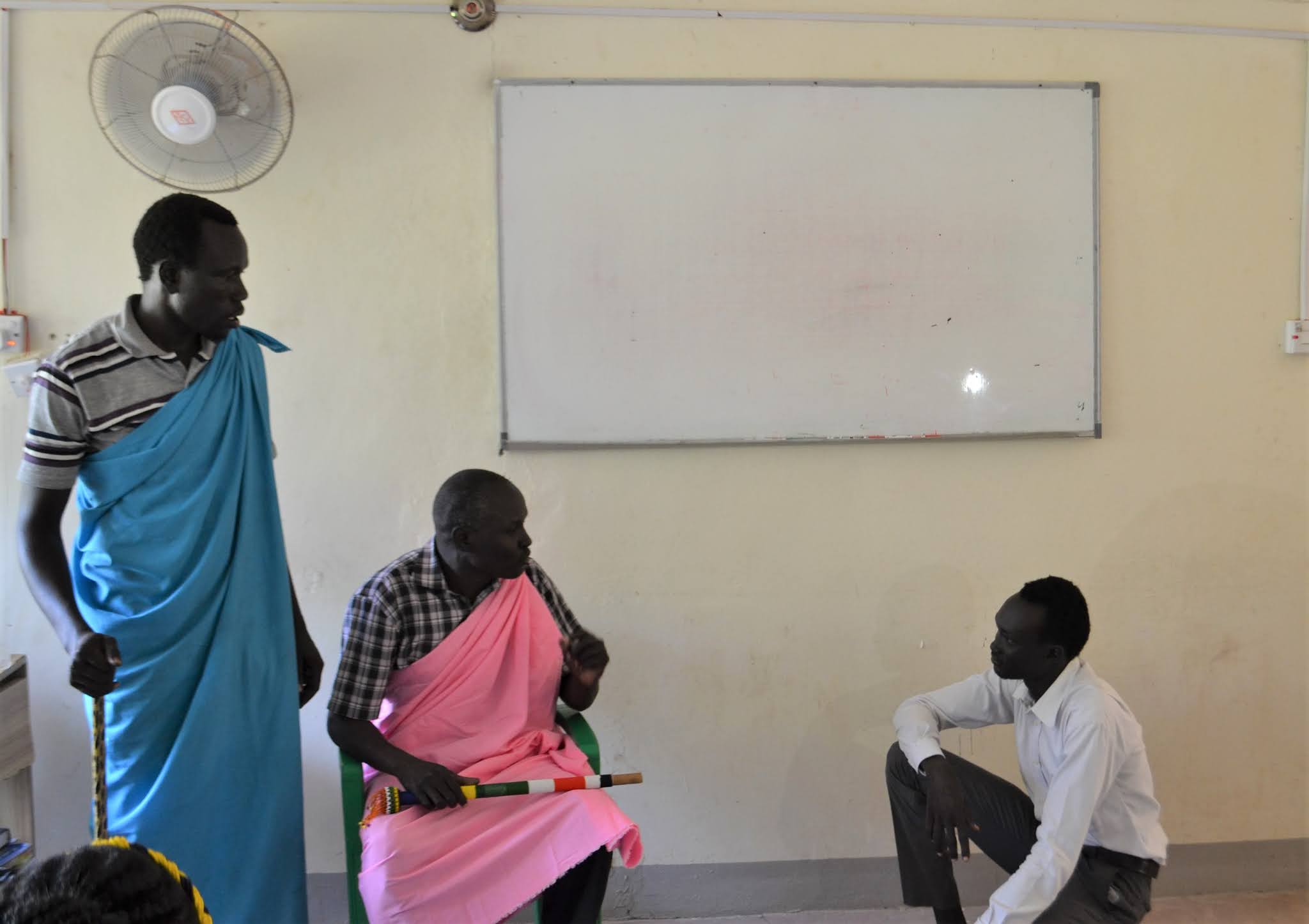
For the Church History IV (Sudanese/South Sudanese) course which I taught this semester, students gave presentation on the final day of class on notable figures and events from the last two hundred years in southern Sudan church history. Students created dramas, they sung and created songs in various languages, and they solidified in our hearts and minds many of the things we learned together over the semester, also teaching us things we did not know before. One of the final stages in the learning process is teaching, so I am so pleased to see my students as our teachers. The photos and descriptions below paint a picture of our time together.


Students dramatize the burial and funeral of Father Angelo Vinco, Catholic Missionary to the Sudan in the 19th Century. Chief Jubek of the Bari people, a rainmaker, far left, presides over the funeral which attracts 4,000 Bari people and lasts for eight days. The royal type burial for Father Vinco signifies the love the Bari people have for  Father Vinco, a dedicated missionary who learned the Bari language, provided reconciliation between warring clans and tribes, and killed a lion which was terrorizing the people. The students highlight the extraordinary self-denial of Vinco and his total surrender to Jesus, quoting the words of our Lord, 

"... unless a kernel of wheat falls to the ground and dies, it remains only a single seed. But if it dies, it produces many seeds" (John 12: 24).


With the legacy of Arab slavers from the North, the Moru people had good reason to be suspicious of Dr. and Mrs. Kenneth Fraser when they arrived in Moruland. Yet, after winning the confidence and trust of one of the local chiefs who became their staunch advocate, as demonstrated by the student drama pictured above, Dr. Kenneth and Mrs. Eileen Fraser were able to conduct a holistic ministry far and wide of physical healing, teaching, and sharing the Good News of Jesus Christ. Moreover, they brought unity to a scattered Moru people who had been living in fear of one another and of outsiders due to Arab invaders. Because of Dr. and Mrs. Fraser, the Moru people have developed a reputation even to this day as healers (practicing medicine) and as self-starters and initiators of development projects in their region. As Roger Sharland writes in the book "Gateway to the Heart of Africa," it is almost universally understood among the Moru peoples themselves that it was "the love and dedication of Dr. Fraser and his wife Eileen that made the Morus become Christians."


Archibald Shaw was one of six Church Missionary Society (CMS) missionaries to arrive in Malek, southern Sudan, in the early 20th century. Two years later, Shaw was the only one remaining due to his "stickability" and his fierce love for the Jieng (Dinka) people. Unlike the others, Shaw recognized that the Jieng people needed patience, love, and humble service. 

In this photo, students dramatize Shaw humbly going before a local Jieng chief asking for a cow that had been stolen from his herd. The chief, in this case, chose not to administer justice to Shaw, a foreigner, whose hip was subsequently broken in a wrestling duel with a young Jieng man. History would vindicate Shaw when the grand-son or grand-nephew of the man who broke his hip would become the great Bishop Nathaniel Garang, a church leader who would provide hope and relief and a meaningful contextualization of the Christian faith to his people during the war years in the 1980s. Shaw's love for music and his sensitivity to local idiom in song creation would inspire the Jieng people of the Bor region to become the foremost authors of the most beloved Christian worships songs in the Jieng language which are still sung today, including the song "...in the day of devastation and in the day of contentment" composed by Mary Alueel Garang. As noted by historian and former missionary Marc Nikkel, Archibald Shaw was "The only white man with the heart of the Jieng." The Jieng gave Shaw the honorific name "Machour," a descriptor title of one of their prized cows.


Lual Ayei, represented by a student (above), was a wanderer looking for money so he could buy cows so he could marry. In his wandering, however, he found Jesus. He was the pioneer of a "people movement" amongst the Ng'ok Dinka of Upper Nile, southern Sudan, a movement marked by mature and respected men of an older age-set who became followers of Jesus and who were willing to give up their dignity and status to become followers of The Way of Jesus. Students dramatize a significant event whereby Lual Ayei goes into the Luak (barn) of Deng Ker and begins beating the infamous drum, a drum reserved only for serious occasions such as war. Because Lual Ayei did not die after beating the drum as everyone expected, many came to faith. The students sung songs in Dinka, and shared with us the song which Lual Ayei never failed to sing when entering a luak and engaging the people which says, "Truly brother, I have something good - better than money."


These students dramatize the Wunlit conference which brought together 2,000 leaders and community members from the Nuer and Dinka people in the late 90s for the purposes of reconciliation. Wunlit utilized traditional methods of reconciliation (e.g. slaughtering a bull), emphasized Gospel values of peacemaking, and used modern intellectual peacemaking techniques. It was highly effective and serves as a model for peacemaking in South Sudan.


These students share about the life and ministry of Catholic Bishop Paride Taban and Episcopal Bishop Nathaniel Garang, and about the role of the New Sudan Council of Churches. Both Bishops modeled faith under fire, brought needed relief to communities during war, brought international attention to the plight of the southern Sudanese peoples bombarded by Northern terror and aggression, and who empowered thousands of church leaders to care for the physical and spiritual needs of their people. The group who presented felt inspired to walk in the way of these two bishops, caring for the physical and spiritual needs of the people they serve and will serve in the future.


What a joy to learn alongside my students! These students will begin
their final year at NTC in 2022 - please say a prayer for them. Shukran! 


Monday, November 15, 2021

SSPEC General Assembly Update

 Last week pastors and delegates arrived in Juba for the South Sudan Presbyterian Evangelical Church (SSPEC) General Assembly. I met two men living in Nairobi who said they had not been to Juba for at least 5 years. Three pastors who lived in the far north region of Abyeyi arrived. Some church leaders in Juba called or wrote letters to people who might be able to help transport those who were still looking for a way to get to Juba. It was a last minute scramble against many challenges. Several regions of South Sudan were experiencing severe floods, so planes were not able to land and they could not travel by road. There was political unrest in Khartoum that closed down the airport. Everyone wondered if enough people would be there to hold the meeting.

The banner for the meeting

On Tuesday, everyone showed up at the Atlabara church to register. I enjoyed seeing small groups of people connecting and talking. People who had been colleagues in Bible school many years ago were thrilled to finally see each other again. I enjoyed meeting some of the people I had heard about and learning more about some of the rural congregations where significant Kingdom work is taking place despite many challenges.

Delegates gathering in the courtyard of the church

On Wednesday, the meeting opened with worship led by the local youth choir and a presentation of the vision and current status of SSPEC. In the process of confirming a quorum, several people raised the concern that because many people had not been able to make it to the meeting, that it should be postponed until a later date. There was long discussion about this, with several different people sharing their views. The leadership met together to assess and understand the desire of the participants. Finally, they decided to confirm the quorum and then determine how to proceed. A quorum was confirmed, and then the motion was passed to postpone the meeting. A vote was taken with a large majority agreeing to postpone the meeting until March when it would be more likely that other people would be able to attend. Several people told me that that they felt that postponing the meeting was the best way to promote the unity of the church, since people who were absent would feel excluded if they had proceeded.

The Moderator, Rev. James Par Tap opens the meeting

We are grateful to those who prayed for this meeting, and trust that God will continue to lead and provide for the unity of the church and for this meeting to be held. Since a General Assembly has not been held for nine years, there are many significant issues to be addressed, including the election of new leadership. Please continue to pray for God to guide and provide as plans are made for this meeting to be held in March.