Tuesday, February 25, 2020

Healing workshop for women in Juba

Last week we landed in Juba Tuesday evening after two days of travel from a conference in South Africa. Wednesday morning I left early to go find St. Thomas parish of the Episcopal church, where my friend Lucia was organizing a Healing Hearts, Transforming Nations (HHTN) workshop for women. It was the third and final day of the workshop, and I regretted that I had not been able to be there for the first two days, to be present for discussions about divisions and pain they had experienced.


Lucia started on Wednesday morning by inviting people to share testimonies of what they felt or how they saw God working as they gave their pain over to Jesus the previous day during the cross workshop. One woman described the feeling of lightness and freedom she felt after giving over her pain and burdens to Jesus, knowing that he welcomes and carries them (Isaiah 53:4). Another woman, Mama Doruca, shared that the pain she had written on her paper, prayed over, and nailed to the cross was the sickness of her son. He had been sick for several days, and she was hesitant even to leave him the previous day to attend the workshop. But when she returned home in the evening, he was healed! A third woman stood up to give thanks to God because she had been sick for nearly two months, often experiencing dizziness and falling down. She had been chosen by her church to attend the workshop, and she really wanted to attend despite the challenge of her sickness. Another woman from her church was assigned to accompany her and help her in the event of an episode of the sickness. She attended the first day, but was hesitant to eat lunch for fear of getting sick. She attended the second day, and was able to eat without any feeling of sickness. Now she was praising God for giving her strength to experience the workshop and protecting her from this sickness for the whole three days. We praise God that they saw God at work bringing physical healing – often a side-effect of emotional healing.


I taught that morning about giving and asking for forgiveness, and then Lucia facilitated a session on Standing in the Gap, or corporate repentance. Participants were eager to share testimonies of forgiveness, but seemed reluctant to ask for forgiveness for wrongs done by their own people. Lucia invited me to come and confess to demonstrate the principle that she had tried to explain. I knelt on the ground, and began to describe some of the ways that my ancestors, Europeans, British, and Americans had exploited them and their land through colonialism, slavery, corporations taking resources, etc. As I spoke out some of the injustices committed against them, I grieved as I saw their faces acknowledging the truth and the pain that it had caused. One woman, as representative for the group, came forward, knelt on the ground with me, and offered forgiveness as she hugged me. It felt like a meaningful moment of honesty, acknowledging our connected brokenness.


The final session is the Celebration of the Holy Nation. The women took seats in a large circle and each put on a paper crown, symbolizing their participation in the Holy Nation, looking forward to the banquet of the Lamb, together with members of all tribes and nations. Members of specific tribes were called forward, and the rest of the group spoke out some aspects of their culture or talents that everyone admired. “They really respect their women.” or “They are loyal and will never betray one of their group, even if you are a guest.” or “they make the best peanut sauce!” were some of the descriptions. They asked me to stand, representing Americans and Westerners. “They are the reason we have cars and buses in South Sudan!”, or “They taught us how to read”, or “they are generous, and give help to others in need” were a few responses. But the one that I heard multiple times was “They helped us to believe in Jesus. They brought us the good news of the Gospel.” This felt like redemption – after acknowledging the pain that my culture has caused in South Sudan, I rejoice to also see the fruit of the good, from many people with hearts of sacrificial love.


But you are a chosen people, a royal priesthood, a holy nation, God’s special possession, that you may declare the praises of him who called you out of darkness into his wonderful light. 
1 Peter 2:9

Monday, February 3, 2020

Praying in Hope

 Women kneeling in prayer on the road

We knelt on the pavement, three long lines of women. One women at a time led in prayer, acknowledging our need and crying out for God’s intervention in South Sudan. The rest of us joined in, praying silently or quietly, and I could feel the collective passion as we publicly prayed together. Women from different denominations took turns leading specific prayers – for soldiers who are hungry and underpaid, for youth who are sucked into the gang and drug culture, for leaders implementing the peace agreement, for the economy and jobs, and for our churches and families. It was about ten o’clock in the morning, but the sun was already hot. Lively worship interspersed the times of prayer, and several women who had been passing by got in line to join the prayers.


The opening of the prayer march

After praying and singing at the starting point for nearly an hour, we marched about 2 miles on a narrow dirt road to a village called Kwarijic, singing along the way and stopping three times to pray. A woman washing clothes in the stream waved in encouragement as we passed, and barefoot women carrying bundles of long sticks on their heads smiled in greeting.

The women approach the village of Kwarijic

We gathered in the village’s Catholic Church, continuing our prayers and worship, and encouraged by a word from the local priest about prayer connecting us to God’s infinite power. The women’s theme this year is Romans 12:12 “Be joyful in hope, patient in affliction, faithful in prayer.” These women reflect that verse well – I was encouraged by the hope expressed, rooted in faith and God’s faithfulness. One woman exhorted everyone to get up at 1 A.M. to pray – because that was an hour when they could find quiet and focus. When I was invited to give a word of greeting, I extended greetings from the many churches we visited last year, and told them that they are an example for us in America of commitment to prayer.


Agnes Wasuk, Director of Women’s programs at the South Sudan Council of Churches, has been organizing these ecumenical prayer gatherings for 6 years – a beautiful expression of unity and faith. For real change and healing in South Sudan, it will take not just the decisions of political leaders, but also the unity and commitment by people at the grassroots. After being away for six months, I was excited to join them again, especially because the increased atmosphere of peace around Juba meant that they could hold the prayers at a church outside of the city. When I reached home in the afternoon, my whole body felt tired, but I was energized and inspired by the sense of hope and grateful for the gift of joining these women in prayer.

Sharing tea and bread in the shade near the church

Saturday, January 25, 2020

Our “Reality Check”


Twice per week Susan comes to clean our apartment. Susan does not speak English so we are wonderfully obliged to practice and speak the local Juba Arabic with her – Susan has become one of our many, patient and gracious language teachers. Susan is from the Torit area of Eastern Equatoria, and she often walks a long distance to cultivate her fields. In many ways, Susan represents the simplicity of rural life and thinking, yet finds herself transplanted into the urban metropolis of Juba.

Susan in the middle, with Kristi and another
woman also named Susan who used to work in our building  

We sometimes refer to Susan as our “Reality Check” here in South Sudan. Her life belies and represents the suffering of so many, yet "Susan mashi hal,” Susan pushes along. Having given birth to ten children, only a few remain, most having died because of disease or due to the violence and trauma which continues to inflict this land. Last year Susan's sixteen-year-old son was shot and killed in broad daylight at a birthday party. Susan’s grief was immeasurable, and her willingness to forgive divine.

Within our first few months of being here, I was targeted and overtaken by “toronto,” thieves who travel by motorcycle and swipe possessions from unsuspecting pedestrians. I came home feeling victimized. Susan, while not discounting my trauma, said to me, “Bob, do not condemn them for what they have done…have compassion, they are acting out of their own desperation.” On another occasion, Kristi and I bemoaned the fact that rats continued to invade our apartment at night, eating into our bananas and causing general havoc. When we informed Susan about our “rat problem,” she sympathized, but responded with this rejoinder – “Ah, you have rats, that means you have food. You are blessed to have food!” She later told us that in many homes, rats come and nibble at people’s toes at night because there is no food.

Most recently, since we arrived back in Juba almost three weeks ago, we rejoiced to see Susan glowing! After months of melancholy since the death of her son, Susan seemed to have regained a sense of hope and joy. Yet again, the challenges of this country would land themselves square on her shoulders. One day last week Susan confided to Kristi that in the afternoon she would go across town to Jebel to pick up the three children of her late brother and sister-in-law, taking them home to care for, to feed and send to school. The following week Susan would report to me that previously she had taken in another three children from the same brother and that of his first wife after the first wife had died and her brother and his second wife were unwilling to care for them. It seems that HIV/AIDS had wiped out at least two of the parents, leaving behind a retinue of orphans. Susan said when she thinks about the needs of her household, it is too much, she is overwhelmed. "But I put God first," she says smiling, "and have faith that He will provide." 

What can one say when confronted with the life of Susan? What words of comfort or encouragement can one provide? I am left speechless and dumbfounded by Susan’s witness of resilience and faith. Could I endure what Susan has endured and keep going? I do not know. What Kristi and I do know, however, is that Susan is our “Reality Check.” She is our inspiration.

Monday, January 13, 2020

Return home to Juba

We arrived in Juba on Tuesday, exhausted after nearly 24 hours of travel but excited to be back to our adopted home. The heat hit us as soon as we stepped off the plane, and we smiled at the stark contrast from the Illinois winter weather we had left the day before. It felt so familiar, and yet so different and strange!


On the ride home from the airport, Bob chatted in Arabic with our taxi driver. Our Arabic is rather rusty after not using it much for six months, so it feels like digging at the bottom of the closet for the word we are looking for. As I greeted some familiar women this week on the street and wished them ‘Happy New Year’, I said “Ndi mortaah kukumona”, which means “I’m happy to see you”, as long as you are understand my hodgepodge of Tshiluba and Arabic. The woman smiled at my gibberish and returned my greeting.

This week we have been busy trying to get settled again. The day after we arrived we spent the morning at the police station renewing our visas and doing the new alien registration. Another day we filled out forms and compiled documents for our work permits – the paperwork and fees required to live in South Sudan might rival that of our own country. We also have been clearing away the dust in our apartment, shopping for food, trying to get organized, and coping with our bodies that want to sleep at the wrong times. Our allergies immediately responded to the dust, and we have been sneezing and blowing our nose as we get our bodies and habits acclimated again.
Bob organizing our bookshelf to fit on new books

One sign of dry season in Juba is that there are ants everywhere – they are in search of water, so they will instantly materialize on any scrap of food or water available. One morning I opened a new bag of cereal and poured some in bowls. I could see the cereal moving, and realized that it was teeming with ants. I picked out several as they crawled around the bowl, and then asked Bob whether he thought we should eat the cereal with ants, or find something else for breakfast. “Oh, Juba!” was his immediate reply. Despite all the insects that we DID eat in Congo, we had not seen people eat common ants. “Well,” he said pragmatically “They will drown in the milk, right?” I googled “Can you eat ants?”, and the answer came back “Yes, they can be eaten raw or cooked, covered in chocolate or honey, or tossed in a green salad…” So, we plunged in and ate our cereal with ants that morning, trying not to look too closely.

Pastor Angelo was one of our visitors this week

A highlight this week has been reconnecting with colleagues, friends, and shopkeepers. Bob went to buy a few things at one of our neighborhood stores one afternoon, and was quizzed on everyone’s name, offered multiple cups of tea, and of course had sit and catch up on the news with owners. Some friends have spontaneously stopped by, giving us a break from the cleaning and helping us practice the flexibility and hospitality that the South Sudanese excel at. We are excited to re-engage with our work after long conversations with colleagues, catching up on all that has happened while we were gone. And so much has happened! We look forward to sharing more updates soon here on the blog or in newsletters.

Friday, December 13, 2019

So grateful!

How can I repay the Lord for all his goodness to me? Psalm 116:10

At the end of November we finished our visits to churches for this year. We reflected on all the ways God has encouraged and blessed us as we have traveled around this year, reconnecting with so many of you who partner with us. We are truly grateful to God and to all the people we encountered along the way.  `Here are a few pictures and specific highlights of things we are grateful for in this season:

1. Safe travel…about 10,000 road miles logged and a few flights. We prayed extra hard on the curves and hills of West Virginia in the driving rain!


2. All the people who expressed an interest in South Sudan and the work of the church there – who asked probing questions and wanted to learn more.


3. Conferences (like New Wilmington Mission Conference, Big Tent, and the Sudan/South Sudan Mission Network), where we reconnected with lots of people we know and had a chance to share more in-depth about our work in South Sudan.

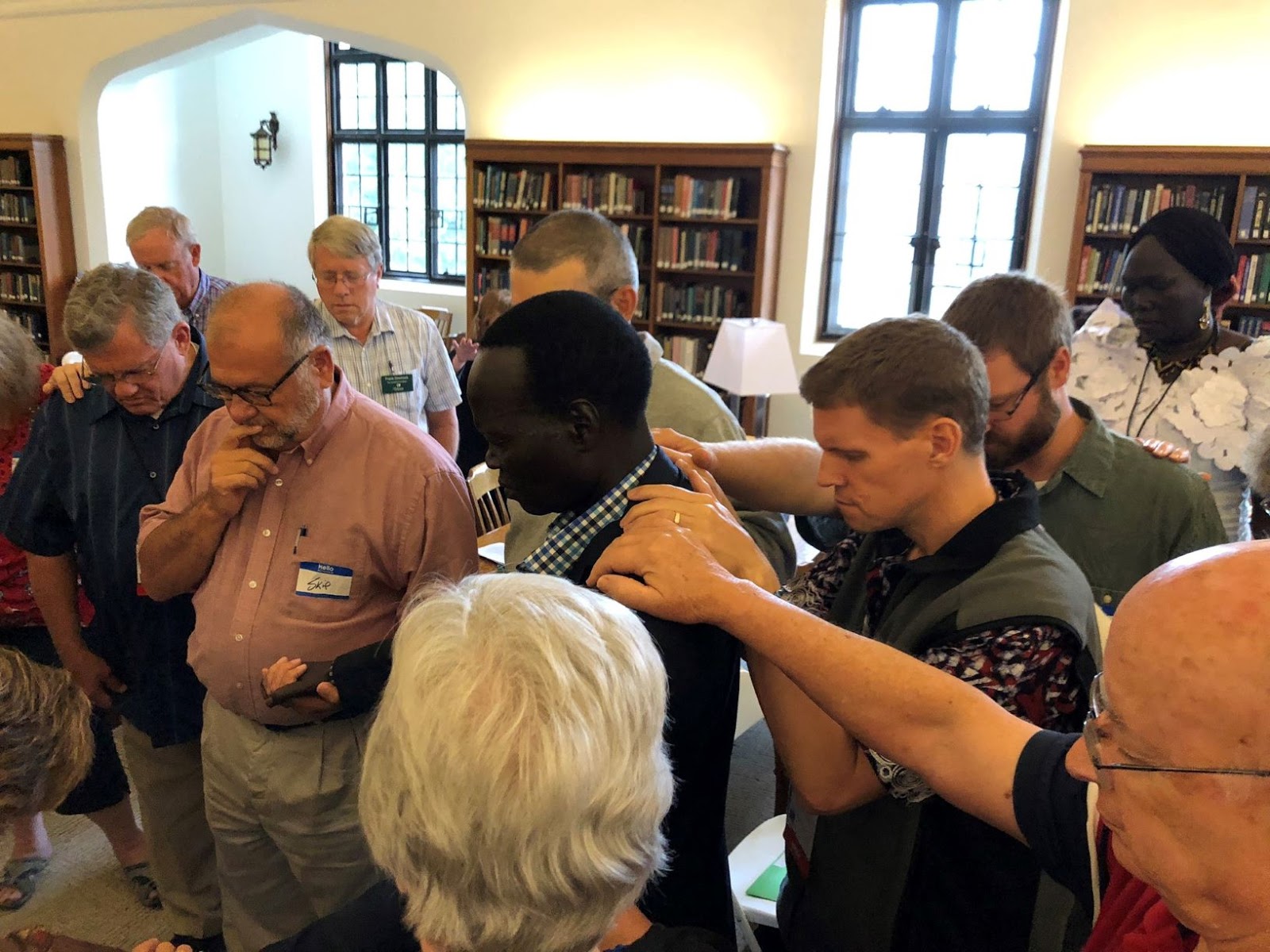
Praying for Rev. Santino, principal of NTC, at the mission network


4. Hospitality – Many people hosted us for the night or for a meal, drove us somewhere or loaned us a car. We appreciate the generosity, and also the connections and conversations those opportunities provided.


5. The gift of reconnecting with friends and families. Seeing people face to face feels so special when it is so rarely possible for us. Relationships that have spanned many years are so refreshing to pick back up on!

6. Answered prayers when we were nervous before speaking, or trying to figure out how to best use the time given us to share.


7. Recovery time – Bob experienced more physical pain with his broken hip than he has ever experienced, and it forced us to cancel lots of plans. We are very grateful for healing and for the time of recovery; we feel like God redeemed the cancelled and rescheduled plans.

8. Good reports from our colleagues in South Sudan. The media team at NTC produced a newsletter without Bob’s monitoring and assistance, and Kristi’s colleagues facilitated a healing and reconciliation workshop in July. The church continues to have a significant role in pushing for peace, and we look forward to returning in July.

9. The seasons! We watched extra-closely this year the leaves changing colors as autumn progressed, noticing deeper colors as we traveled north. Sometimes we just stared in awe at the rainbow of colors in the trees. Of course, a picture can never do it justice! We watched an early winter blizzard in Oregon, and look forward to a little more snow this year.


10. Exploring new places – we had some short-but-sweet days of savoring the beauty and uniqueness of some places we had not visited before – like the Indiana Dunes National Park, a mountain-top monastery in Portland, the shores of Lake Erie, and Madera Canyon in southern Arizona.

Our hearts are full of gratitude – to you, and to God, for making this year possible. We have a few more weeks of savoring some time with our families over Christmas, last-minute medical appointments, and packing, and then we return to Juba the first week of January.