Showing posts with label Nile Theological College. Show all posts

Tuesday, February 27, 2024

“If My Wife is Holy Enough, Can I Take Another?”

The “long semester” at Nile Theological College began earlier this month. I am teaching Contextual Theology, one of my favorite courses. Some rightfully argue that all theology is contextual, that is, our understanding of God is birthed from our experience, from our context. Stephen Bevans describes contextual theology as “dialogue” between two realities: the experience of the past as recorded in Scripture and church tradition, and the experience or present to which we who do theology now live (Bevans, 1992). David Bosch, the noted South African missiologist, describes contextual theology as “theology from below,” from the underside of history, informed by the social sciences, a theology whose primary “interlocuter” or communication partner is the poor and the socially marginalized (Bosch, 1991).

As my students and I are learning together, we recognize the need to understand the Gospel and how it relates to our cultures and peoples. On that note, at the end of class during our second week together, John, a pastor, who sits in the front near the door, asked a personal and culturally informed question when he asked, “If my wife is holy enough, can I take another [wife]?” Despite some chuckles from a few classmates, I assured John that his question was appropriate and helpful. When I asked the class if John’s question was a question shared by other members of John’s people group (the Nuer), everyone affirmed that to be the case. As we were at the end of the day, I suggested that we return to John’s question at the beginning of class the following week.

Before we met the following week, I prepared a worksheet which listed several questions and a list of scripture references concerning marriage to help us. My goal was threefold: to discuss the meaning of marriage according to the Nuer and other people groups in South Sudan, to discuss what Jesus says about marriage and God’s original intention for marriage, and to compare the two. As we began the discussion about the purpose of marriage according to local Nuer culture, these dominant themes emerged: the priority of children, protection, status, power, and overpowering others through procreation of sons. We discussed the reasons a man would have more than one wife, all of which can be identified in the above themes. When we looked at what Jesus said about marriage, we observe that he cites the creation account in Genesis,

"But at the beginning of creation God 'made them male and female.' 'For this reason a man will leave his father and mother and be united to his wife, and the two will become one flesh.' So they are no longer two, but one. (from Mark 10: 6 – 8)

One important distinction between the purpose of marriage defined by Jesus and by the Nuer lies in the idea of companionship and becoming ‘one flesh’. This idea was not cited as a purpose for marriage according to Nuer tradition and culture. 

The root question we discussed was whether it was good for a Nuer man, or even a pastor, to take a second wife, commonly practiced here in South Sudan. It seems that the motivation for John taking a second wife is that his wife is becoming old. One of the students, half-humorously and half seriously, quipped, “Well, if a wife’s husband is getting old, shouldn’t she also be able to marry a second husband, a younger man?” 

One experienced pastor felt that despite church law, which permits lay church members to have more than one wife, that the practice of marriage within the church should be for all men to have one wife only, that being the case for pastors/elders and for everyday Christians. Considering scripture, his view rings true, but the culture is still so strong. How do we make sense of the two? Although I am not sure we fully satisfied John in response to his question, I do believe that as a class we had a meaningful discussion, addressing John’s question from many important angles.

A couple of days later I was asked by an Ethiopian neighbor concerning how I had advised my student. I told him that my goal was not to give advice, but rather to help my student and the class meaningfully explore this issue for themselves, finding solutions and owning decisions. Advice from a missionary might be helpful in the short run, but long-lasting and transformative change will result from thoughtful and scripturally informed decisions made by local Christians themselves. As Christians, we invite the light of the Gospel and the Person of Jesus Christ to speak into our contexts and our cultures. Jesus must be Lord over all. In the end, as my professor at Nairobi Evangelical Graduate School of Theology (NEGST) says, “Our faith becomes our culture.” Lord, may it be so!

Wednesday, March 4, 2020

Matthew 25

And the king will answer them, ‘Truly I tell you, just as you did it to one of the least of these who are members of my family, you did it to me.’ (Matthew 25: 40)

As a denomination, the Presbyterian Church (USA), we are currently embracing the Matthew 25 vision, caring for members of Jesus’ family – the hungry, the thirsty, the stranger, the naked, the sick and those in prison. In the milieu of the United States, this call has been translated into dismantling structural racism, ending systemic poverty, and building congregational vitality. It is a wonderful initiative spearheaded by Rev. Dr. Dianne Moffett, Executive Director and President of the Presbyterian Mission Agency, the umbrella agency of Presbyterian World Mission with whom we serve. Congregations across the land are heeding this significant call to cross socio-economic and cultural barriers to behold and become the sweet aroma of Jesus Christ (3 minute invitation video here).

A couple of weeks ago I preached from Matthew 25 at our chapel service at Nile Theological College here in South Sudan. After the scripture was read, I asked the students to tell us what they heard and what they felt. Most of the responses were somewhat typical. Students felt compelled to action; they had a choice. They sensed that God wanted them to see the marginalized and needy as members of His family. One student, Linda, had an interesting insight. She described how African cultures tend to prioritize the needs of the ancestors, the “living dead.” She described how Africans must remember the ancestors, pay respect to them, and even provide food and sacrifices to them, otherwise they may feel the wrath of the ancestors. But here in Matthew 25, Jesus is not talking about the ‘living dead’, He is talking about the living. As I gave us a moment to reflect on Linda’s insight, it felt like a light-bulb had switched on in the minds and hearts of students. While not neglecting those who have gone before us, our priority, says Jesus, is always for those who are still with us, those who are suffering and needy…these are the ones to whom we must give attention and priority.

Last week, on our way home from visiting friends, Kristi and I stopped by Suk Malakia, the small market across from our building to buy some fruit and vegetables. As we faced Alima who was handing Kristi a bunch of carrots, I felt a gentle tap on my shoulder. I turned and there he was. I was tongue tied. I could not remember his name. I felt awful. He stood tall, self-possessed, silent like a sentinel, missing one leg from the snake bite incurred near his village. Of course, it was Grovener! I fumbled with a series of greetings in Arabic, somehow feeling “small” in relation to Grovener’s stature, his innocence, his meekness, his obvious need, being homeless like so many other children here in Juba. As always, Grovener was gracious towards me, greeting me with a gentle smile, expressing kindness. Standing before me was a child of God, a son of the King, a brother to Jesus. The manner in which we receive the "Groveners of our world" says everything about who we are and the fate “the king” will one day pronounce over the two groups of people, the sheep and the goats.

Jesus’ message from Matthew 25 is stark. It is final. It is the point of no return. As one my students said to all of us at chapel, “Yes, but we still have time.” Yes, we still have time to choose rightly, to be sheep and not goats, to heed the call of Jesus, to welcome the marginalized and poor with outstretched arms and open, loving hearts.

Tuesday, November 19, 2019

A Cause for Celebration! (Nile Theological College Newsletter)

Please celebrate with me!  Over the last 15 months I have been working with a team of students and staff to create a bi-annual newsletter for our college, Nile Theological College, located in Juba, South Sudan.

As Kristi and I are on Interpretation Assignment (furlough) and vacation for six months in the US this year, my hope has been that the students and staff whom I have been working alongside would be able to create a newsletter in my absence.  You can imagine my jubilation when I recently learned that they did it!  (and it looks good).   Here is the link to our newest edition of our newsletter - happy reading!


Wednesday, December 12, 2018

We made it to graduation!

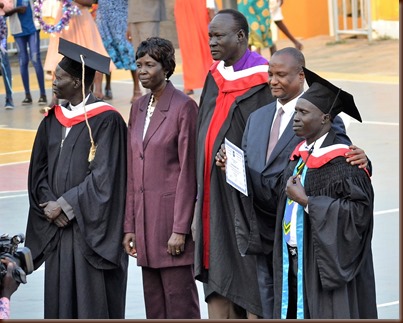
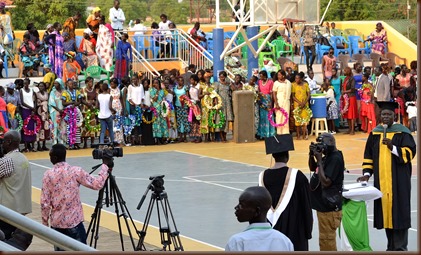
“Today the playground is transformed,” said Honorable Rebecca Joshua, government Minister of Roads and Bridges, “adorned with flowers and the presence of many dignitaries.” It was true – the outdoor basketball stadium in Juba did not look like the same place where we had watched basketball practice the night before. The bold colors of the women’s dresses reflected in the bright sun highlighted an atmosphere of celebration. Families of the graduates brought buckets of home-made sweets from home that they passed out to everyone around them. Government ministers arrived with their security detail and television cameras were poised to broadcast the event. But it was clear throughout the program that the ‘stars’ of the show were the 15 graduates of NTC proudly receiving their diplomas.
DSC_0006
The ceremony opens with a procession of the
graduates and faculty around the stadium

Rev. Santino, principal of NTC, recounted the history of the school in his remarks. Started in Khartoum in 1991, NTC opened a branch in Southern Sudan in 2011 in the city of Malakal. But devastating conflict in 2013 took the lives of 4 students and caused them to temporarily close the school. They reopened in Juba in 2014 with only 5 students, but gradually some who had interrupted their studies and fled the conflict were able to resume their studies. On Monday, the first graduation for NTC in Juba was held, with graduates from ‘batch 11’ (finishing this year) and also ‘batch 10’ (who finished 2 years ago). Of the students in batch 10, 26 started the program in 2011, to be interrupted by the conflict in 2013. Only 5 were able to complete their studies and only 3 were present for graduation. Gideon, one of those three, having moved his family to Ethiopia for security reasons where his wife is currently in school, made the long journey to Juba just for graduation. Several of the graduates have not seen their families in more than a year or even longer, sacrificing and persevering to finish their studies.
DSC_0054 (2)
(Left to right) Rev. Santino, Principal, Honorable Rebecca Joshua, Rev. James Par Tap,
Chair of College Council, Gen. Taban Deng Gai, First Vice President of South Sudan, with Gideon

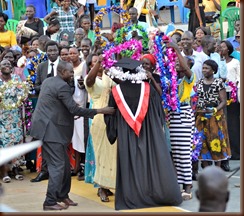
With the low rates of education in South Sudan and the struggle that it takes to complete school, graduation is truly something to celebrate at any level. Relatives, church members, and friends all came to join in acknowledging the rare distinction of completing a bachelors-level program. The culture of graduation in Juba is to adorn the graduate with a ‘wreath’ of tinsel when they receive their diploma, along with sometimes spraying with powder, wrapping a traditional embroidered sheet around the graduate to wear, or giving them flowers. Rev. Philip Obang, the Emcee for the event, was careful to instruct the families where to stand to receive their graduates in order to minimize the confusion of people coming from all directions.
DSC_0040 (2)
Family members line up along the side to receive their graduates

Rev. Michael Aban, NTC Registrar, read the names and a short bio of each of the graduates as they came forward to receive their diploma and congratulations from the leadership of NTC and the government representatives. Each graduate even had their picture taken with the First Vice President of South Sudan, General Taban Deng Gai. As they returned to their seats, fanfare and jubilation erupted from their families and friends waiting on the side. Each one was joyfully wreathed with tinsel, sometimes piled so high that the graduate could not even see. Cheers and ululations broke out, along with jostling for hugs and selfies with the graduate.
   DSC_0073 (2)  DSC_0056 (2)


Prominent church leaders, including the moderators of both the Presbyterian Church of South Sudan (PCOSS) and the South Sudan Presbyterian Evangelical Church (SSPEC) exhorted the graduates in continuing the ministry that God is calling them into. Gen. Taban Deng Gai appreciated the long history of the Presbyterian Churches in Sudan and South Sudan, and the emphasis on providing education that will promote peace and stability in South Sudan. Bishop Isaiah, General Overseer of the Pentecostal Church of Sudan, offered a challenge and a charge to go and make disciples, empowered by the Holy Spirit and the assurance that Jesus has all authority in heaven and on earth (Matthew 28:18-20).

Sunday, August 12, 2018

South Sudanese Hospitality


While in Uganda for vacation and R&R a couple of months ago, I stumbled upon an article in a travel magazine about Levison Wood, a British adventurer who walked almost the entire length of the Nile, a 4,000 mile journey along the longest river in the world beginning at the mouth in Rwanda and ending in the Mediterranean in Egypt (YouTube short video here).  While Levison’s journey was filled with misadventures, challenges and joys, one detail stands out to me.  Levison mentions the incredible hospitality and care he received in both South Sudan and Sudan.  In South Sudan, due to war, he was advised by the government military to divert his journey for his own safety.  In Sudan, a man walked forty miles with him and helped care for his camel.  Of all the countries he passed through, he spoke most highly of the hospitality in this corner of the world where we now live.      

Photo:  Levison Wood
Courtesy:  Associated Press/Ilya Gridneff at this linked article 

Hospitality is a core value in African cultures, a key feature which has drawn us back, time and time again.  While both visiting and living in Rwanda, I was so blessed by the care given to us during our visits and the efforts taken to see us off when we left.  While living in Rwanda, I was treated like one who truly belonged, like family.  In Congo, Kristi and I ate in countless homes and were treated like royalty.  We were welcomed with open arms by our wonderful host community.  Here in South Sudan, we have been blessed in similar fashion and always enjoy being in the homes of colleagues, friends and acquaintances. 

Making the journey out to the home of a student -
the last part by foot and it was quite muddy after a huge rain!  


Today was a special day for us in the home of a student and his family.  As our friend, Rev. Paul Hensley, wraps up his time here after teaching a three week intensive at Nile Theological College (NTC), a celebration to honor him was hosted by Rev. Santino Odong, the principal, and other faculty, staff and students this last week.  During that splendid affair with speeches, songs and food, Joseph Tubo Apar, one of our students, approached me and invited Paul, Kristi and I for a special gathering on Saturday featuring the local food of their Chollo (Shilluk) tribe.  The inspiration for this idea came when a couple of the students, Joseph and John Ohdong Mayik, learned that Paul would be leaving; they said to themselves, “Ah, we must do something!  We don’t have much here, and we cannot treat them as we would in our home region of Upper Nile, but we must host them and bless them before Paul leaves.”  Thus the impetus for a grand afternoon together, eating Akelo which is a staple for their people, a greens dish called Lōm, and fish.  This sumptuous meal was topped off by sliced guava and tea with ginger.  

John Ohdong Mayik serves us the famous Akelo -
a staple of the Chollo (Shilluk) people

All three students shared kind words of appreciation with us and we were introduced to each member of the family.  Before leaving, we expressed our gratitude and Paul prayed a blessing over the family and the home; we then snapped some photos together outside.  In good African fashion, they escorted us to the bus park and said goodbye as our bus took off, having already that day paid some of our bus fares and asking us to be sure to call them to let them know we had arrived home safely. 

Students John and Daniel (left, back) with members of John's family
also a close friend to John, pictured with Paul and Kristi 

Ahhhh, what a wonderful way to spend a Saturday afternoon!  We are grateful for South Sudanese hospitality and the opportunity to enter into the homes and lives of our students here, students who are becoming so very dear to us.  May God bless Joseph, John, Daniel, and John’s family for their invitation and their gracious welcome and care for us.  “Allah kwes kalis!”  (God is so very good!).