Tuesday, August 27, 2024

“We Feel Seen”

As I am halfway through writing my dissertation, it is helpful to hear the thoughts and advice of those who have gone before me on this journey. I recently sat together with Dr. Joshua Settles of the Akrofi-Christaller Institute of Theology, Mission and Culture (ACI) in Akropong, Ghana. Dr. Settles reinforced the notion that I am writing to two audiences: the committee at Stellenbosch University in the faculty of theology, and the peoples of South Sudan. As I have thought about our conversation over the last several weeks, I realize that by default I must be cognizant of the needs and interests of the committee; I also recognize that the peoples of South Sudan are the audience I value the most. On that note, Dr. Settles asked the salient question, “Will the peoples of South Sudan see themselves in your work?”

Recently I had the opportunity to sit with Reverend David Dach and Evangelist John Odhong, my two research assistants, both of whom have accompanied me on this research journey over the last three years. A few months ago I gave them each a hard copy of my first case study. I had shared my first case study with a few others, including my supervisor. Yet somehow, I felt the most nervous about the response and feedback of David and John as they represent the peoples of South Sudan. As they shared their reflections, it was clear that they had read my work, even multiple times. I am humbled by what they shared with me…

David and John and I together reviewing our work
(Nile River in background) 

David and John described how they feel seen in my writing. They not only named several key concepts and themes from the case related to the religious heritage of their peoples and the relationship between the missionaries and the South Sudanese peoples, they took those ideas and elaborated and expanded upon them. It seems that my writing took them to important places in their own thinking and reflections on the history of the Gospel being brought to their peoples over the last one hundred and twenty years. One important example is the missionary practice of giving those persons baptized a “Christian name.” David suggested that the missionaries gave South Sudanese converts names like James and David because their African names were too difficult to pronounce. He then asks the question, “Why were [we South Sudanese] not baptized with [our] family name instead of names like John, Peter, and Anna?”

David describes how things have changed. Serving as a pastor with the Presbyterian Church of South Sudan, David recently baptized his young daughter with her Nuer name, “Nyanath,” which means “girl of the people.” David contends that God does not object to this name; he also suggests that this habit of baptizing people in their local names should have been the habit of missionaries from the beginning. “To give African converts ‘Christian names’ (names in English, French, Italian, Portuguese, German), says David, “was an imposition of the Western missionaries.”

On a different note, both David and John appreciated the tremendous sacrifices the missionaries made coming to Greater Upper Nile, South Sudan. Some of the missionaries lost children to disease and some lost their mental and emotional well-being due to intense challenges, suffering, and deaths of loved ones. Yet, David and John enumerated the value of missionaries coming to live and stay in Africa as both sides welcomed one another as their own, sharing burdens and helping one another in various ways. They also emphasized the unique and special friendship between the two central figures of the case study, Pastor Moses Kuac Nyoat, the local Nuer agent of mission, and missionary Eleanor Vandevort, known to the Nuer as Nyarial.


The story of the friendship between Pastor Moses Kuac Nyoat
and Missionary Eleanor Vandevort is told in this book (link here)

More could be said from our time together reviewing my first case study, but in sum, I am grateful that my writing thus far has enabled those whom I am writing about and representing to “feel seen,” and thus feel empowered. It is also an important affirmation that I am on the right track with my research. In many ways, the core of my study is to help African Christians appreciate their “African-ness” and to stand with confidence as together we proclaim our faith in the Lord Jesus Christ to a broken world filled with cynicism and despair. To God be the glory.

Wednesday, August 7, 2024

Healing for Pastors in Maridi

Last week we facilitated a Healing Hearts, Transforming Nations (HHTN) workshop in Maridi, a town in the southwest region of South Sudan. The unique thing about this workshop was that the participants were nearly 100 pastors and their spouses, all of them from the Anglican Church in the diocese of Maridi. The Anglican Bishop in Maridi had called all of his pastors together for an annual retreat. In a serendipitous encounter while he was visiting Juba, he learned about the HHTN workshop, and Mission Aviation Fellowship (MAF) was able to organize a workshop with less than two weeks notice to be done at this retreat.

The Bishop and leadership in Maridi with our team when we arrived

Bishop Moses shared with us when we arrived that his vision was to focus on 1 Peter 2:9 and our identity as God’s people. He said that he was seeing many pastors in his diocese whose lives did not reflect the identity and transformation of Christ. Alchoholism, adultery, domestic conflicts, and witchcraft were among the top challenges he saw. He recognized that many of his pastors had endured the trauma of war and the ongoing trauma of poverty and that the unhealed trauma had opened the door for these destructive practices in the lives of his pastors that limited their effectiveness to minister to others.

A full church for the workshop!

Usually when we do the HHTN workshop we limit it to 40 or 50 participants so that there can be discussion and active engagement for everyone. This time had to make several modifications, particularly in the activities and discussion, given that we had nearly 180 participants. But God helped us to still be able to have good interaction and discussion and people shared that they found it meaningful and helpful.

women share their pain and pray together in pairs

The time of giving over pain to the cross was especially meaningful. Since all the participants were pastors or spouses of pastors, part of their ministry is listening and supporting others through challenges. But they often do not have someone that they can go to and share their struggles with. After they had written down pain or struggles that they wanted to give over to God, they divided into pairs to share and pray together. I walked around the church and observed the pairs sharing under trees or in the grass, and I could sense the sacredness of the time in the intensity of the prayers and the delay in coming back together. Back in the larger group, each person had an opportunity to lay their paper at the cross, representing giving over their burdens and pain to Jesus.


Burning the papers, representing giving over our pain to God

The following morning, we heard from several people who expressed how God had worked through that time. One older male pastor said that he has suffered from body pain. “But yesterday you said, ‘open your heart and let God work.’ And I did that. I felt God bring healing. Now my body feels strong!” Another pastor said that his grown son has been drinking a lot of alcohol and can not keep a job. That is the burden that he shared with his colleague and brought to the cross. That night he called his son and the son said that he is giving up drinking and committing his life to Christ and wanted his father to help hold him accountable. A woman pastor shared that she took in a boy who is an orphan to care for in her home, but she struggled because he was always disobedient and rebellious. After the teaching on the importance of showing love in our families, she went to the boy and asked for forgiveness for being angry at him and mistreating him. He then asked her forgiveness for not obeying or helping in the house. The following morning the boy was the first one up and mobilized the other youth in the household to work in the garden.

I celebrate the ways that God brought together this opportunity for the spiritual leaders in Maridi to be refreshed and ministered to. The vision and motivation of the Bishop and the diocese, the resources and organization from MAF, the facilitation team who came together, and the commitment and openness of all of the participants all brought together through the Holy Spirit made for a really significant time. Please pray that God continues the work of healing in Maridi as these pastors return to their homes and churches.

The lush green trees and farms of Maridi, seen from the air

“But you are a chosen people, a royal priesthood, a holy nation, God’s special possession, that you may declare the praises of him who called you out of darkness into his wonderful light.” 1 Peter 2:9

Sunday, July 28, 2024

The impact of inflation

In the last few months prices in South Sudan have increased dramatically. One of the big reasons for the inflation is because the currency, the South Sudanese Pound (SSP), is declining rapidly.  Oil, the primary export, has decreased production because a rupture in the pipeline cannot be repaired while there is active war in Sudan. Nearly all food is imported from outside of South Sudan, so US dollars are used in the purchase and import of goods and fuel from other countries. Therefore, as the currency declines, local prices go up accordingly. It is a complex mix of factors that most people cannot do anything about.

Bundles of South Sudanese Pounds. Each bundle is worth about $25

We have one friend who teaches in a private secondary school. He is paid 150,000 SSP per month by the school. In January of this year, that was worth about $150. Now it is worth less than $40. Even in January, that was barely enough to buy food for his family, and he worked other jobs to supplement. Because of the struggle to make ends meet, he sent his wife and kids to Uganda where living expenses were cheaper. Now, with the currency decline, he has almost nothing to send them.

Prices for food and goods have increased dramatically in the local currency because of the exchange rate. One liter of fuel cost about 1200 SSP in January, and now costs about 4500 SSP.  One kilo of beans was 5,000 SSP a few months ago and now is 15,000 SSP. Another friend sells charcoal and basic food items at a stand in the market. She lamented the high price of cooking oil now, and fears that her customers will not be able to pay the increased price. One shop-owner selling grocery items said he estimates that his sales have fallen by half in the last couple of months because people are cutting back on the meals they eat – some going from two meals a day down to one.

The small-scale entrepreneurs are affected the most because their prices do not increase at the same rate. The price for a cup of tea on the street or a bag of peanuts has not increased at the same rate as imported goods. This means that the profit margin of the sellers decreases, and the profit they earn does not buy as much as it used to. Last week I stopped to see our friend Mary in her tea-shop. Usually her place has several customers, but that day it was empty. When I commented that it seemed unusually quiet, she said “Because people don’t have money. They stop drinking tea when there is no money.”

A few years ago, South Sudan introduced a new one thousand SSP note. It was a larger bill than the others with more color and added security features. At the time it came out, it was worth nearly $5. Now it is worth about 25 cents. The one thousand note bill is still the largest bill in South Sudan. I realized that we can no longer carry the money to go out for dinner in a pocket, and we hope that this devaluation does not continue at this terrifying pace.

Please join us in praying that God hears the cries of his people here – for an end to war in Sudan, for peace and provision for people in South Sudan.

Saturday, July 20, 2024

Life Beyond Sunday

Emily, a student from Pittsburg Theological Seminary visited South Sudan in June as part of a research fellowship exploring how people are finding hope and healing after trauma. We visited several activities of South Sudan Presbyterian Evangelical Church (SSPEC) congregations while she was in Juba in order to give her an overview of the life of the church. I wanted to share a few of the highlights with you, and hope you will be encouraged by the impact of local congregations in their communities.

There happened to be a 3-day national holiday because of a Muslim celebration, so several congregations took advantage of the opportunity to hold conferences. We visited a youth conference at the new Referendum congregation. We were impressed at the exuberant worship, the thoughtful ways that the youth to engage with the content and with each other, and with their eagerness to learn and be equipped. One of the speakers gave an overview of a trauma healing workshop, and asked how many of the participants had come from Khartoum in the last year. Nearly half of the people raised their hands.

The youth performed a drama about
Jesus setting someone free

The Eden congregation in Juba organized a conference for children in their neighborhood during that holiday. It is a rare opportunity for children to have an event to attend like this other than school, and we were impressed to see the mix of singing, lessons, and games that they included. This congregation, on the edge of town in another neighborhood where many people have come recently because of the war in Sudan, is providing hope and care to families by nurturing the children.

One of the children leads a review of the topics

Children playing a game of who can get the
biscuit in the mouths without their hands

We also attended church services on Sunday and a monthly women’s prayer meeting. Singing, and particularly choirs, are an important part of worship here. Choirs practice multiple times a week for a few hours, and some members shared that the time spent together in practice provides opportunities for encouragement, discipleship, and healing from painful experiences of war. Since very few people read music, a new song is learned by repeating line by line as one person models the singing.

The children's choir at the Eden congregation 

In addition to these events, we attended a wedding, a funeral, and a monthly women’s prayer meeting. It was evident that the local congregations are an important part of nourishing the faith, health, and connections in their neighborhoods. It is always great to see a place through new eyes, and Emily’s perception and great questions made for a rich experience!

Women dancing at the wedding

Thursday, July 4, 2024

The Akrofi-Christaller Institute of Theology, Mission and Culture (ACI), Akropong, Ghana

During my first day at the Akrofi-Christaller Institute of Theology, Mission and Culture (ACI) in Akropong, Ghana, I sat at a lunch table with Rev. Felix Cornelius Agyei, a PhD student. I asked Pastor Felix about his research topic, a question which launched us into a riveting conversation about the relationship of language and culture with the Gospel of Jesus Christ. Pastor Felix described his research topic as “the study of ‘the works of the law’ and ‘justification’ from the book of Galatians, from the Akan* mother tongue perspective.” Pastor Felix describes how the mother-tongue hermeneutical* approach helps people understand the scriptures from their own context. He says, “It allows the people to hear God speak in their own language.” He acknowledges how many Ghanaian and African peoples see the Bible as the white man’s book and as a European document. Yet, he says that the Bible is a "universal document." He reminds us that the scriptures, much of what we know as the Bible, found their way to Africa before they travelled to Europe, providing the example of the Ethiopian eunuch (see Book of Acts, chapter eight). Pastor Felix shared with me an example of the mother tongue hermeneutical approach, saying

When explaining the concept of sin to people, every theologian wants to use idea of “harmartia,” which means “missing the mark,” a Graeco-Roman concept which the [Graeco-Roman] world of that time would understand…But as an Akan, when I explain “missing the mark,” there is no understanding. But, [culturally speaking], when I want people to desist from a certain thing, I need to describe it as smelly, as foul, as something you don’t want to touch. In Akan we say “e-bone.* When some of these [local] concepts are employed and amalgamated with the hamartia concept...when missing the mark of Christ [is connected with] the thing you are involved with [which] is ‘smelling’…[you question yourself about] how can you go close to God with that smell? These are some of the things that will ring well in the African, and this is what is motivating me to study [in mother tongue language and our local  thought categories]


Rev. Felix Cornelius Agyei

Pastor Felix and his research interest represent the ethos and vision of ACI. Founded by the late African Theologian Kwame Bediako almost thirty years ago, ACI seeks to be a “pacesetting postgraduate university, training Christian workers and leaders for effective mission in the African context.” ACI achieves this vision by developing robust academic programs which provide tools for “serious and creative research into African Christianity,” serving the wider community in Ghana, Africa and beyond, focusing on training for Christian mission according to the African context. Amara Baptizo, a student from Sierra Leone, testifies to the effectiveness of ACI’s vision and mission when he tells me, “Here at ACI, I feel like my ‘African-ness’ is appreciated.”

Professor Gillian Mary Bediako pictured in her home with
a painting of her late husband Kwame Bediako
 
I learned of ACI many years ago when I first read the book Jesus in Africa: The Christian Gospel in African History and Experience, by Kwame Bediako. This book has changed me, shaping how I engage and think about ministry in Africa. To visit ACI is a dream I have nurtured over many years.  


Photo Credit: from Amazon 

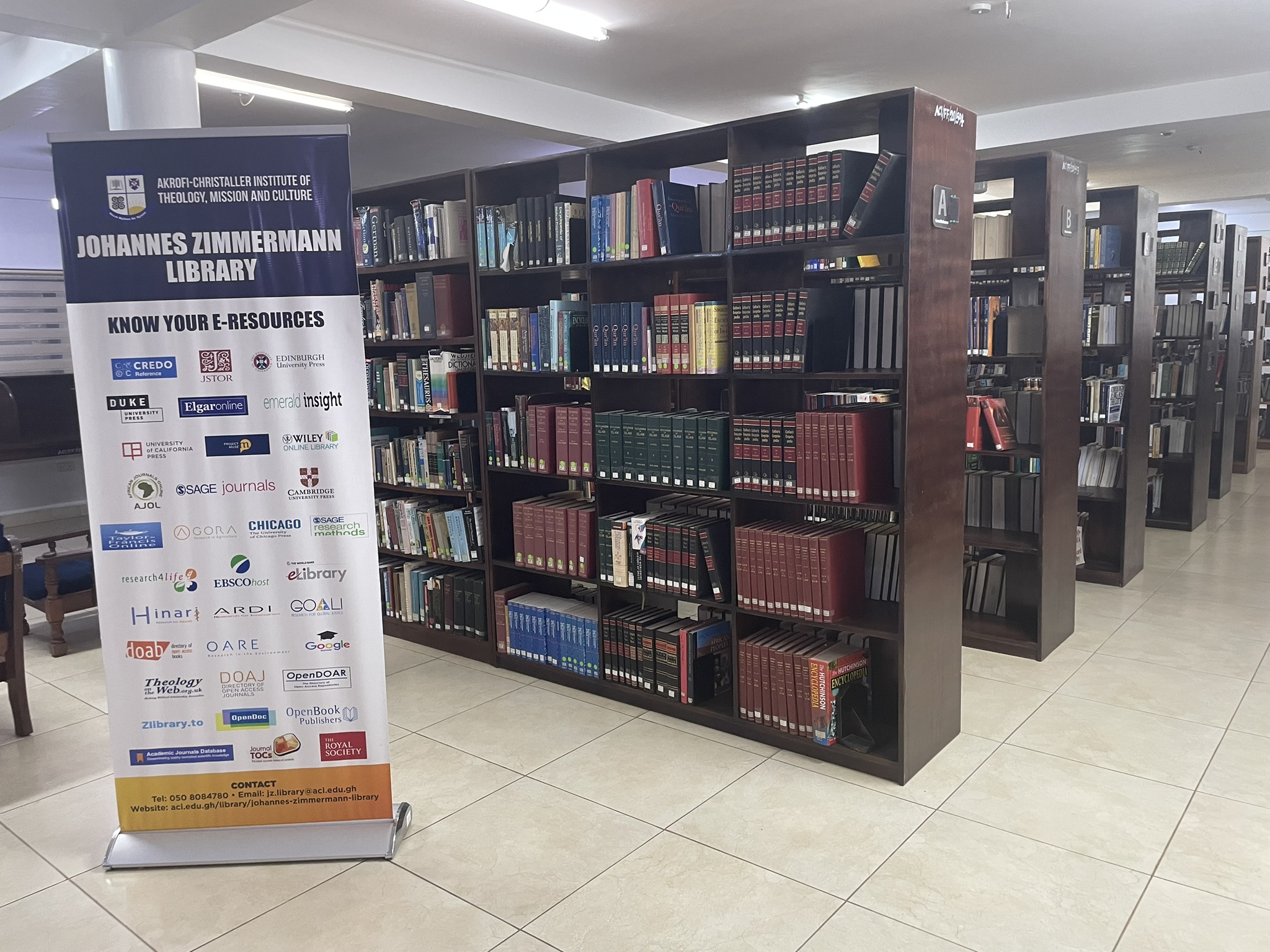
This year, from the end of May until the end of June, I was privileged to spend four full weeks at ACI, spending quality time with staff, faculty, and students over lunch, breakfast, and during and after our daily devotions. I was also invited into the homes of a few faculty members, and I am grateful to have had focused discussions with two faculty members regarding my own research interest; their input and feedback challenged me in some very important ways! Having been invited to ACI as a Research Associate, I am grateful to also have had access to their world class library where I logged many hours writing two sections of my doctoral thesis. The staff could not have been more accommodating and delightful. 


Newly built and dedicated library with conference hall,
periodicals room, archives, and museum 


World class library which centers titles concerning
Christianity in the Global South 


Library carrel where I did most of my writing


Justice, who works in the Archives Section of the library, 
is passionate and committed to preserving historical documents 
of the church and mission in Ghana

During my four weeks, I felt like I was welcomed as part of the ACI family, attending and helping with special events and being invited to preach during their Wednesday morning extended worship the final week I was there. 


After devotions on my final day with ACI Registrar
Rev. Dr. Michael Nortey and ACI Chaplain Dr. Ernest Afrifa Anane

I am grateful to Rev. Cheryl Barnes and the Africa Office of Presbyterian World Mission for their support to pursue this unique opportunity to travel to a new place, make new friends, and be inspired by what is possible as we listen together for what God is doing in our unique contexts. From personal experience, I can say that "ACI is a great place," and in the words of our friend Ingrid, "Given its awesome foundations, ACI can be an even greater place, amen." To God be the glory!


During my time at ACI, I was able to attend and assist with three major 
events:  the annual Kwame Bediako Memorial lecture, the Inaugural Professional Lecture of Professor Laryea, and ACI's annual Interfaith Symposium


Professor Philip Laryea, newly installed Rector of ACI, being 
congratulated by a Ghanaian king after his Inaugural Lecture
Photo Credit: ACI 

*Akan refers to a family of languages and peoples found in southeastern Ghana.

*The term “hermeneutical” or “hermeneutic” refers to the idea of the means and methods by which we make interpretation and deduce meaning.

*this is an English transliteration of the Twi word “bÉ”ne” and the Twi expression “hua bÉ”ne,” signifying a bad smell. Twi is a language shared by the Akan peoples of Ghana.