Monday, February 13, 2023

The Bee Sting

South Sudan is no stranger to division, brokenness, and pain. At the highest levels of government, within the church, within families, and across communities, what separates us defines us and keeps us from one another. Since 2013 alone, not to mention two previous horrific civil wars which lasted almost fifty years, hundreds of thousands of South Sudanese have been killed during an ethnic, internecine, and bloody civil war. Fear continues to walk alongside us, uncertainty calls our name, and violence runs deeply as the most trafficked way of relating to one other.

Into this maelstrom of fear, uncertainty, and violence, has entered messages of healing, peace, justice, and reconciliation. These messages were most recently brought by leaders from the highest levels of the ecclesial and religious landscape known to our twenty-first century. It is almost unbelievable, but for the first time in five hundred years, an ecumenical peace pilgrimage was made by Catholic, Anglican and Protestant leaders to South Sudan. Pope Francis, Archbishop of Canterbury Justin Welby, and Moderator of the Church of Scotland Rev. Iain Greenshields responded to an invitation to come to South Sudan after South Sudanese political and ecclesial leaders visited the Vatican in 2018. To have participated in this historic event last week was an amazing privilege and an unforgettable blessing.

On the plane as they leave Juba together on Sunday afternoon
Photo Credit: Church of Scotland
 
The events began in earnest Friday afternoon when the Pope arrived at the airport from Kinshasa, Democratic Republic of Congo. As the last vehicle in a long line of cars going to the airport to welcome Pope Francis on a sultry Friday afternoon, we stopped, and I marveled at the thousands of South Sudanese lined up peacefully and joyfully along the road. The immediate line of persons held hands, serving as a buffer, a human chain, shielding all safely behind. Those behind were beaded with drops of sweat, the unforgiving sun bearing down as they sang choruses and danced, sweet smiles from young and old greeting me. One group of Catholic pilgrims walked nine days to Juba; a woman among them said, "When you have smelled and seen death and hopelessness, then you will search for peace with all the might that you have." The true and enduring strength of South Sudan was on full display as we waited for Pope Francis.

The next few days were a whirlwind of activity. On Friday afternoon the three faith leaders and other notable faith leaders among them visited the President and the five Vice Presidents at the Presidential Palace. On Saturday morning each faith leader spent time with their respective faith communities. The Presbyterian Church of South Sudan and the South Sudan Presbyterian Evangelical Church hosted a reception and worship service today for the Rt. Rev. Dr. Iain Greenshields, Moderator of the Church of Scotland, and Rev. Shavon Starling-Louis of the Presbyterian Church (USA), along with other members and leaders from both denominational bodies. It was a joyous occasion with almost sixteen thousand in attendance, including Spirit inspired worship through song and messages about unity, love, and our shared history and hopes for our shared future. It was an extraordinary event, and it served as a reunion of sorts as Kristi and I saw many church leaders whom we know and several of my former students. Entering into that worship space in its magnitude defies description. Seeing the smiling, joyful faces welcome us into the huge blue and white tent will forever be etched on my soul.


Rev. Iain Greenshields of the Church of Scotland receives flowers
from a child upon arrival at reception/worship service 

The women of the Presbyterian Church of South Sudan 
joyfully greet our delegation as we arrive


Rev. Shavon Starling-Louis, Co-Moderator of the Presbyterian Church (USA)
gives a message on unity from Psalm 133   

That afternoon we joined hundreds at Freedom Hall where Pope Francis and the others welcomed internally displaced persons from all over South Sudan. Three children from the IDP camp in Malakal shared their stories of life in the camp and the significant challenges they face regarding daily life and schooling. 


Rev. Iain Greenshields, Moderator of the Church of Scotland greets a young man
from one of the Internally Displaced Persons (IDP) camps in South Sudan
Photo Credit: Church of Scotland (on FB page) 

With Colleagues Jeff Boyd and Sharon Kandel at a forum whereby the Pope and the 
two other leaders listen to the stories and realities of IDPs in South Sudan 

To our surprise, Kristi and I were included with the ecclesial leadership community, both from South Sudan and abroad on the stage where the Pope and others led us in an ecumenical prayer and worship service. The following morning I joined colleagues as we worshiped at the same venue, the John Garang Mausoleum, participating in the Mass with the masses. Both Saturday night and Sunday morning, it is reported that between fifty and seventy thousand people were present. Everyone who came walked long distances as there was no public transport in operation. Mama Lucia, a colleague and friend, told Kristi that she was so tired Saturday night when she finally arrived home after two hours of walking. Yet, she was there the next morning to help with a medical effort as people had no means to eat, had stayed at the worship site all night, and were now suffering from dehydration, lack of access to food and water, and a hot sun.


The Stage from where the Pope and other leaders led us in prayer at the 
Saturday evening Ecumenical Prayer Service
Photo Credit: Church of Scotland (FB page) 

Pope Francis compares the challenges of South Sudan with the 
children of Israel leaving Egypt, finding themselves in a hopeless
situation which requires God's intervention


Bishop Paride Taban of South Sudan, a true hero, listens to the Pope's message of peace;
Bishop Taban has been actively working for the peace of his people for over forty years 

The crowds at the Sunday Morning Mass could take your breath away! The Red Cross
was present to assist those who had waited all night without access to food or water


The choirs, singers and dancers help us worship as the Pope preached from the
Gospel of Matthew, announcing that we are to be the  salt of the earth, the light of the world! 
Photo Credit: Shelvis Smith-Mather 

By Sunday afternoon, all the notable visitors had left, but a palpable sense of hope continued to fill the landscape. On the following Friday, our friend and colleague Shelvis Smith-Mather connected us with  Bishop Paride Taban, a notable Catholic bishop best known for his peace-making efforts over the last forty years. When asked about the Pope’s visit, the aged and wizened bishop said to us in characteristic African proverbial fashion, “The Pope’s visit is like a bee which came to us, stung us, and has now left us. We trust and pray that the ‘itch of peace’ left by his sting will remain.”


Shelvis Smith-Mather, our friend and colleague, graciously connected 
Kristi and I with Bishop Paride Taban (right, foreground) after the Pope's visit
Photo Credit: Shelvis Smith-Mather


Wednesday, January 18, 2023

Church visit in Akobo

 This is part two of my visit to Akobo in December. After we completed the workshop (read about from a previous post), we worshipped with the Presbyterian Evangelical Church congregation in town. Going to church in a new place is never a small affair in South Sudan.

Since there is no public transportation in the sprawling town of Akobo, we walked. At least 8 months of the year the roads turn to mud and are nearly impassable, but in December the ground has been transformed into hard caked clay. We had been told to set out at 6:30AM, and it was nice to enjoy the cool morning air. As we made the half-hour walk to the other side of town, we passed cows meandering down the road, women commenting that my lawa (draped material tied over one shoulder) was over the wrong shoulder, and people bringing fresh fish from the river to the market to sell. 


We arrived at the church before 7:30, and it was a flurry of activity as people were preparing for the service and as church members were arriving. In Nuer tradition, hosts will wash the feet of their guests as a sign of welcome. They brought out basins of water and sat all of us down at the entrance of the church to wash our feet. 


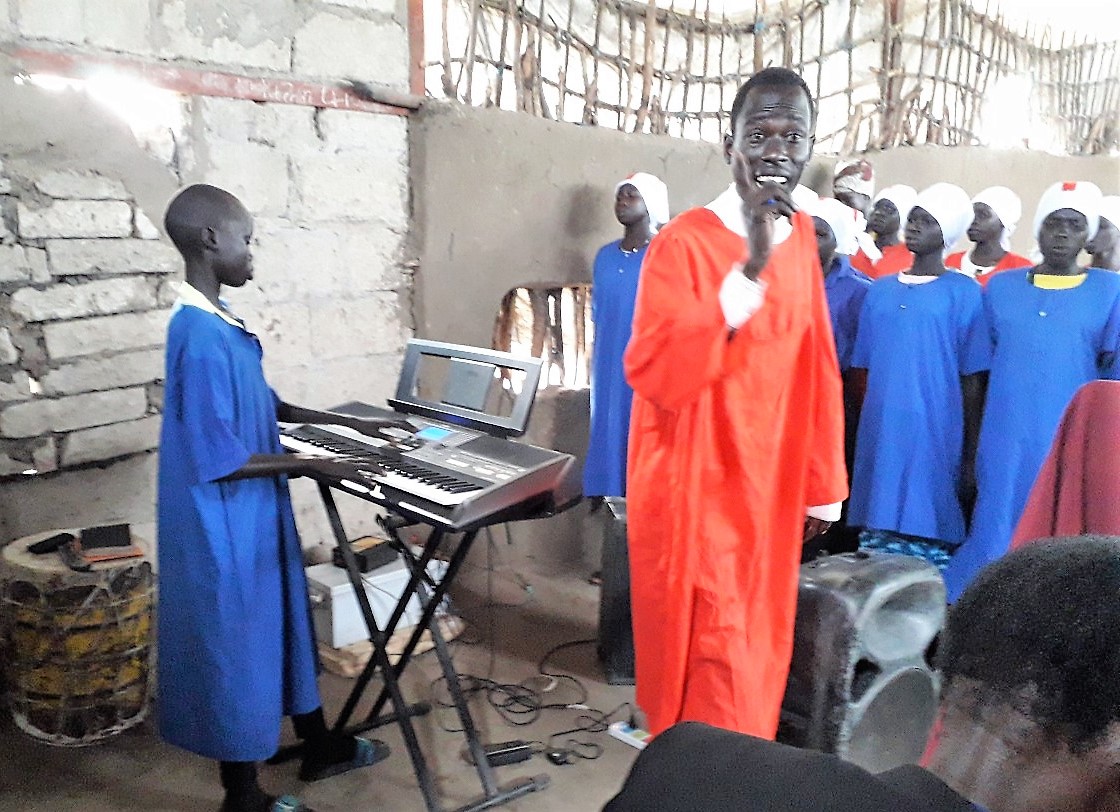
We were seated at the front of the sanctuary, along with all the pastors and leaders of the congregation. The youth choir sang an exuberant opening song, and we were impressed that their keyboard player looked so young. Everyone joined in some of the common Nuer hymns from their songbook, and the women's choir and an adult choir also had their turn to sing. I always enjoy hearing God worshipped in different languages and styles! The congregation had invited members of their branch congregations to come together in one location because of our visit, so the church was soon packed full.


A highlight from the morning was hearing the testimonies from two members who attended the Healing Hearts Transforming Nations (HHTN) workshop that week. One woman shared that they saw that forgiveness has to start from the family. Husbands and wives have to forgive each other and should not let their egos get in the way (this is counter-cultural!). Luka, a youth leader, said "In the workshop, we came to understand that the thief (as in John 10:10) has stolen many things from us. That is why there is conflict in Akobo. The thief has stolen love. When you see someone coming from a different place, you realize the thief has stolen love from you." 


When the offering was collected, I noticed that many people put in an ear of dried corn or some millet from their fields. I knew that money was a scarce commodity, and this seemed like a good way to show their contribution to the work of the church, particularly in the dry season when things were not growing.

After the nearly 4 hour service, we were welcomed to the home of an elder who lived nearby. First they brought soda (a rare commodity in Akobo), then big pots of food. Walwal is eaten nearly daily in many Nuer communities - it is made of flour and water that is artfully mixed by hand so that it forms small balls. They served fresh milk to pour over the walwal, which makes for a hearty meal. I was amazed to see the big pots of food serving clusters of people as nearly the whole congregation gathered joyfully in the compound.


After drinking tea and relaxing in the shade, we were invited to come and visit the home of one of the pastors. Now in the heat of the day, we made our way to Pastor Michael's compound nearby. A traditional round thatched-roof barn provided shelter at night for his cows and goats. A fence of sticks surrounded his living quarters, which comprised three small huts with an open space in the middle. He brought chairs for us to sit in the shade of a tree and his wife brought water to drink. He introduced us to other members of his extended family, then we prayed for them before continuing the journey back to our accomodation. 


We meandered through the market on the way home, stopping by a pharmacy run by a Christian known to some in our group, and he immediately brought some sodas as everyone caught up on the news from Juba and on mutual acquaintences. By the time we reached home at nearly 3pm, I was exhausted but grateful for the full day of worshipping with God's people in Akobo and seeing a slice of the life of the church there.

Tuesday, January 17, 2023

A Day in Our Lives in Juba

Though we have patterns and structure, life in Juba is fluid. Last Saturday our alarm sounded at 5:20am, as usual. At 5:30am the local church bells sounded, as usual. We got up, exercised, watered the plants, showered, ate breakfast, and did our devotions, as usual. That day I would be hosting a friend in the morning and doing some work in the afternoon. Kristi had a 10am meeting at the office, and then would attend the Juba Women’s Bible Study in the afternoon, as usual. Our compound was a bit raucous that morning as neighbors and friends were hosting a birthday party for fifty children from a nearby orphanage, a bit unusual.

Not too long after Kristi left, she called me. Almost sheepishly she mentioned that she had just spoken with our friend Omot who told her that today would be “final prayers,” the end of several days of the funeral service of the father of our mutual friend Ajullu Susan. Kristi said me, “I am thinking of going. Do you want to go?” Though I had some work to do, I remembered how important it is to visit people here and be with them in times of loss. “Yes. I think it’s a good idea,” I said. “Let’s go.” I called Juma, our rickshaw driver, asking him to pick me up at 12:30pm; we would then pick up Kristi at her office across town. In a moment, the complexion of our day changed.

After a nice morning of fellowship, food, and prayer with my friend Albino, Juma came to pick me up. Picking up Kristi, however, turned into a complicated affair. A high-ranking government official had recently died, and the president was attending the funeral at the large field across from Kristi’s office, which meant that roads would be blocked, and military presence would be pronounced. With creative communication efforts between Kristi and myself, outstanding driving techniques and “heads up” thinking from Juma, we found Kristi and then propelled ourselves out to the outskirts of Juba to Lologo 2, near the Nile River, where Ajullu lives and where the ‘final prayers’ were being offered.

With Albino, outside our home


With Juma, our trusted, faithful, and beloved 
rickshaw driver

Upon arrival, family and friends were busily preparing. Four large tents were erected and chairs for about five hundred people set up. After we sat down, two former students greeted me. What a gift it was to see Alfred and Peter! They are both members of the Anyuwa tribe, hailing from the same region as Ajullu and her family. The service began. Choirs sang, family members and friends spoke, and then community leaders and elders had their turn. We were struck by the impact of the life of Ajullu’s father. We were also struck by Ajullu’s commitment to him during his time of sickness. The service was conducted in three languages, Anyuwa, Arabic, and English. Like most funerals and final prayers here, the service was long. At the very end, Omot, who was leading the service, invited me to come and say a final prayer. Though I was not expecting to offer the final prayer, I went to the front, prayed in English, and then I prayed in Arabic. People were pleased. Afterward, as usual, everyone was invited for a sumptuous and large meal. We stayed to eat, yet Juma was on his way. At around 5:30pm, Juma picked us up along with our friend Rev. Paska who was the preacher that day. We had just been with Rev. Paska in her home a few days previous as she had just lost her nephew to sickness.


A choir sings at the funeral of the father of Ajullu Suan
(his photo above the choir)

When Juma dropped us home, the colors of the fading sun in the west were brilliant, a glorious mixture of orange and receding red. It was a typical day in Juba, given that life here is fluid, and plans can change in an instant!

Tuesday, December 20, 2022

Call to prayer for Upper Nile

Indeed, most of us like to be “home” with family for Christmas. Interestingly, that was not the case for two humble Jewish villagers, Mary and Joseph, living under the shadow of the Roman Empire, finding themselves far from their home on the birth of their firstborn son, 2,000 years ago. In Fashoda County, South Sudan, the situation is worse than it was for Joseph and Mary. People’s homes and communities are being burned to the ground, they are running for their lives, they are hiding in swamps, surrounded by floodwaters. The innocents have been targeted for death, the elderly, women, and children. Please pray for those in harm’s way, those who seek refuge, and those who need God’s supernatural intervention. Bob visited this area in August of this year, so it feels close to home. Two evangelists and several members of the South Sudan Presbyterian Evangelical Church have been killed in Fashoda this month.


Bob in Kodok with pastors and evangelists of SSPEC this year

We want to share a ‘call to prayer’ (below) from the Stated Clerk of the Presbyterian Church (USA) this month, and invite you to join thousands of hands and hearts in prayer for the people of Upper Nile in South Sudan this Christmas Season. Shukran! Thank you.


Dear friends in Christ,

I urge you to join me in prayer for justice and peace for the people of the young nation of South Sudan.

Within the last few months, relatively localized fighting between two groups in the Upper Nile region of South Sudan has gradually become a more widespread conflict between the Shilluk and the Nuer peoples, two ethnic groups who used to live peacefully together. The latest reports indicate that more than 3,000 people — mostly women, children, and elderly people — have been killed in Fashoda county.

This situation is made even more dire due to heavy flooding in the region, so survivors have had to flee their homes and are living on small “islands” of land or seeking shelter in camps for displaced persons. Many people have no way of contacting their loved ones, so they do not know if they have been killed or if they are alive and displaced or in hiding.

Let us be in prayer for the people of South Sudan, especially those who carry the burden of this ongoing conflict — the women, children, and the elderly. Pray also for our Global partners, the South Sudan Presbyterian Evangelical Church, the Presbyterian Church of South Sudan, RECONCILE, ACROSS and the South Sudan Council of Churches. Pray that God will give wisdom to these partners as they minister to their fellow South Sudanese and that they can be a voice to the leaders of the country. Let us pray for the leaders of South Sudan that they will put peace, genuine security and the dignity of all the people of South Sudan as the priority of their leadership.

Pray also for the anticipated joint ecumenical visit to South Sudan by Presbyterians, Anglicans and Catholics in early 2023. May this visit bring hope to the people of South Sudan and prompt meaningful action to address the suffering of the people.

I would also invite those who feel able to do so to contribute to the PC(USA)’s efforts to accompany and support our partners’ ministries by making gifts to:
  • DR000097-South Sudan, Presbyterian Disaster Assistance’s crisis response and recovery initiatives in South Sudan
  • E051172, Presbyterian World Mission’s South Sudan Education and Peacebuilding Project
  • E052152, the Presbyterian Ministry at the United Nations and the Office of Public Witness in Washington, D.C., help to amplify our partners’ voices in the public square.

Let us look to God, our help, our hope and our salvation.

Stated Clerk Signature
Rev. Dr. J. Herbert Nelson, II
Stated Clerk of the General Assembly
Presbyterian Church (U.S.A.)

Call to prayer published by PC(USA) News Service here.

Saturday, December 10, 2022

Healing Visit to Akobo

 On our drive from the airport to our guest house in Akobo, we saw a busy and colorful market with a mix of goods from Ethiopia, Sudan, and other places. We were told that in the wet season the main roads of the town are barely passable due to the thick clay-mud that forms. Now that dry season had arrived, the clay hardened into firm ‘rocks’ with big cracks in between, so that you always had to watch where you walked. In parts of the town, the road was lined by big trees that gave shade over the road. My colleague lamented that those who planted the trees decades ago did not plant fruit trees that would produce something useful for the people. The town of Akobo is spread along the bank of a river which has many tributaries coming off it. Many of the other nearby villages are also along the rivers, so water is a common mode of transport.

The main road through Akobo, lined with trees

kids playing and washing in the river

Our workshop was to start on December 1. But on that morning as we prepared to start, we learned that each year the churches in town hold a march and combined worship service to celebrate the beginning of the Christmas season. At six in the morning we heard the drums and singing as people marched, and we found our way to the church by following the sound of singing. We started our workshop just as their service was ending, setting up in the shade of a big tree next to the church building.

The first day of the workshop. We were grateful for a big tree!
We moved the chairs around as the shade moved through the day. :)

During introductions at the beginning of the workshop, we learned that participants came from the four different ‘payams’ (districts) of Akobo, and a diverse representation of chiefs and members of local government, church leaders and members, men and women, older people and youth. We were told that the primary conflict in Akobo is between clans based in the four different payams, so we were happy that people came from all the regions, even if some had to travel by canoe or cross rivers to get there. We discussed the overall purpose of the workshop and the expectations that people had. There are many humanitarian organizations as well as the United Nations working in South Sudan, even in remote corners like Akobo, so a workshop is a common occurrence, particularly for leaders. This meant expectations were high, including things like receiving a t-shirt, sitting allowance (to compensate for the work they were missing), and even requests for things like raincoats and tarps. It was a difficult conversation and reality check for our team and also for all the participants; we all came to an understanding about what we could provide and why we were not meeting all of their expectations.

We were given a ‘security briefing’ when we checked in with the humanitarian organization that was giving us lodging. “The security situation is relatively stable right now,” the staff person said, “so if you hear gunshots it is probably either a celebration or a revenge killing.” On our third day, we heard the gunshots late at night, and learned the following morning that someone had been killed in a revenge attack between the clans in two different payams. It was the final day of our workshop, and we wondered how our participants were affected by the killing and whether they would be able to come. We were pleasantly surprised to see almost all of the participants made it that day, which showed the value that they placed on the workshop and their commitment to promote peace.

Doing a drama about our identity in the
holy nation that God calls us to (1 Peter 2:9)

On the second day of the training, we were talking about wounds in our hearts. One older man raised is hand and said “since you’ve been digging at my wound for the last two days, I have to speak it out. I had a conflict once, and one of the men here was the judge of the local court over my case. He did not give me my right in the case, but instead gave favor to one of his relatives. I have been angry with him ever since. But now I forgive him. I don’t hold it against him anymore.” He stood up and reached over to the man he had referred to, who also stood up and they shook hands warmly, both smiling.

Pastor John Lam from Akobo teaches about the church.
The man in the front row (second from right) is the one
who stood up to forgive another participant.

We heard several testimonies on the third morning of the workshop of how God was working in people’s lives. One woman said “All of these teachings were about me. I think they came to Akobo just for me, because this is what I needed to hear.” She then described how she had been abused by her husband and finally separated from him when he continued to mistreat her and her children and did nothing to help or provide for them. She has struggled with bitterness and anger against him. She said that she now forgives him and feels free in her heart, although she will not return to her husband. She even said that if she were able she would call her husband on the phone right there to prove to us that she has forgiven him.

A woman sharing her testimony on the second day

Participants put their papers with their pain writtenon it
in a basket at the cross, sybmolizing giving it over to Jesus

We conducted the workshop in Nuer, since that is the common language in Akobo. We always like to have a diverse teaching team, so we had two Nuer from different regions, a Dinka woman, and me. And because Mama Sarah (the Dinka) has a remarkable gift for languages and heart for people, she was able to teach in Nuer. This made discussion and sharing much easier when we did not have to translate very often. One of the SSPEC pastors in Akobo, Rev. John Lam, was trained to facilitate the workshop in March of this year. He coordinated all the logistics in advance of our coming, including inviting participants, and also taught one of the sessions.  We were very grateful to have someone local who had experienced the workshop and knew what to expect.

Our team of facilitators who came from Juba

Near the end of the workshop is the ‘Standing in the Gap’ session about corporate repentance. When the opportunity was given for people to repent, Mama Sarah was the first one to confess the ways that her people, the Dinka, had hurt the people of Akobo. A woman came up in response to Mama Sarah’s confession and shared that some of her relatives had been killed by Dinka people and she had been filled with anger and hurt towards them. But now she felt able to forgive and warmly expressed her forgiveness and thanks to Mama Sarah. Others also shared how significant it was to hear her acknowledge how they had been hurt and expressed forgiveness. Nyakuma, who was facilitating the session, then invited me to come and confess the wrongs done by my British and European ancestors that has harmed those in Akobo. I named a few of the more significant ways that those in Europe and America have caused harm in South Sudan, particularly coming with an attitude of superiority and taking the freedom to exploit the people and the natural resources. As I was sharing, the participants started clapping – I think they were surprised and pleased to hear someone acknowledge how our actions from the West had contributed to their suffering.

A man responds to Mama Sarah's confession with forgiveness

We capped off the workshop with a celebration of being God's Holy Nation, where all people are included and valued. The people from each payam stood up in turn and the rest of us affirmed the good qualities and talents from that community. Then we blessed them and spoke out the good things we wished for them before they shared a dance or song from their community. It was so beautiful to see how eager people were to affirm the other groups and the collective joy as we celebrated each others' cultures. Knowing the backdrop of the pain and conflict that these participants carry, to experience the joy of celebration together was a real gift and I pray that it gave them as much hope as it did for me.

Giving people crowns to symbolize that each of us a citizen of God's Holy Nation

Affirming each community by sharing the things we appreciate about them

Participants who live in the town of Akobo sing a song celebrating their town